



Nikolay Sterev,
Daniel Yordanov,
Krasimir Petkov
University of National and World Economy (Bulgaria)
https://doi.org/10.53656/ped2026-3.05
Abstract. Teaching business economics can serve as a foundation for developing academic entrepreneurship by equipping students with the requisite mindset and skills to engage in entrepreneurial activities. This experimental study examined the development of entrepreneurial competences in economics students before and after instruction in university-level business economics courses. The EntreComp framework was used to define and measure 15 key entrepreneurial competences. Students from two cohorts self-assessed their competence levels, perceived importance, and perceived utility of each competence at the start and end of the semester. The results showed statistically significant and educationally meaningful improvements across all competences after the semester. The largest gains were in competences directly reinforced by course content, such as financial literacy and creativity. Students also developed a greater appreciation for the importance and utility of entrepreneurial skills. The magnitude of improvement (overall effect size d~1.7) suggests that the economics courses introduced new ways of thinking and led to a “learning transformation” in students. The findings indicate that infusing entrepreneurial competencies into economics and business curricula is highly effective for promoting academic entrepreneurship. Thus, universities, and other educational providers, can leverage existing courses to elevate the entrepreneurial preparedness of graduates.
Keywords: entrepreneurial competences, business economics, academic entrepreneurship, entrepreneurship education
Introduction
Entrepreneurial activity is widely recognized as a driver of economic growth and innovation (Lv et al. 2021). In today’s rapidly changing, knowledge-based economy, equipping young people with entrepreneurial competences has become a strategic priority. Developing and promoting entrepreneurship education has been a key objective for policymakers, especially in the context of high youth unemployment and economic uncertainty. Transversal skills such as entrepreneurship are deemed essential not only to shape the mindsets of young people, but also to provide the skills, knowledge and attitudes central to building an entrepreneurial culture1. Universities in particular are expected to play a crucial role: modern entrepreneurial universities aim to install an entrepreneurial mind-set in every student and faculty member by embedding innovation and entrepreneurship throughout their curriculum and culture. This emphasis on academic entrepreneurship – the multitude of ways in which academics and students engage in venture creation and knowledge commercialization – reflects a shift in higher education toward fostering innovation and societal impact (Meyers and Pruthi, 2011).
Within this context, teaching core business and economics subjects can provide a critical foundation for developing entrepreneurial competencies among students. Business economics courses typically impart fundamental knowledge in areas such as opportunity recognition, market and financial literacy, strategic planning, and resource management – all of which align with the skillset of successful entrepreneurs. There is a growing consensus that education can cultivate entrepreneurial qualities (e.g. relevant knowledge, skills and attitudes) and creativity in students (Lv et al., 2021). Indeed, policymakers see entrepreneurship education as a means to spur innovation and social value creation.
Research shows that formal entrepreneurship education positively influences students’ entrepreneurial intentions and abilities. Students receiving such education report higher entrepreneurial intentions than others. Evidence indicates that entrepreneurship education improves students’ entrepreneurial competences – the knowledge, skills, and attitudes enabling entrepreneurial action. Studies have found that targeted programs enhance students’ creativity, opportunity recognition, and business skills (Lv et al., 2021). Some scholars go so far as to argue that entrepreneurship education is the main driving force for developing entrepreneurial abilities in learners (Fu et al., 2022). These findings underscore the pedagogical importance of integrating entrepreneurship oriented outcomes into educational curricula. However, while dedicated entrepreneurship courses and programs have been extensively studied, there is less research on the entrepreneurial learning outcomes resulting from traditional business and economics education. It remains pertinent to ask: Can teaching mainstream economics or business subjects at university cultivate the competences needed for entrepreneurship? This question is especially relevant for universities aiming to produce graduates who not only have economic knowledge but are also entrepreneurially minded – a cornerstone of academic entrepreneurship initiatives.
To address this gap, the present study examines the development of entrepreneurial competences in economics students before and after instruction in university-level business economics courses. We apply the comprehensive EntreComp framework (the European Entrepreneurship Competence Framework) as our basis for defining and measuring entrepreneurial competences (Bacigalupo et al., 2016). EntreComp2 identifies 15 key competences in three areas – Ideas and Opportunities, Resources, and Into Action – that together describe what it means to be entrepreneurial. By assessing students on these competences at the start and end of their economics education exposure, we aim to quantify any growth in their entrepreneurial competence and thus evaluate the effectiveness of business economics teaching as a foundation for academic entrepreneurship development. The findings of this experimental study will not only contribute to the literature on entrepreneurship education outcomes, but also yield practical insights for curriculum design in both higher education and earlier educational stages. In line with evolving educational policy, if traditional economics courses can significantly boost entrepreneurship competences, it strengthens the case for embedding such content across educational levels to nurture future entrepreneurs (Meyers and Pruthi, 2011).
- Literature Review
Entrepreneurial competences refer to the set of knowledge, skills, and attitudes that enable individuals to create value, innovate, and act upon opportunities in uncertain contexts (Bacigalupo et al., 2016). The EntreComp framework by the European Commission defines entrepreneurial competences and is widely accepted in policy and education. It comprises 15 competences under Ideas & Opportunities, Resources, and Into Action, including creativity, vision, financial literacy, and initiative. The framework2 views entrepreneurship as a broad capability beyond business creation, aiming to develop competences for creating value across different contexts. Recent years have seen efforts to integrate EntreComp into educational curricula, as it provides clear learning outcomes and proficiency levels for each competence. This has been particularly useful in designing and assessing pedagogical interventions aimed at fostering an “entrepreneurial mindset” – a mindset characterized by initiative, creativity, and responsibility for shaping one’s own opportunities (Meyers and Pruthi, 2011).
The European Commission and Member States promote entrepreneurship education at schools to build entrepreneurial skills from a young age. Entrepreneurship is a key transversal skill for the 21st century, with many countries incorporating it into secondary school curricula. Implementation varies: while some education systems have extensive experience fostering entrepreneurship, others are just beginning. Starting in secondary education helps shape innovative mindsets early, with activities like mini-company projects and idea contests building entrepreneurial interest. However, the Eurydice report1 indicates that despite progress, better integration and teacher training are needed to embed entrepreneurship in schools.
The entrepreneurial university concept promotes universities to drive innovation and venture creation beyond knowledge transfer. It supports faculty and students in translating research into marketable innovations through leadership commitment, entrepreneurship curriculum, networking, innovation culture, and experiential learning. Universities have launched entrepreneurship centers, incubators, and startup support programs for students. However, entrepreneurial education can be infused into traditional courses across disciplines, with business faculties serving as natural hubs for entrepreneurial learning. According to Meyers and Pruthi (2011), entrepreneurial universities integrate entrepreneurship as a technology that permeates the curriculum, incorporating entrepreneurial elements into economics, management, and finance courses (Meyers and Pruthi, 2011).
Entrepreneurship education itself has been scrutinized for its effectiveness. Some critics have argued that traditional business education may “miss the point” when it comes to entrepreneurship, as it can be too theoretical and not sufficiently experiential (Adcroft, Dhaliwal and Willis, 2004). In response, contemporary programs emphasize experiential learning: students engage in simulations, case studies, and real-world projects that mirror start-up processes. Authors underline that entrepreneurial training is the first step of recognition of the academic entrepreneurs, implying that early exposure and practice can reveal which students have entrepreneurial potential and simultaneously build their capabilities. This perspective aligns with the idea of learning by doing, where the educational process itself functions as a filter and a springboard for future entrepreneurs.
A crucial component of entrepreneurship education is the development of specific competencies. The EU’s EntreComp framework, mentioned earlier, has been influential in shaping curriculum outcomes. Prior studies have found that targeted training can improve competencies like opportunity recognition, creative problem-solving, and self-efficacy among students (Nabi et al., 2017). Self-efficacy in particular – the confidence in one’s entrepreneurial abilities – is often a predictor of entrepreneurial intention and behavior. Thus, building students’ self-belief through incremental achievements and feedback is a key pedagogical aim. In the digital era, researchers have noted that teacher training programs are placing special focus on fostering self-efficacy and resilience alongside digital skills, as these personal competences are “important determinants of successful teaching and learning in a digital environment” (Peytcheva-Forsyth, Mizova and Tsokov, 2022). By analogy, in entrepreneurship education, enhancing students’ resilience (e.g. coping with uncertainty and risk) and self-efficacy (believing they can start a venture) is just as critical as imparting business knowledge.
Assessment methods influence students’ entrepreneurial competence development. Modern theory emphasizes formative, learning-oriented assessment over purely summative approaches. Research notes that e-assessment mirrors face-to-face assessment, with technology playing a supporting role. For entrepreneurship courses, assessments may include business plans, case study analyses, and pitch presentations. Digital platforms can enhance accessibility but must align with rubrics targeting specific competences like creativity and financial planning. Including self-assessment and peer evaluation develops metacognitive skills, which research shows benefits skill development (Delibaltova, 2022).
This educational approach aligns with Bulgarian policy frameworks. The State Educational Standard for “Economist” (qualification level 4) includes entrepreneurship training outcomes. Ordinance No. 4 of 26 March 20213 requires economists to develop business plans, measure performance, and manage resources. The standard mandates written exams and case studies to evaluate theoretical knowledge and applied skills in enterprise management. This aligns with entrepreneurship education practices emphasizing conceptual and practical learning. Our Business Economics courses teach students market analysis, business planning, and risk assessment, meeting Bulgaria’s national standards for “Economist” qualifications. This integrates entrepreneurship into formal academic requirements.
Substantial research has investigated the outcomes of entrepreneurship education (EE) interventions. A consistent finding is that well-designed EE can positively influence students’ entrepreneurial intentions, i.e. their likelihood of considering and planning to start a business. For example, Walter and Block (2016) found that students who underwent entrepreneurship education reported significantly higher startup intentions than their peers who did not (Walter and Block 2016). Similarly, а meta-analysis concluded that EE generally has a positive, though moderate, effect on entrepreneurial intentions, especially when combined with practical experience (Nabi et al., 2017). These results align with Ajzen’s Theory of Planned Behavior, where education shapes attitudes and behavioral control, raising entrepreneurial intent. EE influences competences and skills, bridging the gap between entrepreneurial intent and readiness. These competences parallel EntreComp elements, indicating EE develops broad competencies. Draycott and Rae (2011) argue that entrepreneurship education is a primary catalyst for enhancing entrepreneurial ability in learners, provided it is delivered with clear competency frameworks in mind (Draycott and Rae, 2011). This underscores the value of using models like EntreComp to intentionally design educational experiences that target specific competences.
It is therefore an open question to what extent a traditional business economics curriculum – which focuses on economic theory, business principles, and case studies – can shift the needle on entrepreneurial competences. Some prior research offers encouraging hints. For example, Otache (2019) reported that incorporating entrepreneurship topics into a business administration course in Nigeria significantly improved students’ entrepreneurial knowledge, self-efficacy, and attitudes towards creativity (Otache, 2019). Gibb et al. (2012) noted that even in conventional business education, the way content is delivered can stimulate entrepreneurial thinking if educators encourage students to apply concepts to innovative projects (Gibb, Haskins and Robertson, 2013).
The literature indicates that high-school and university education develops entrepreneurial competences through established frameworks and active pedagogies. This study examines economics students at UNWE4 through pre/post competence assessment to explore improvements achievable via mainstream business education. It aligns with policies advocating entrepreneurship integration across subjects to build students’ competences throughout education.
- Methods
Participants and Context
The study was conducted with undergraduate economics students at the University of National and World Economy (UNWE). These students were enrolled in core business economics courses during the academic year, which constituted the instructional intervention in this study. Total number of 953 fulfilled questionnaires are used as follows (Table 1):
Table 1. Demography of respondents by year and training participation. Source: Created by the authors
| Year | Baseline /BT/ | Resultative /AT/ | TOTAL |
| 2023 | 259 | 99 | 358 |
| 2024 | 461 | 134 | 595 |
| Total | 720 | 233 | 953 |
The design was experimental and longitudinal, with measurements taken at the beginning of the semester (as a baseline Before Training, BT) and at the end of the semester (after completing the courses, After Training, AT) for both cohorts. No control group was used outside of the year-over-year comparison; instead, each student’s progress from BT to AT served as the primary measure of improvement. All participants completed the surveys voluntarily, with assurances of anonymity and use of data for research purposes.
Measures
The main instrument for data collection was a structured questionnaire aligned with the EntreComp competence framework. Students were asked to self-assess their level of proficiency in each of the 15 entrepreneurial competences (e.g., Creativity, Taking the initiative, Financial and economic literacy, etc.) on a Likert scale (with higher values indicating greater confidence or skill). They did this self-assessment twice – at the semester start and end – allowing us to measure gains. In addition, students rated the importance of each competence (i.e., how important they believe that skill is for a successful entrepreneur or their future career) and the utility of each competence in the context of the courses (i.e., how useful developing that skill was, or was expected to be, for their learning and goals). Importance and utility were also rated on a Likert-type scale. The “utility” ratings at the end of the semester effectively captured students’ reflections on which competences the courses helped them with and how valuable they found that. By collecting these three sets of perceptions (self-assessed competence level, perceived importance, and perceived utility), we aimed to get a nuanced view: the first indicates skill growth, the second indicates mindset change regarding what matters, and the third indicates perceived value of the course content.
Data Analysis
All quantitative analyses were conducted using IBM SPSS (v26) and Microsoft Excel. First, we computed descriptive statistics (means, standard deviations) for each competence’s ratings at BT and AT, for each cohort. Paired sample t-tests were then performed to determine whether the changes from BT to AT were statistically significant for each competence (within each cohort). Independent sample t-tests were also used to compare the two cohorts (2023 vs 2024) on their BT and AT scores, to detect any differences in starting levels or outcomes between the years. Additionally, we calculated effect sizes (Cohen’s d) for the pre-post changes to gauge the practical significance of any improvements. Given the number of competences (15), we applied a significance level of α = 0.05 and viewed effects in light of a Bonferroni corrected threshold as needed (though in practice most improvements were consistently positive and of moderate size, as shown below).
To visualize the differences, Excel was used to produce radar charts for the various comparative analyses in the Results section. All figures (radar charts) included in this paper are directly derived from the data and were exported from Excel for consistency.
- 3. Results
After the one-semester course intervention, students in both cohorts demonstrated notable improvements in their entrepreneurial competencies and shifts in their perceptions. In this section, we present five radar charts (Figures 1 – 5) that illustrate these outcomes. Each radar chart plots the 15 competences on axes radiating from the center, enabling a visual comparison of profiles. Figure 1 shows students’ self-assessed competence levels before and after the training, Figure 2 shows the importance ratings of those competences, Figure 3 the utility ratings, Figure 4 a composite view of overall assessments, and Figure 5 the distribution of gains across competences. All figures include data from both the 2023 cohort (plotted in blue tones) and the 2024 cohort (in red tones), with a shaded area indicating the overall sample average as a reference.
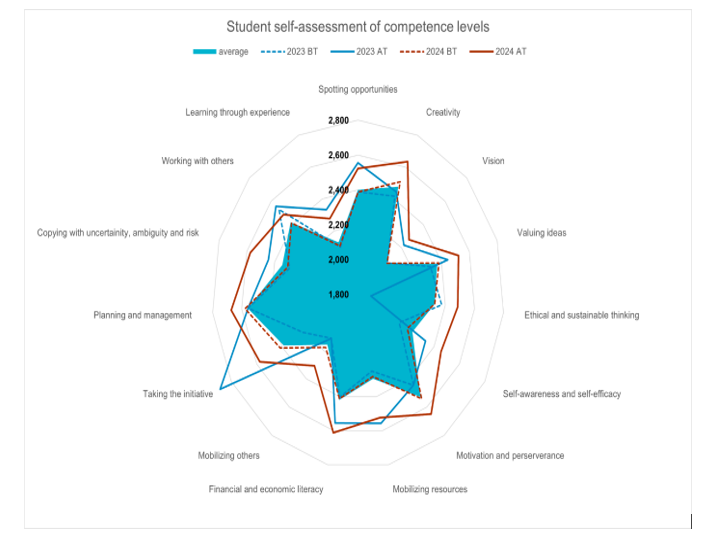
Figure 1. Student self-assessment of competence levels before training (BT, dashed lines) and after training (AT, solid lines) for the 2023 cohort (blue) and 2024 cohort (red), plotted against the overall average (shaded area). Source: Created by the authors
As shown in Figure 1, students’ self-assessed competencies improved significantly from the beginning to the end of the semester. The dashed lines (initial self-assessments) are uniformly contained well inside the solid lines (post-semester self-assessments), indicating growth on all 15 dimensions for both cohorts. Importantly, both cohorts’ post-semester profiles (solid lines) extend well beyond the shaded area representing the pre-course overall averages, underscoring the positive impact of the courses on building entrepreneurial self-confidence across the board.
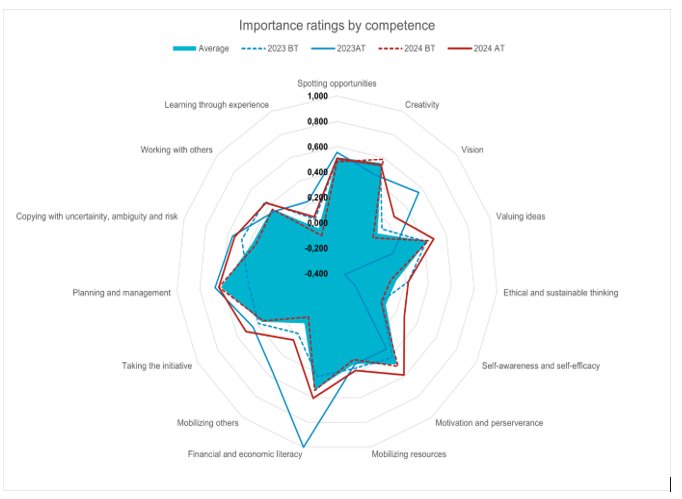
Source: Created by the authors
Figure 2. Importance ratings by competence, before (dashed) and after (solid) the courses. The scale is centered on 0 (average importance), with positive values indicating above-average importance and negative values below-average, for the given time point. Blue = 2023 cohort, Red = 2024 cohort, shaded area = overall average reference
Figure 2 illustrates how students’ perception of the importance of each entrepreneurial competence changed from pre- to post- training. The radar chart is centered such that an importance rating equal to the mean importance (across all competences) appears at 0.0 on the axis; points further out indicate competences seen as more important than the average, while points closer to the center (or negative) indicate less important than average. At the start (dashed lines), students had varied views on which competences mattered most. Notably, they undervalued certain competences initially: for example, Spotting opportunities (the ability to recognize business opportunities) had a large negative deviation (approximately -0.4) in both cohorts before training, meaning students generally did not consider it as important as other skills at first. After the courses (solid lines), this changed dramatically – Spotting opportunities moved to about +0.4 (one of the highest importance ratings) for both groups. In fact, it appears to have undergone one of the biggest mindset shifts: from being regarded as among the least important to one of the most crucial skills for entrepreneurship. The overview of Figure 2 shows a convergence in the importance profile post-course: many of the dashed lines (BT) had both positive and negative spikes, indicating strong opinions (some competences considered far more important than others). The solid lines (AT) are more balanced and outward-biased, indicating that by the end, students tended to recognize most of these competences as important to some degree (fewer large negatives). This can be interpreted as a broadening of their understanding of entrepreneurship – they learned that successful entrepreneurship requires a well-rounded skill set. The pattern was similar for both cohorts, though 2023’s changes were a bit more pronounced in certain areas (e.g., 2023 students gave even higher importance to Vision and Creativity after training, blue solid line peaking slightly beyond the red in those segments).
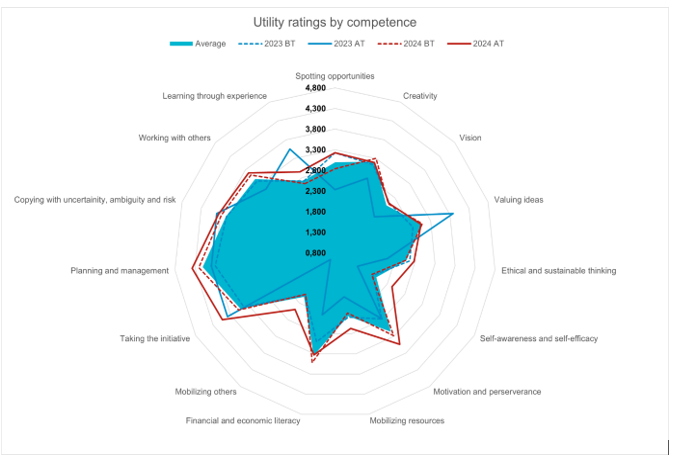
Source: Created by the authors.
Figure 3. Utility ratings by competence, as perceived by students. “Utility” here refers to how useful or beneficial students consider each competence to be, particularly in the context of the training and their future plans. Dashed lines = before training, Solid lines = after training. Blue = 2023, Red = 2024, with shaded average reference
Figure 3 turns to the utility perspective. This metric captures students’ appraisal of each competence’s usefulness – effectively, a mix of “How useful is it to have this skill?” and, by the end of the semester, “How useful was it that the training helped me develop this skill?”. Before the training (dashed lines), students already believed that many of these competences were quite useful; indeed, most initial ratings are high on the scale (the radar uses an absolute scale from the minimum observed ~0.8 up to ~4.8, roughly corresponding to a 1 – 5 agreement scale on utility). The profiles for 2023 and 2024 at BT (dashed blue vs dashed red) show some differences. The 2023 cohort tended to give uniformly high utility ratings from the start – their dashed blue line is more outward on most competences relative to the red. The most notable improvements in utility were in competences that initially had lower ratings. Students came to find teamwork and leadership significantly more useful after having engaged in group projects and observed the value of mobilizing peers during the business plan assignment. We interpret these consistently high utility ratings as an indicator that students, even beforehand, recognized the practical value of most entrepreneurial skills (perhaps from general culture or prior training). The courses then served to reinforce and slightly elevate these perceptions, especially for those skills they got to practice actively. The overall shape of the radar in Figure 3 (solid lines) is quite filled out towards the outer edge, signifying strong agreement on the usefulness of nearly all competences. Overall, Figure 3 indicates that students finished the semester believing strongly in the usefulness of the entrepreneurial competencies. The intervention not only increased their skill levels (as per Figure 1) and their appreciation of importance (Figure 2), but also, in areas where initial skepticism existed, convinced them of the practical value of those skills. This finding bodes well for their likelihood to further pursue and apply these competencies in the future, since perceived utility can drive continued motivation.
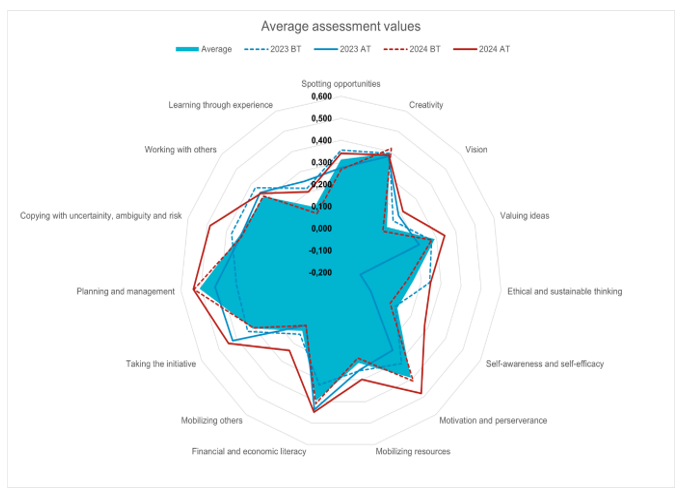
Source: Created by the authors.
Figure 4. Radar chart of average assessment values for each competence. This chart synthesizes multiple aspects of assessment (including effect sizes of improvement) to compare outcomes. The scale is centered at 0 (no change or average reference) and extends to around 0.6. Blue = 2023 cohort, Red = 2024 cohort, shaded = average
To better gauge the overall impact of the training and compare the two cohorts, Figure 4 presents a composite “average assessment” radar. In this chart, higher values correspond to stronger positive outcomes for a given competence (taking into account improvement magnitude and consistency). One way to interpret the scale is as an approximate effect size (Cohen’s d) or normalized gain for each competence’s improvement, with 0.0 indicating no improvement and 0.5 indicating a moderate to large improvement. The blue shaded area again denotes an average benchmark. As seen in Figure 4, the 2023 cohort (blue line) tends to reach or exceed the shaded benchmark on many competences, with several points around 0.5 (indicating quite substantial improvements). The 2024 cohort (red line) also shows positive outcomes across all competences but is generally a bit closer to the center, implying slightly smaller gains on some metrics. The pattern of strengths and weaknesses in Figure 4 is similar for both cohorts. In practical terms, Figure 4 validates that the pedagogical approach had a positive impact on the targeted competences broadly, with effect sizes mostly in the moderate range. It also highlights the competences which may need additional instructional emphasis in the future (the ones with lower outcomes, such as ethics and teamwork – perhaps these were already well-developed or not sufficiently addressed by the course content). Overall, this composite view provides a summative confirmation that Teaching Business Economics with an entrepreneurial focus improved students’ entrepreneurial competency profile significantly, which was the primary objective of the intervention.
Source: Created by the authors.
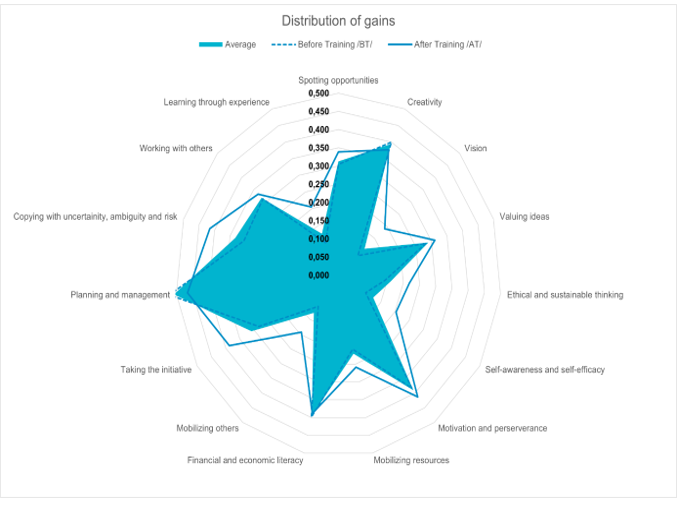
Figure 5. Distribution of gains across the 15 competences, comparing average pre-training vs post-training levels. The solid bold outline represents the After Training (AT) average, the dashed outline the Before Training (BT) average (for the combined sample), and the shaded area indicates the mean gain. Essentially, the bigger the shaded “star” protrusion on an axis, the larger the improvement on that competence
While Figure 4 provided a normalized view, Figure 5 offers a more direct depiction of the absolute gains in each competence (for ease of visualization, this chart aggregates both cohorts, plotting the overall average before vs after). The solid line in Figure 5 is the post-training average of all students, and the dashed line is the pre-training average. The blue shaded region between them represents the magnitude of improvement for each skill. The shape of this shaded region looks somewhat star-like, indicating that improvements were not uniform – some points on the star spike out much further than others. The longest “spikes” of the star occur at certain competences, confirming quantitatively what was inferred earlier. Figure 5 essentially summarizes that the training was universally beneficial, but with particularly strong impact on certain entrepreneurial skills like initiative-taking and opportunity recognition. These happen to be very entrepreneurial-specific traits, supporting the idea that traditional Business Economics courses, when tweaked appropriately, can indeed teach entrepreneurial behavior and thinking.
The results provide clear evidence that studying business economics at university was associated with significant improvements in entrepreneurial competences among the participating students. The gain was not only statistically significant but also educationally meaningful, with students moving from a low-moderate competence level to a solidly moderate-high competence level on average. The next section will discuss these findings in the context of pedagogical implications and previous literature.
- 4. Discussion
This study shows that traditional economics education with entrepreneurial context can enhance students’ entrepreneurial competences. After one semester, students reported higher capability across the EntreComp framework dimensions, indicating that business economics education can develop academic entrepreneurship by providing necessary mindset and skills.
The magnitude of improvement in competences was remarkable, with an effect size of d ~ 1.7 rarely seen in educational interventions. This profound change likely stemmed from students’ minimal prior exposure to entrepreneurship concepts, as the economics courses introduced new perspectives on market opportunities and business finances that significantly increased self-efficacy. This aligns with the theory that entrepreneurship education has the greatest impact on those who start with lower knowledge or confidence (Piperopoulos and Dimov 2015). It is also possible that through the training, students underwent a “learning transformation” – not only acquiring knowledge, but reframing their self-image to see themselves as more entrepreneurial. The significant jump in self-efficacy (from 2.0 to 3.44) supports this; students became more assured in their ability to create value and perform entrepreneurial tasks, a change that can fuel further entrepreneurial action (as per Bandura’s social cognitive theory).
The competence gains were broad but showed clear patterns. The highest gains occurred in competences directly reinforced by course content: financial literacy was explicitly taught, yielding the highest post-score, while creativity improved through case studies and problem-solving. This aligns with research showing entrepreneurship education enhances domain-specific skills when embedded in curriculum (Piperopoulos and Dimov, 2015). Competences requiring extensive behavioral practice or mindset shifts improved less significantly – such as learning through experience or ethical thinking. While the training included reflection and ethical discussions, mastering experiential learning often requires real entrepreneurial exposure. Students improved from 1.96 to 3.13 on that item, though it remained their lowest competence. Universities should complement classroom teaching with experiential learning through internships and simulations to enhance these competences (Meyers and Pruthi, 2011). It is encouraging, however, that even competences like working with others and mobilising others saw strong gains, implying that group projects in the class successfully developed teamwork and leadership aspects of entrepreneurship. This aligns with pedagogical recommendations that collaborative project-based learning is effective in building soft skills needed for venture creation (Gibb, Haskins and Robertson, 2013).
These findings have pedagogical implications for universities as the EU practice compromise entrepreneurial education through whole curricula. Therefore, the pedagogical experience how to retrieve entrepreneurial mindset during the professional training especially for non-economists, become more and more essential for the Life-long learning development. Thus, by infusing entrepreneurial competencies into economics and business curricula proves highly effective, universities can promote academic entrepreneurship by incorporating competences from frameworks like EntreComp into existing Business Economics, Management, and Finance courses, enhancing entrepreneurial preparedness for all graduates.
For high-school education, our findings, although coming from a university setting, provide a hopeful message. Based on the main results, if a semester in university yields such improvement, integrating entrepreneurship education in high school could establish an earlier foundation. Furthermore, entrepreneurial education out-of-the box could be used at classical high school training by developing special training instruments that are focused on creativity, initiative, teamwork, and opportunity identification for teenagers. This entrepreneurial mindset preparation before university can lead to higher starting competence levels for advanced entrepreneurial development. Policymakers can use frameworks like EntreComp and our results to implement entrepreneurship modules in economics classes. Additionally, extracurricular activities at high school can develop these competences. Our results showed high gains in both knowledge-oriented competences like financial literacy and soft skills, suggesting that school-based activities can effectively build these abilities even without real business ventures.
Several Bulgarian and European studies shed light on whether mainstream business and economics education can foster entrepreneurial competences. Researchers describe a successful initiative at a Bulgarian university where a Junior Achievement “student company” program was integrated into the curriculum, resulting in enhanced entrepreneurial mindsets and competencies among students (Ruskov, Stoycheva and Todorova, 2010). This experiential, learning-by-doing approach within a traditional academic course underlines that mainstream education can cultivate entrepreneurial skills if active methods are used. Quantitative evidence further supports this: Yordanova and Filipe (2019) found that exposure to entrepreneurship education was positively associated with students’ desirability towards entrepreneurship. They conclude that universities should infuse an “entrepreneurial perspective” into mainstream courses and even develop doctoral programs in entrepreneurship to sustain modern teaching methods (Yordanova and Filipe, 2019). In the same vein, a recent study by Pergelova et al. (2023) confirms that taking an entrepreneurship-related course significantly boosts students’ self-efficacy (perceived feasibility) and intentions to start a venture (Pergelova et al., 2023). These findings align with the original results, suggesting that even conventional business/economics classes – when enriched with entrepreneurship content – can strengthen key entrepreneurial attitudes and competencies that precede venture creation.
However, the literature also cautions that mainstream courses alone may have limited impact unless their design and context are suitably tailored. Yordanova et al. (2021) report that merely participating in a standard entrepreneurship or business course did not significantly increase STEM students’ likelihood of engaging in nascent venture projects (Yordanova et al., 2021). These nuanced outcomes suggest that traditional lecture- based teaching of business subjects may fall short in cultivating genuine entrepreneurial competence.
Instead, the pedagogy must actively involve students in practical entrepreneurship experiences. Indeed, action-based learning methods – such as student-run companies, simulations, and workshops – are identified as more effective at boosting students’ entrepreneurial self-efficacy and behavior. In Bulgaria, scholars have emphasized extracurricular and experiential strategies to bridge the gap between academic theory and entrepreneurial practice. In line with this, Stoycheva et al. (2010) and Ruskov and colleagues have demonstrated the value of practical programs (e.g. the Student Company model) implemented alongside university courses, showing they can significantly enhance students’ entrepreneurial competencies in ways regular classes might not (Ruskov, Stoycheva and Todorova, 2010). Furthermore, transforming universities into more entrepreneurial institutions appears to be a complementary approach: initiatives in Bulgaria and across Europe stress internal support mechanisms, faculty attitudes, and university–industry links as vital to nurturing student entrepreneurship. Taken together, these studies reinforce the view that while mainstream business/economics education can contribute to entrepreneurship development, its impact is greatest when coupled with hands-on learning opportunities and an enabling university environment. This comprehensive perspective supports and enriches the original finding that traditional courses can be a foundation for academic entrepreneurship, but also highlights the need for pedagogical innovation and institutional support to fully cultivate entrepreneurial competences in students.
Academic Entrepreneurship Development – Implications
In academic entrepreneurship, these findings show that entrepreneurial development starts in the classroom. Universities seeking to generate spin-offs and commercialize research must recognize entrepreneurial competences as essential drivers. Developing these competences through curriculum increases the likelihood of graduates founding companies, driving organizational innovation, or solving problems entrepreneurially. Business economics naturally aligns with entrepreneurship by focusing on business operations and value creation. Teaching business economics effectively can instill an entrepreneurial mindset for applying economic principles in real ventures.
Initially, some students were hesitant to identify as „entrepreneurial“ due to cultural perceptions. However, by the end, more students embraced this identity. This culture shift within the academic institution is significant. A culture where students see themselves as innovators can create a more dynamic environment, potentially leading to future start-ups and research commercialization. These findings align with the entrepreneurial university concept and Bulgaria’s innovation goals.
Limitations
Despite the strength of the results, a few limitations must be acknowledged.
Firstly, our measurement relied on self-report, which, while practical and aligned with how EntreComp can be assessed, might not capture actual behavioral competence to the same degree as direct observation would. Students might have an inflated sense of competence post-training that is not fully borne out in practice (though one could argue that confidence is a necessary precursor to action, so it’s still valuable). Future research could incorporate performance-based assessments (e.g. evaluating the quality of a business idea students develop, or using role-play scenarios) to triangulate self-perceptions.
Secondly, the study was conducted at a single institution in Bulgaria, so generalizability may be limited. UNWE’s student population and curriculum might differ from other universities or countries. Nevertheless, we believe the core lessons are transferable, as the competences are universal and the teaching methods are not unique to one cultural context. Replicating this study in other settings – including high schools or other university departments – would be a fruitful way to validate and extend our findings.
Conclusion
This study provides strong evidence that teaching business economics at the university level can significantly develop students’ entrepreneurial competences, thereby laying the groundwork for academic entrepreneurship. Over the course of one semester, students showed statistically significant and educationally meaningful improvements in a range of entrepreneurial skills, from creativity and initiative to financial literacy and risk management. They also developed a greater appreciation for the importance and utility of these skills, indicating an internalization of entrepreneurial values.
The pre-to-post improvements observed – across creativity, opportunity recognition, financial literacy, and more – underscore that even without a dedicated “Entrepreneurship” course, students can acquire an entrepreneurial skillset through mainstream business education. This has important strategic implications for educational institutions: by embedding competence frameworks like EntreComp into regular curricula, universities and even high schools can nurture future entrepreneurs on a large scale, rather than only in niche programs. The results align with the broader policy direction that calls for integrating entrepreneurship education throughout formal education to foster an entrepreneurial culture and mindset in society.
For educators and curriculum designers, the takeaway is to be intentional about competence-oriented teaching. It is not enough to teach economic theories in abstraction; coupling theory with practice-oriented tasks and encouraging students to take initiative, work in teams, and think creatively can dramatically boost their entrepreneurial readiness. Moreover, academic leadership should recognize that investing in these competences is investing in the institution’s innovative capacity – today’s competent students are tomorrow’s successful alumni who may start companies, drive regional economic development, or contribute to the university’s own innovation ecosystem.
Additionally, based on the results, we could set couple of instruments forcing up entrepreneurial mindset during the classical and professional high school and university education: 1. practical training examples: a lot of courses allow practical exercises – laboratory or field researches, for example chemistry, physics and etc.; 2. Group tasks: training working in group and leadership skills, group working is a practical tool for complex tasks – for example mathematic problems, technical problems and etc.; 3. Out-of-box thinking: the exercise include unsolved problems; 4. Time and resource management: the task could be longer than training and could be a part of study homework for a month.
Finally, this study contributes to the literature by quantifying the entrepreneurial learning outcomes of a quasi-experimental scenario in a real classroom. It reinforces the message that entrepreneurs are made, not just born, and education is a critical making process (Lv et al. 2021). In an era where societies face complex challenges and need innovative, proactive citizens, developing entrepreneurial competences through education is a timely and impactful strategy. The study offers empirical support for that strategy, showing that even the foundations in business economics classes can ignite the entrepreneurial spark in students – a spark that universities and policymakers can foster into a flame of innovation through continued support and education.
NOTES
- European Commission/EACEA/Eurydice, 2016. Entrepreneurship Education at School in Europe. Eurydice Report. Available from: https://op.europa.eu/en/publication-detail/-/publication/42947516-e80e-11e5-8a50-01aa75ed71a1/language-en [Accessed 15 May 2025].
- EUR-Lex. EntreComp – Glossary of summaries. Available from: https://eur-lex.europa.eu/EN/legal-content/glossary/entrecomp.html [Accessed 15 May 2025].
- Ministry of Education and Science, 2021. Ordinance No. 4 of 26 March 2021 for the Acquisition of Qualification in the Profession ‘Economist’. Available from: https://mon.bg/upload/27574/naredba_4_2021.pdf [Accessed 10 June 2025].
- UNWE, the University of National and World Economy. Available from: https://www.unwe.bg/ [Accessed 10 June 2025].
REFERENCES
Adcroft, A., Dhaliwal, S. & Willis, R. (2004). Missing the point? Management education and entrepreneurship, Management Decision, 42(3), 512 – 521. https://doi.org/10.1108/00251740410518958.
Bacigalupo, M., Kampylis, P., Punie, Y. & Van den Brande, G. (2016). EntreComp: The entrepreneurship competence framework. Publications Office of the European Union. https://data.europa.eu/doi/10.2791/160811.
Delibaltova, V. (2022). Characteristics and specificity of learning-oriented e-assessment in higher education – points of view and research, Pedagogy, 94(8), 982 – 993.
Draycott, M. & Rae, D. (2011). Enterprise education in schools and the role of competency frameworks, International Journal of Entrepreneurial Behaviour & Research, 17(2), 127 – 145. https://doi.org/10.1108/13552551111114905.
Fu, X., Zhang, X., Zhang, J. & Du, X. (2022). Exploring factors influencing students’ entrepreneurial intention in vocational colleges based on structural equation modeling: Evidence from China, Frontiers in Psychology, (13). https://doi.org/10.3389/fpsyg.2022.898319.
Gibb, A., Haskins, G. & Robertson, I. (2013). Leading the entrepreneurial university: Meeting the entrepreneurial development needs of higher education institutions. In: A. Altmann & B. Ebersberger (Eds.). Universities in Change. Innovation, Technology and Knowledge Management (pp. 9 – 45). Springer.
Lv, Y., Chen, Y., Sha, Y., Wang, J., An, L., Chen, T., Huang, X., Huang, Y. & Huang, L. (2021). How entrepreneurship education at universities influences entrepreneurial intention: Mediating effect based on entrepreneurial competence, Frontiers in Psychology, (12). https://doi.org/10.3389/fpsyg.2021.655868.
Meyers, A. D. & Pruthi, S. (2011). Academic entrepreneurship, entrepreneurial universities and biotechnology, Journal of Commercial Biotechnology, 17(4), 349 – 357. https://doi.org/10.1057/jcb.2011.22.
Nabi, G., Liñán, F., Fayolle, A., Krueger, N. & Walmsley, A. (2017). The impact of entrepreneurship education in higher education: A systematic review and research agenda, Academy of Management Learning and Education, 16(2), 277 – 299. https://doi.org/10.5465/amle.2015.0026.
Otache, I. (2019). Entrepreneurship education and undergraduate students’ self- and paid-employment intentions: A conceptual framework, Education + Training, 61(1), 46 – 64. https://doi.org/10.1108/ET-10-2017-0148.
Peytcheva-Forsyth, R., Mizova, B. & Tsokov, G. (2022). Digital competences and educational inequalities in European context as a consequence of an accelerated shift to distance e-learning in the COVID-19 pandemic. Pedagogy, 94(8), 963 – 981.
Pergelova, A., Angulo-Ruiz, F., Manolova, T. S. & Yordanova, D. (2023). Entrepreneurship education and its gendered effects on feasibility, desirability and intentions for technology entrepreneurship among STEM students, International Journal of Gender and Entrepreneurship, 15(2), 191 – 228. https://doi.org/10.1108/IJGE-08-2022-0139.
Piperopoulos, P. & Dimov, D. (2015). Burst bubbles or build steam? Entrepreneurship education, entrepreneurial self-efficacy, and entrepreneurial intentions, Journal of Small Business Management, 53(4), 970 – 985. https://doi.org/10.1111/jsbm.12116.
Ruskov, P., Stoycheva, M. & Todorova, Y. (2010). Pattern for graduate student company. In: Proceedings of the 14th European Conference on Pattern Languages of Programs (EuroPLoP 2009). Kloster Irsee, Germany.
Walter, S. G. & Block, J. H. (2016). Outcomes of entrepreneurship education: An institutional perspective. Journal of Business Venturing, 31(2), 216 – 233. https://doi.org/10.1016/j.jbusvent.2015.10.003.
Yordanova, D. & Filipe, J. A. (2019). Towards entrepreneurial universities: Barriers, facilitators, and best practices in Bulgarian and Portuguese universities, International Journal of Economics and Business Administration, 7(4), 213 – 227.
Yordanova, D., Kanazireva, R., Petkova, I., Mihaylova, I. & Mladenova, I. (2021). Feasibility of technology entrepreneurship among Bulgarian STEM students: The role of university, Proceedings of CBU in Economics and Business, (2), 149 – 154. https://doi.org/10.12955/peb.v2.268.
Nikolay Sterev
ORCID iD: 0000-0001-8262-3241
Business Faculty
University of National and World Economy
Sofia, Bulgaria
E-mail: ind.business@unwe.bg
Daniel Yordanov
ORCID iD: 0000-0002-1235-5891
Economics of Infrastructure Faculty
University of National and World Economy
Sofia, Bulgaria
E-mail: dyordanov@unwe.bg
Dr. Krasimir Petkov, Assist. Prof.
ORCID iD: 0009-0005-5356-9182
Business Faculty
University of National and World Economy
Sofia, Bulgaria
E-mail: krasi.petkov@unwe.bg
>> Download the article as a PDF file <<

Свързани статии:
 Challenges to Entrepreneurship Education in High School. Interaction between Formal and Informal Assessment
Academic Entrepreneurship: Practical Results and Training
Exploring Entrepreneurial Readiness among University Students: Insights from a Preliminary Study
Forming Entrepreneurial Culture through Education
Challenges to Entrepreneurship Education in High School. Interaction between Formal and Informal Assessment
Academic Entrepreneurship: Practical Results and Training
Exploring Entrepreneurial Readiness among University Students: Insights from a Preliminary Study
Forming Entrepreneurial Culture through Education