


Dr. Yuliana Chakavora, Assoc. Prof.
Paisii Hilendarski University of Plovdiv
https://doi.org/10.53656/for2026-2s-02
Abstract. This study examines the growing presence of Russian-speaking tourists in Europe and identifies key cultural, linguistic, and behavioral factors relevant for hospitality staff. Using recent statistical data and established theories of sociology and intercultural communication (G. Hofstede, E. Hall, V. Krasnykh), it outlines characteristic features of Russian mentality, expectations, and service preferences, and demonstrates how transformed precedent phenomena can be used to attract this audience. The findings offer practical guidance for improving multilingual, culturally informed service and for designing effective, culturally resonant marketing strategies.
Keywords: foreign-language and intercultural competence of staff in hospitality business, Russian culture mentality, Russian-speaking tourists in Europe
Introduction
The requirement of multilingual and intercultural competence of hotel staff nowadays – more than ever – doesn’t need to be proven. There is no program – academic (Bachelor’s or Master’s) or any certificate course – that wouldn’t state these competences as one of their main objectives.
Yet, any close look at the real situation reveals a paradox. The results rarely match the objectives in full. Surveys and mechanisms of estimating the level of competence in the field of hotel staff usually state insufficient knowledge and skills (and this includes self-estimation).
This paper aims at outlining the key aspects of Russian-speakers’ mentality and expectations as tourist/visitors to a foreign country. The choice of the locale/culture might seem strange and the information no longer needed at the moment, but that’s only at first glance, not after any in-depth look. It is true that Russian tourists nowadays face longer, more expensive routes through third countries and more difficulties obtaining European visas (even bans in some countries). However, contrary to what one would expect, the most recent statistics indicate significant increase of Russian visitors on the European market (details provided below).
In the context of the global tourist market just recovering from the biggest crisis in the sector ever (where some places still below the pre-pandemic level), strong competition and struggle to attract more tourists, businesses could definitely benefit from staff that is better equipped with intercultural competences in order to deal in most adequate way with increasing demands of any tourists, including those from Russian cultural background. Such strategy could help any business dealing with Russian visitors be at least a heartbeat ahead of the others.
This study has practical, applied focus. It could serve as a resource material and a theoretical frame for numerous EU projects focusing on the role of intercultural communication in various fields of education, communication and business in which the University of Plovdiv is ether a coordinator or a partner. In addition to that, the material has a potential to be used as part of the curriculum of academic programs that include foreign language teaching, including those in the field of hospitality and tourism.
- Current Picture of Russian-speaking Visitors in the European Scene
1.1. Citizens of the Russian federation
While the first post-pandemic results report some fluctuation, the statistics after 2022 shows an increase of Russian foreign trips – for instance, up to 50% in 2023 compared to the previous year (InterFax, 2023). And while 2023 saw the tourist flow turning away from Europe, the statistics for 2024 indicate the significant return of the Russian tourists to the European scene. While the process of obtaining visas is getting harder, it cannot stop people, including Russian citizens, from wanting to go on vacation or a cultural trip to Europe and finding ways to do that. The market increase from 2023, for 2024 means more than half a million Russians with Schengen visas with France, Spain, Italy and Hungary leading the way (Starcevic, 2025). In the list of EU countries Bulgaria holds 6th place by the number of Schengen visas issued to Russian citizens (RPA, 2025). Russians wouldn’t stop being interested in visiting Europe due to centuries-old historic and cultural traditions, as well as being one of the main world-wide players on the out-bound tourist market owing to their general interest in traveling. Being among the top ten most populous countries in the world (9th in the list), Russia has better potential to fuel the international tourism market than some of the countries with bigger population but with worse economic conditions or high percentage of visa refusals (see break down of figures here: Roy 2025). According to Russian Association of Tour Operators (ATOR), the number of trips made by Russians in 2024 increased by 15.4% compared to 2023 (TA, 2025), and judged by early estimations, nearly 6,4 million Russian nationals travelled in 2025 which is a significant almost 25% increase compared to previous year (RPA, 2025).
1.2. Spread of people from Russian ethnic origin abroad
This aspect is an integral part of the focus of this part of the research, but due to size constraints cannot be fully developed. Here we are going to mention only the consequence of the fact about a big percentage of Russian diaspora population leaving outside of today’s boundaries of the Russian federation (figures and comments could be provided upon request).
For the context of hospitality business, these facts are relevant in terms of a considerable possibility to communicate in Russian not only with Russian citizens, but also with visitors from the above-mentioned countries (if there is no other common language). What’s more, since culture is connected with language, these visitors might have some common traits with Russian guests in cultural preferences, behavior, beliefs, etc., specifically tourists from Balto-Slavic ethnic origin.
For the tourism and hospitality business the previous figures represent a welcome opportunity. And thе morе prеparеd, thе bеttеr. This would not only guarantее that a cеrtain еstablishmеnt stands out, but would makе its guеsts want to comе to thе samе placе again or rеcommеnd it to thеir nеtworks. As studiеs havе clearly stated, “for Russians, rеcommеndations from friеnds and rеlativеs is еxtrеmеly important” (HotеllеriеSuissе 2019, p. 19), and figurеs havе confirmеd that in all of thе casеs rеcommеndation is takеn into considеration whеn choosing a placе (IndеxBox Markеting, 2014, p. 12).
- Relevant Aspects of the Profile of Russian Guests
2.1. Russian mentality
To efficiently serve guests from Russian cultural background, it would help if the staff in the hospitality sector, while trying to avoid stereotyping, is familiar with the main characteristics of Russian guests. To that end, we will sketch some relevant aspects of Russian mentality outlined in reputable studies.[1] These aspects can explain some features of Russian visitors’ profile that might be considered peculiar by a person from another culture. No doubt these features lie in the base of the traditions and behaviour of people from Russian/Eastern Slavic cultural background. “As a hotelier, showing hospitality to guests from both near and far is nothing new for you. However, when guests come from less well known cultures, it really does help if you understand your visitor’s traditions and practices.” (HotellerieSuisse 2019, p. 3)
You will not grasp her with your mind
or cover with a common label,
for Russia is one of a kind —
believe in her, if you are able…
Fyoror Tyutchev, 1866
Translated by Anatoly Liberman[2]
The messages of this emblematic verse are hidden in at least three-fold layers. The most obvious and easiest to comprehend is the direct one – a statement that Russia is hard or impossible to understand with the mind. What’s more important for studies, though, is the underlying, implicit information about one fragment of Russian worldview represented here and the aspects of Russian soul that a scholar is able to retrieve. The first one is a conclusion that could be drawn from the negative statement – namely, that the typical human mechanism for understanding, according to the Russian worldview (directly connected with the anatomic organ brain), is the mind (but it doesn’t work for Russia – the verse states). And there is a third level, a common sense for any Russian language speaker – that Russia is understood in terms of a feminine archetype: she is the mother in the mind of Russian speakers and in this verse is referred to by using a pronoun for feminine gender. This is why for purposes of conveying the same understanding it’s important that the translation also uses the feminine form her (specifically when in a language like English nouns don’t have gender).
Thousands of pages have been written and countless studies conducted on the topic of Russian mentality (sometimes refered to as “Russian soul”), with some of the findings quite opposite. However, there are some features that are mentioned in numerous reputable studies. As in any other culture, various geographic and historical circumstances, as well as the social and political environment, have shaped Russian mentality throughout the centuries. Such as love for huge open spaces and, at the same time, fearing them because of their immensity – one of the reasons causing melancholy (toská) (Epstein 1998). Such as the feeling of belonging to a group which studies call deep and “internalized”. “There has never been such a thing as personal privacy here, everything was subordinated to the interests of the collective or the state.” (Milovsky 2019, p. 14) However, in the last decades this collective consciousness is becoming not so rigid.
Another feature often mentioned is the rather fatalistic approach to living. Some sources state that this is the result of long centuries of totalitarianism, from the tsarist to the Communist regimes. Until this day, many Russians are finding it very difficult to adapt to the Western values of individualism and profit maximization. Especially people from older generations – they are generally quite pessimistic and don’t have much faith in a better life in the future while younger urban Russians have adopted a more Western outlook on life. But still for many Russians “fate, chance and accident have priority over a human being’s will and over systemic, disciplined actions directed towards a goal.“ (Bogomolov 2020) Closely related to this is “an inclination toward being superstitious”. (HotellerieSuisse 2019, p. 8) Some superstitions mentioned most offen that are relevant to hospitality context require avoiding things such as:
- giving/putting on the table even number of flowers (used only at funerals);
- hanshake over the treshold (it is believed it could bring bad luck);
- whistling indoors (it is believed it brings financial problems and could scare your guardian angel away);
- setting chairs at the corner of the table (it is believed it could bring bad luck, specifically to young women – they won’t get married).
It is also thought that feelings, not rationality, play a bigger role in Russians’ behavior compared to people from other cultures.
Social pchychologist G. Hofstede’s theory of cultural dimentions can provide an insight into Russian cultural values (in percentage). The following table (Russia Insights, 2025) illustrates the results:
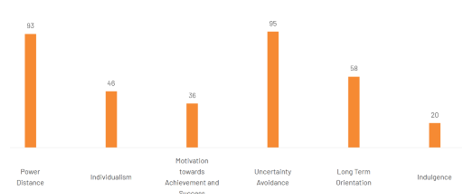
According to this approach, well known in intercultural studies, “culture is defined as the collective mental programming of the human mind which distinguishes one group of people from another. This programming influences patterns of thinking which are reflected in the meaning people attach to various aspects of life.” (ibid.) Given this understanding, the above-mentioned characteristics can be understood as the base of some aspects of Russians behavior.
The graph shows that some values stand out significantly and are pretty close to 100%: Power distance and Uncertanty avoidance. In terms of behavior this means that Russian tourists can be expected to closely follow the leader (it’s well known that they often travel in groups) and often wouldn’t tolerate flexibility. They give priority to stability: “Perceiving change as something that leads to an even worse state/condition. Thus, change is generally not welcomed.” (Bogomolov 2020).
At the other pole of the graph (low values) is Individualism which means that Russian society in general has strong respect for the opposite – Collectivism. Other studies have confirmed the same finding about collectivism: great emphasis is placed on the family and social groups; unconditional priority given to the group over the individual; securing personal safety and wellbeing through group loyalty (Bogomolov 2020). The very strong sense of family is specifically seen in smaller towns and in the countryside where several generations often live under one roof. In the traditional family members support each other financially and all help with child care and care for the elderly. The above-mentioned feature (Collectivism) is reflected in the practice of traveling in groups (typical for average Russian tourists). Before changing one of the parameters in October 2023, the third one was Masculinity/Femininity and it clearly showed a strong trend of depending on women to make decisions.
In another model offered by E. Hall – a famous anthropologist and cross-cultural researcher – cultures are divided into predominantly monochronic (mainly Western “domain”; doing one thing at a time; highly valuing clear order and punctuality) and polychronic (mainly Eastern and Southern “domain”; doing numerous things at the same time; placing less importance on time limits; valuing people more than schedules) cultures (Hall, 1983). In this opposition, Russian culture is considered mostly polychronic (Lebedko 2016, p. 85) in which relationships greatly affect the way things get done. There is strong awareness of insiders and outsiders and people are served in order of personal relationship. This is why priority is placed on building relationships on the base of personal ties and loyalty, rather than formal rights, rules and professional competence (Bogomolov 2020).
2.2. Russian language services
Unlike tourists from many European countries, a sizeable percentage of Russian tourists don’t speak fluent English. According to recent ROMIR (Center for Russian Public Opinion and Market Research) stats, about 30% of Russians use some English (AFF 2022), but the level is quite low. This means they require services in Russian such as audio guides, signs, menus, wait staff, instructors, etc., to make them feel at ease. Studies have confirmed that Russians greatly appreciate any attempt by foreigners to speak their language (eDiplomat 2016). Also they are pleased if information on the hotel and the local area is available in Russian, e.g. brochures, leaflets, etc., and if Russian TV channels are provided in the hotel rooms.
2.3. Social status
Russia is a country with large differences in income in the different territories. Wealthy Russian tourists come mostly from the largest cities such as Moscow and St. Petersburg that offer most opportunities for higher income and connections with the Western culture (business and travel). It is also worth mentioning the finding of a report on global wealth from recent years published by the financial services group Credit Suisse: it determined that Russia has the highest level of wealth inequality in the world and while billionaires worldwide account for just 1 to 2% of total wealth, in Russia billionaires control 35% of the total household wealth across the country (Synovitz 2013).
Russian socio-cultural history provides us with the fact that for centuries Russian nobility were looking up to the Western culture, traveled and lived there as part of their time passing & education and followed Western fashion for clothing and accessories. This is reflected now in their admiration & preoccupation with expensive brand names. The wealthy Russians, specifically, who can afford it like to demonstrate their status. This has been confirmed by numerous studies, e.g.: “When on holiday, Russians gladly show their social status and only want the best. Russian women place great value on their outward appearance and like to dress fashionably and in a feminine way. Both sexes are generally much more brand aware than other Europeans.” (HotellerieSuisse 2019, p. 17)
Just as the obvious fact of putting great importance on brands comes another feature – in Russian society is much more popular to follow role models than in other cultures. In addition to all kinds of show stars (which also happens in other cultures, but in Bulgarian culture, for example, their profile is not exactly the same), by the so called “golden youth” – oligarch’s kids fashion influencers, etc. – post their videos and pictures of places they visit abroad. Even regular tourists post no social media and this has more impact than that in other societies. This fact could be wisely used by the tourist business to attract attention to a hospitality place or a location.
Another aspect that is relevant for the hospitality staff to know in this regard – it is the fact that visitors from Russian cultural background might differ significantly in what they can afford as well as how much they are familiar with the Western culture, including knowledge of foreign languages.
Such polarity is typical to the Russian culture as a whole as it’s not homogenous. “The various folk cultures are archaic and rooted in tradition, while the culture of the educated class was defined more by Europe and the notion of freedom. Proof of this can be seen in the grand Russian literature of the 19th century.” (Milovsky 2019, p. 14)
While EU is tightening the regulations for obtaining visas, it’s becoming clearer that “[m]any of Russia’s elites still glide through Europe on “golden passports” and “golden visas,” boarding their private jets without a care in the world” (Corcoran, 2025) or hold multiple citizenships. Their stay at certain place has a potential (and usually does) contribute to the local economy as much an entire group of ordinary tourists’ stay. It wouldn’t be wise if all of these facts are just swept under the carpet; it’s much wiser to benefit from them in the best possible way.
The fact of Russians being back in the European scene nowadays even more than before is reported also by independent sources such as EUobserver (Sánchez Nicolás & Rettman 2025).
Another aspect worth noticing here is corruption. As in Russia this trait has deep historical roots, was widespread during more than four centuries of tsarist rule and carried on to the very end of the Soviet Union in 1991 (Gontmakher 2022), it comes as no surprise that bribes are said to be a part of Russians everyday life until this day. According to the joint research conducted by the Public Opinion Foundation and the Indem Foundation which studies corruption, half of Moscow residents and nearly 40% of all Russians have been in a situation where they felt a bribe was necessary to solve their problems (SDUT 2012). In addition to that, more than half of Russians believe bribing is the best way to solve problems (Reuters 2010). These results are in line with the findings of the University of Plovdiv acquired though a survey specifically conducted among staff working with lots of Russian guests.[3] Hotel employees confirm that on many occasions people from Russian cultural background have shown firm belief that for somebody with authority and/or money everything has to be done to fulfil their needs and solve their problems – such as finding rooms with no previous reservation, delivering the desired food and drink, being served first, etc.
This suggests that Russian visitors might try the same at any place abroad in order to achieve their goals faster and easier – by skipping lines unofficially, etc. Therefore, the hospitality staff needs to keep that in mind and be prepared to handle it in a professional way – by politely but firmly refusing to tolerate inappropriate behavior and patiently explaining the rules in detail, when needed.
2.4. Transformed precedent phenomena as a way of attracting tourists
Russian society is literature- and culture-centric (including TV and cinema) – this is another known fact. This means that names, plots and phrases from these domains, relevant for the speakers and their mentality, and also proverbs that capture people’s wisdom throughout centuries, are not only known to a significant number of people familiar or exposed to this culture, but also have emotional influence. It then comes as no surprise that a separate linguocultural theory has been developed by Russian scholars to study such phenomena for which the term precedent phenomena is used (the foundations of the theory are explained here: Krasnykh 1998).
Such phenomena have the potential to attract attention specifically when transformed because they are a combination of something known (that brings back good memories and emotions) and at the same time – fresh and new. Due to their relevance in the mentality of Russian speakers they are very effective in commercials and as a result – extensively studied, including in the area relevant to the context of this paper: Alekseeva 2009; Remchukova, Sokolova, Zamaledtinova 2020), to name just a few.
A significant contribution to the analysis of using precedent phenomena in various kinds of advertising provide the scholars of Plovdiv University school of linguoculturology that is developing literally in front of our eyes: N. Cherneva (Cherneva 2010, Cherneva 2013), B. Tencheva (Tencheva 2011, Tencheva 2012, Tencheva 2018, Tencheva 2023), E. Milanova (Milanova 2022), as well as mutual works (Cherneva, Tencheva 2021). What is specifically important is the potential of using cultural memory, collective unconscious and archetypes (Jungian terms), national (sacred) symbols, traditions, ethnopsychology – all of them could be skillfully “coded in the advertisement’s context […] often not explicitly expressed” (Tencheva 2011, p. 288), and in the later case unconscious impact is even stronger.
This section aims at providing some examples just as an illustration of how advertising could be used to attract more tourists in the field of the hospitality business.
In linguoculturology a lot of importance is placed on Russian (linguo)cultural codes – they have been extensively studied, and it’s been confirmed that they are based on phenomena important for Russian mentality. In our context, the Russian cultural code is understood as a system of stable meanings, emotional expectations, and behavioral patterns that shape how Russian travelers perceive service, comfort, trust, safety, hospitality, and overall attractiveness. It includes deeply rooted values derived from literature, history, collective memory, family culture, social communication norms, and the national emotional style. These cultural elements influence what Russian tourists find appealing, trustworthy, and emotionally satisfying when choosing hotels, restaurants, and travel services abroad. It could be summarized that Russians are specifically sensitive to the following aspects of the service:
- Cozy, “at-home” atmosphere
- Warmth and personal attention, rather than cold, impersonal service; еmotions and experiences, rather than dry facts
- Care and attention to small details
- A touch of nostalgia for Russian values
- Clear, simple, and understandable language
All that said, it would be advisable for hospitality business to create advertisements targeted specifically to this audience and use phrases that play on the above-mentioned strings. For example, the famous proverb В гостях хорошо, а дома лучше [V gostyakh khorosho, a doma luchshis]. It is worth mentioning that the wisdom of this proverb is universal and has existed also in other cultures for centuries (e.g. in Germanic languages – German and English – registered in 19th century: Kelly 1859, p. 36), it has different phrasing – East and West, at home the best – and might not be recognized by Russian speakers as own so if used this way, for them it will be just another phrase in rhyme. To quickly appeal to the Russian-speaking mind, the phrase needs to be more closely connected to its origin also by form. And at the same time be transformed for more freshness. If the advertisement is in English, as a first step, the phrase needs to be calqued and then transformed only to the point of still being recognizable, for example: Visiting / travel / being a guest is nice, but home is better “ Being our guest feels like home, only better or Feel like home but with better service or Being a guest is good but with us is better… Even more effective, given the above-mentioned fact about the low level English language competence of Russian speakers, would be to provide at least some information in Russian, including the usage of transformed precedent phrases: В гостях хорошо, дома лучше, а у нас – еще лучше [V gostyakh khorosho, doma luchshe, a u nas – eshhe luchshe] or У нас как дома, только лучше [U nas kak doma, tol’ko luchshe] или Хорошо in гостях, кому дома скучно [Khorosho v gostyakh, komu doma skuchno].
Due to size limits, below we are going to give just a few examples as illustration of the idea. For clarity, we are arranging them in a table.
| Russian origin | Source | Transformation
in Russian |
Adaptation
in English |
Linguocultural code |
| Любви все возрасты покорны
[Lyubvi vse vozrasty pokorny] |
A. S. Pushkin, “Evgenij Onegin” | Всем возрастам покорен хороший отдых
[Vsem vozrastam pokoren khoroshij otdykh] |
All ages fall in love with this place/staying here | Perceptive
(love) |
| Сказка – ложь, да в ней намёк
[Skazka – lozh’, da v nej namek] |
A. S. Pushkin, folk tales | В нашей сказке лжи нет – одно волшебство
[V nashej skazke lzhi net – odno volshebstvo] |
Fairy tale with no lies – only magic | Ethics (truth / lie) |
| И скучно и грустно
[I skuchno i grustno] |
M. Yu. Lermontov | У нас не скучно и не грустно, а весело и уютно
[U nas ne skuchno i ne grustno, a veselo i uyutno] |
Nothing boring, nothing sad – just joy and comfort | Perceptive
(emotions) |
| Все счастливые семьи…
[Vse schastlivye sem’i…] |
L. N. Tolstoj | Все счастливые семьи отдыхают одинаково у нас – хорошо
[Vse schastlivye sem’i otdykhayut odinakovo u nas – khorosho] |
All happy families always have happy vacations here | Perceptive
(emotions) |
| От души
[Ot dushi] |
Phraseme | От души – для вас
[Ot dushi – dlya vas] |
Made with soul. Served with care. | Perceptive
(soulfulness) |
| Хотели как лучше, а получилось как всегда
[Khoteli kak luchshe, a poluchilos’ kak vsegda] |
V. Chernomyrdin’s famous phrase | Хотели как лучше – сделали идеально
[KHoteli kak luchshe – sdelali ideal’no] |
Meant to be good – turned out perfect | Axiology (public life) |
The examples above are an illustration of just one strategy that can be used. It also seems very effective to use transformed biblical phrasemes (about using precedent phenomena from the Bible see Milanova 2024a) since religion place a significant role in Russian mentality. For instance, Не хлебом единым, но и десертом [Ne khlebom edinym, no i desertom]. In this context it’s important to keep in mind the target group of generations that is moving toward the center of tourist packages users and for whom new channels of perception are becoming more influential:
Precedent phenomena are moving more and more toward visualization. These phenomena are often accompanied by an image, animation or a short video.
(Milanova 2024b, p. 140)
The size of this paper doesn’t allow us to develop this part further with various other strategies – they can be presented in another study. We find very effective playing upon the expressive potential of various kinds of language units or using collective wisdom hidden in stereotyping with its fluctuations and ethnospecificity (Kuzova 2019, Kuzova 2022, etc.).
Conclusions
The growing need for multilingual and intercultural competence among hotel staff is universally acknowledged, yet real-world performance rarely meets academic objectives. Despite assumptions that Russian tourism in Europe would decline, recent statistics show a significant rise in Russian visitors, including both citizens and members of the wider Russian-speaking diaspora. This makes cultural awareness essential, especially in a competitive tourism market still recovering from global crises. Russian guests often display distinct expectations shaped by their cultural background, including a preference for warmth, personal attention, emotional communication, and a “home-like” atmosphere. Their behavior reflects features of Russian mentality such as collectivism, high uncertainty avoidance, fatalism, and strong family orientation. Limited English proficiency among many Russian travelers further increases the value of Russian-language services and clear communication. Socioeconomic disparities in Russia create very different tourist profiles, from luxury-oriented elites to budget travelers, making nuanced service strategies necessary. Historical patterns of status display and the strong influence of social media and role models can also shape their choices abroad. At the same time, hotel staff must remain professionally neutral and avoid letting political views affect service quality. Finally, hospitality businesses can effectively attract Russian-speaking visitors by using culturally resonant, transformed precedent phrases that evoke familiarity, trust, and positive emotions.
References
Alekseeva, M. S., 2009. Алексеева, М. А. Прецедентные феномены в интернет-рекламе предприятий ресторанного бизнеса. Автореферат дис. на соискание уч. степени кфн. Екатеринбург.
Cherneva, N., 2010. Чернева, Н. Реклама и прецедентность (на материале русскоязычной рекламы услуг для туристов). Научни трудове на Пловдивския университет „Паисий Хилендарски“. Т. 48, кн. 1, сб. Б – Филология, с. 233 – 242.
Cherneva, N., 2013. Чернева, Н. Триадата прецедентност – реклама – прецедентност (върху материал от рускоезичния рекламен дискурс). Славистика IV. В чест на ХV Международен славистичен конгрес, Минск, 2013. Пловдив: УИ „Паисий Хилендарски“, 2013, с. 190 – 198.
Cherneva, Tencheva, 2021. Чернева, Н., Тенчева, Б. Рекламный телетекст в зеркале интертекстуальности и интердискурсивности (на материале болгарской и русской телевизионной рекламы). Chuzhdoezikovo Obuchenie-Foreign Language Teaching. 2021, т. 48, № 4, с. 339 – 351.
Epstein, M. 1998. Эпштейн, M. Русская хандра. Бог деталей. Народная душа и частная жизнь в России на исходе империи. Эссеистика 1977 – 1988. 2-ое, дополненное издание. Москва, ЛИА Р. Элинина, 1998, с. 17 – 24.
Hall, E., 1983: The dance of life. New York: Doubleday, 1983.
Krasnykh, V., 1998. Виртуальная реальность или реальная виртуальность. Москва: Диалог-МГУ, 1998.
Kuzova, M., 2019. Аксиологични щрихи към образите на жената и мъжа in руската фразеология (динамика и полюси на оценката). Научни трудове на Пловдивския университет „Паисий Хилендарски“. Т. 57, кн. 1, сб. А – Филология, с. 305 – 315.
Kuzova, M., 2022. О семантике и прагматике экспрессивных модификаторов и кванторов (в болгарском и русском языках). Научни трудове на Пловдивския университет „Паисий Хилендарски“. Т. 60, кн. 1, сб. А – Филология, с. 284 – 297.
Lebedko, M., 2015. Asymmetry of conceptual perception in Russian and American cultures. Procedia – Social and Behavioral Sciences, 236 (2016), pp. 82 – 88.
Milanova, E., 2022. Грешки на архетипно ниво при адаптиране на руски народни приказки с герои от нисшата митология (върху материал от сайта „Гуси-лебеди“). Научни трудове на Пловдивския университет „Паисий Хилендарски“. Т. 60, кн. 1, сб. A – Филология, с. 321– 329.
Milanova, E., 2024а. Прецедентные феномены библейского происхождения с компонентом родства как часть ядра интертекстуального тезауруса русской and болгарской лингвокультур. Лингвокултурна емблематика: Проекции и интерпретации. Пловдив: Пловдивско университетско издателство, с. 93 – 116.
Milanova, E., 2024b. Прецедентика XXI-го века: миллениалы vs. зумеры. Лингвокултурна емблематика: Проекции и интерпретации. Пловдив: Пловдивско университетско издателство, с. 127 – 153.
Milovsky, A. 2019: Typical values that characterise Russian culture. Swiss Hospitality for Russian Guests. Berne, 2019, pp. 14 – 15.
RemcНukova, E. N., Sokolova, T. P., Zamaledtinova, L. R., 2020. Прецедентные имена культуры в ономастическом пространстве современного города. Лингвистика креатива. Екатеринбург: Уральский государственный педагогический университет, с. 327 – 341.
Tencheva, B., 2011. Тенчева, Б. За българската реклама като обект на изследване от гледна точка на културологията. Научни трудове на Пловдивския университет „Паисий Хилендарски“. Т. 49, кн. 1, сб. Б – Филология, с. 276 – 289.
Tencheva, B., 2012. Тенчева, Б. Функционален потенциал на текст в текста в българския печат (върху материал от вестник „Капитал“). Научни трудове на Пловдивския университет „Паисий Хилендарски“. Т. 50, кн. 1, сб. В – Филология, с. 674 – 688.
Tencheva, B., 2018. Mehrwert und Funktionalität der inneren Form von Phraseologismen in deutschen, bulgarischen und russischen Werbespots. Научни трудове на Пловдивския университет „Паисий Хилендарски“. Т. 56, кн. 1, сб. A – Филология, с. 528 – 538.
Tencheva, B., 2023. Тенчева, Б. О специфике языковой игры на функциональном уровне. Научни трудове на Пловдивския университет „Паисий Хилендарски“. Т. 61, кн. 1, сб. А – Филология, с. 207 – 218.
References (transliterated)
Alekseeva, M. S., 2009. Pretsedentnye fenomeny v internet-reklame predpriyatij restorannogo biznesa. Avtoreferat dis. na soiskanie uch. stepeni kfn. Ekaterinburg.
Cherneva, N., 2010. Reklama i pretsedentnost’ (na materiale russkoyazychnoj reklamy uslug dlya turistov). Nauchni trudove na Plovdivskiya universitet „Paisi Hilendarski“. T. 48, kn. 1, sb. B – Filologiya, s. 233 – 242.
Cherneva, N., 2013. Triadata pretsedentnost – reklama – pretsedentnost (varhu material ot ruskoezichnia reklamen diskurs. Slavistika IV. V chest na XV Mezhdunaroden slavistichen kongres, Minsk, 2013. Plovdiv: UI „Paisii Hilendarski“, 2013, s. 190 – 198.
Cherneva, N., Tencheva, B., 2021. Reklamnyj teletekst v zerkale intertekstual’nosti i interdiskursivnosti (na materiale bolgarskoj i russkoj televizionnoj reklamy). Chuzhdoezikovo obuchenie. 2021, t. 48, № 4, s. 339 – 351.
Epstein, M. 1998. Russkaya khandra. Bog detalej. Narodnaya dusha i chastnaya zhizn’ v Rossii na iskhode imperii. Esseistika 1977 – 1988. 2-oe, dopolnennoe izdanie. Moskva, LIA R. Elinina, 1998, s. 17 – 24.
Hall, E., 1983: The dance of life. New York: Doubleday, 1983.
Krasnykh, V., 1998. Virtual’naya real’nost’ ili real’naya virtual’nost’. Moskva: Dialog-MGU, 1998.
Kuzova, M., 2019. Aksiologichni shhrikhi kаm obrazite na zhenata i mazha v ruskata frazeologiya (dinamika i polyusi na otsenkata). Nauchni trudove na Plovdivskiya universitet „Paisi Hilendarski“. T. 57, kn. 1, sb. A – Filologiya, s. 305 – 315.
Kuzova, M., 2022. O semantike i pragmatike ehkspressivnykh modifikatorov i kvantorov (v bolgarskom i russkom yazykakh). Nauchni trudove na Plovdivskiya universitet „Paisi Hilendarski“. T. 60, kn. 1, sb. A – Filologiya, s. 284 – 297.
Lebedko, M., 2015. Asymmetry of conceptual perception in Russian and American cultures. Procedia – Social and Behavioral Sciences, 236 (2016), pp. 82 – 88.
Milanova, E., 2022. Greshki na arkhetipno nivo pri adaptirane na ruski narodni prikazki s geroi ot nisshata mitologiya (vаrkhu material ot sajta „Gusi-lebedi“). Nauchni trudove na Plovdivskiya universitet „Paisii Hilendarski“. T. 60, kn. 1, sb. A – Filologiya, s. 321– 329.
Milanova, E., 2024а. Pretsedentnye fenomeny biblejskogo proiskhozhdeniya s komponentom rodstva kak chast’ yadra intertekstual’nogo tezaurusa russkoj i bolgarskoj lingvokul’tur. Lingvokulturna emblematika: Proektsii i interpretatsii. Plovdiv: Plovdivsko universitetsko izdatelstvo, s. 93 – 116.
Milanova, E., 2024b. Pretsedentika XXI-go veka: millenialy vs. zumery. Lingvokulturna emblematika: Proektsii i interpretatsii. Plovdiv: Plovdivsko universitetsko izdatelstvo, s. 127 – 153.
Milovsky, A. 2019: Typical values that characterise Russian culture. Swiss Hospitality for Russian Guests. Berne, 2019, pp. 14 – 15.
RemcНukova, E. N., Sokolova, T. P., Zamaledtinova, L. R., 2020. Pretsedentnye imena kul’tury v onomasticheskom prostranstve sovremennogo goroda. Lingvistika kreativa. Ekaterinburg: Ural’skij gosudarstvennyj pedagogicheskij universitet, pp. 327 – 341.
Tencheva, B., 2011. Za balgarskata reklama kato obekt na izsledvane ot gledna tochka na kulturologiyata. Nauchni trudove na Plovdivskiya universitet „Paisi Hilendarski“. T. 49, kn. 1, sb. B – Filologiya, s. 276 – 289.
Tencheva, B., 2012. Funktsionalen potentsial na tekst v teksta v b“lgarskiya pechat (v“rkhu material ot vestnik „Kapital“). Nauchni trudove na Plovdivskiya universitet „Paisi Hilendarski“. T. 50, kn. 1, sb. V – Filologiya, s. 674 – 688.
Tencheva, B., 2018. Mehrwert und Funktionalität der inneren Form von Phraseologismen in deutschen, bulgarischen und russischen Werbespots. Nauchni trudove na Plovdivskiya universitet „Paisi Hilendarski“. T. 56, kn. 1, sb. A – Filologiya, s. 528 – 538.
Tencheva, B., 2023. O spetsifike yazykovoj igry na funktsional’nom urovne. Nauchni trudove na Plovdivskiya universitet „Paisi Hilendarski“. T. 61, kn. 1, sb. A – Filologiya, s. 207 – 218.
Internet sources
AFF 2022. What percentage of Russia speaks English. 26.03.2022. All Famous Faqs. Available from: https://allfamousbirthday.com/faqs/what-percentage-of-russia-speaks-english/. [Viewed 2023-01-27].
Bogomolov, O., 2020. 16 Aspects of Russian mass mentality. 16.04.2020. LinkedIn. Available from: https://www.linkedin.com/pulse/16-aspects-russian-mass-mentality-oleg-bogomolov. [Viewed 2025-11-22].
Corcoran, J., 2025. Visa Bans Don’t Hurt the Russians with True Power. 11.11.2025. The Moscow Times. Available from: https://www.themoscowtimes.com/2025/11/11/visa-bans-dont-hurt-the-russians-with-true-power-a91102. [Viewed 2025-11-23].
Gontmakher, E., 2022. How Russia can shed centuries of corruption. 10.05.2022. Available from: https://www.gisreportsonline.com/r/russia-stop-corruption/. [Viewed 2025-11-23].
IndexBox Marketing, 2014. Research of the behavior of visiting Russian tourists. Moscow, 2014. Available from:
https://ammosrestaurant.files.wordpress.com/2014/03/cebcceb1cf81cf84ceb9cebfcf822014ereyna_eot_russia.pdf. [Viewed 2025-11-21].
InterFax, 2023. Number of foreign trips made by Russian tourists up 50% in 2023. Available from: https://interfax.com/newsroom/top-stories/96210/. [Viewed 2025-11-21].
eDiplomat, 2016. Cultural Etiquette: Russia. eDiplomatTM. Available from: http://www.ediplomat.com/np/cultural_etiquette/ce_ru.htm. [Viewed 2025-11-27].
HotеllеriеSuissе, 2019. Swiss Hospitality for Russian Guests. Berne, 2019. Available from: https://www.stnet.ch/app/uploads/2021/01/Swiss_Hospitality_for_Russian_Guests.pdf. [Viewed 2025-11-21].
Kelly, W. K. 1859. Proverbs of all nations. London: W. Kent & Co (Late D. Bogue). Available from Internet Archive:
https://archive.org/details/proverbsofallnat00kelliala/page/38/mode/2up [Viewed 2025-11-27].
Makagonova, V. 2019. Russian travel tips: How to act properly in public. 05.05.2019. TripSavvy. Available from:
https://www.tripsavvy.com/how-to-behave-in-russia-1622471. [Viewed 2025-11-23].
Reuters, 2010: Half of Russians believe bribery solves “problems”. 13.05.2010. Available from:
https://www.reuters.com/article/oukoe-uk-russia-graft-poll-idUKTRE64C20H20100513. [Viewed 2025-11-23].
roy, r. 2025. Schengen Visa Statistics: Trends, Approvals, Rejections and More. Atlys. 30.09.2025. Available from: https://www.atlys.com/blog/schengen-visa-statistics. [Viewed 2025-11-22].
RPA, 2025. EU Visa Issuance For Russian Nationals: Statistics By Country. 16.09.2025. Russia’s Pivot to Asia. Available from: https://russiaspivottoasia.com/eu-visa-issuance-for-russian-nationals-statistics-by-country/. [Viewed 2025-11-22].
russia insights, 2025. The Culture Factor. Available from: https://www.theculturefactor.com/country-comparison-tool?countries=russia. [Viewed 2025-11-22].
Sánchez Nicolás, E. & Rettman, A., 2025. Wealthy Russian tourists back in EU. 03.07.2025. EUobserver. Available from: https://euobserver.com/eu-and-the-world/arc73447ac. [Viewed 2025-11-23].
SDUT, 2012. Bribes part of everyday life in Russia. 24.02.2012, updated 3.09.2016. The San Diego Union-Tribune. Available from:
https://www.sandiegouniontribune.com/2012/02/24/bribes-part-of-everyday-life-in-putins-russia/. [Viewed 2025-11-23].
Starcevic, S. 2025. EU set to further tighten visa rules for Russians. Politico, Nov. 5, 2025. Available from: https://www.politico.eu/article/eu-visa-rules-russians-schengen-war-in-ukraine/. [Viewed 2025-11-21].
Synovitz, R., 2013. Russia has highest level of wealth inequality. 10.10.2013. RadioFreeEurope. RadioLiberty. Available from: https://www.rferl.org/a/russia-billionaire-wealth-inequality/25132471.html. [Viewed 2025-11-23].
TA, 2025. Number of tourist trips by Russians to destinations abroad rises by 15.4% in 2024. 6.02.2025. Tourism Analytics. Available from:
https://tourismanalytics.com/expertinsights/number-of-tourist-trips-of-russians-to-destinations-abroad-rises-by-154-in-2024. [Viewed 2025-11-21].
Assoc. Prof. Yuliana Chakarova, PhD
Web of Science ResearcherID: C-4720-2016
ORCID iD: 0009-0004-7876-2272
Paisii Hilendarski University of Plovdiv
Plovdiv, Bulgaria
E-mail: j.chakarova@uni-plovdiv.bg
[1] As it can be seen in this paper, many features are shared also with other Russian-speaking guests, not necessarily those coming from the Russian federation.
[2] https://ruverses.com/fyodor-tyutchev/russia-cannot-be-known-by-the-mind/2756/
The origin in Russian:
Умом Россию не понять,
Аршином общим не измерить:
У ней особенная стать –
В Россию можно только верить.
Ф. Тютчев, 1866. Source: Ф. И. Тютчев. Полное собрание стихотворений. Лeнинград: Советский писатель, Ленингр. отд-е, 1987.
[3] The survey was conducted as support material for this study and for a project the University of Plovdiv was involved in; the resume in Russian with statistics & graphs is uploaded to the project platform which has limited access.
>> Download the article as a PDF file <<