



Pervin Bezirc
Istanbul University
https://doi.org/10.53656/for2026-01-02
Abstract. This study examines the relationship between foreign language development tendencies and Psychological Capital (PsyCap) levels among Library and Information Science (LIS) students. Employing a quantitative research design, the study focused on undergraduate students enrolled in the Department of Information and Records Management (IRM) at Istanbul University. Data were collected through a survey-based methodology, and responses from 98 voluntary participants were analyzed. Results indicate that while students demonstrate a high level of professional awareness regarding the importance of English in the LIS field (M=4.25), their active engagement with foreign resources (M=2.85) and overall language development tendencies (M=3.49) remain at a moderate level. Correlation analysis reveals a significant positive relationship between Psychological Capital and language learning motivation (r=.524, p<.01). These findings suggest that to facilitate LIS students’ integration into global information networks, language pedagogy should transcend traditional grammar-centric models. Instead, instructional approaches should prioritize the enhancement of psychological resilience and self-regulated learning strategies to bridge the gap between professional motivation and active linguistic engagement.
Keywords: Psychological Capital (PsyCap), Information and Records Management (IRM), Foreign Language Learning (FLL), Language Learning Motivation, Learning Strategies, Positive Psychology, Higher Education, linguodidactology
- Introduction
In today’s higher education environment – where globalization, digitalization, and interdisciplinary academic production are accelerating – foreign language proficiency has become more than a means of communication; it has emerged as a fundamental competency that directly influences individuals’ academic development, professional mobility, and access to information. Particularly for students in the field of Information and Records Management (IRM), foreign language knowledge holds strategic importance in terms of following international scholarly publications, actively participating in open science and open access ecosystems, mastering professional terminology, and engaging with global knowledge networks. However, the foreign language learning process presents itself as a complex educational experience for many students, intertwined with prolonged effort, anxiety, loss of motivation, and issues related to continuity.
Previous studies aiming to explain foreign language learning have predominantly focused on cognitive skills, motivation, and learning strategies, whereas the positive psychological resources possessed by learners have been addressed to a relatively limited extent. At this point, the positive psychology approach offers a new perspective to learning processes by focusing on individuals’ strengths and their developable psychological capacities. Within this framework, Psychological Capital (PsyCap) stands out as a significant personal resource that supports students’ academic and learning performance. PsyCap consists of four core components – hope, self-efficacy, resilience, and optimism (Luthans et al., 2007) – and facilitates individuals’ effort, goal commitment, and positive engagement in the learning process when facing academic challenges.
Recent studies conducted in the context of foreign language learning have revealed that psychological capital is meaningfully associated with variables such as persistence in learning, willingness to communicate, motivation, and learning continuity. However, the existing literature has largely concentrated on foreign language education in general, on broader university student populations, or on preparatory class samples; studies focusing specifically on Information and Records Management students remain limited. Yet, IRM students’ foreign language learning experiences provide a unique and necessary research context due to the international structure of their field and its professional requirements.
The main purpose of this study is to examine the foreign language learning processes of undergraduate students in the Information and Records Management Department at Istanbul University from the perspective of Psychological Capital, and to reveal the role of PsyCap components within these processes. By addressing the relationships between students’ attitudes toward foreign language learning, learning continuity, perceived competence, and their psychological capital levels, this study aims to offer pedagogical and curriculum development-oriented implications for foreign language instruction within the context of IRM education. In this respect, the research is expected to contribute significantly both to the foreign language education literature and to student-centered educational approaches in the field of IRM.
- Literature Review
In recent years, research in the field of foreign language learning has shifted toward explaining learning processes not only through cognitive and linguistic competencies, but also through learners’ affective and psychological resources. The integration of the positive psychology approach into the second/foreign language acquisition literature has particularly accelerated the examination of the relationships among learners’ positive emotions, psychological capital, and academic engagement (Wu & Kabilan, 2025).
In light of these developments, Psychological Capital (PsyCap) has increasingly emerged as an important and developable personal resource within the foreign language learning process. Composed of hope, self-efficacy, resilience, and optimism (Khajavy, Makiabadi & Navokhi, 2019; Wu & Kang, 2025), PsyCap is supported by empirical evidence demonstrating its direct and indirect effects on learners’ motivation, academic engagement, and willingness to communicate.
Self-Determination Theory (SDT), which underpins the field of positive psychology, emphasizes that social contexts and individual differences enhance various forms of motivation; moreover, the fulfillment of psychological needs – such as competence, relatedness, and autonomy – promotes effective engagement and well-being in learning processes (Ryan & Deci, 2017, 2020; Wang & Reynolds, 2024). Accordingly, researchers have sought to identify the role of positive emotions and personal resources in the linguistic performance and psychological development of English as a Foreign Language (EFL) learners (Budzińska & Majchrzak, 2021; Derakhshan, 2022; Hiver, 2022).
Studies in applied linguistics demonstrate that positive emotions may enhance EFL learners’ intrinsic motivation and academic engagement (Printer, 2023; Wang, Derakhshan, & Zhang, 2021). Academic engagement—which encompasses behavioral, cognitive, emotional, and agentic dimensions—is a critical component of success in the language learning journey (Derakhshan, 2022), and engaged learners are more likely to achieve linguistic success and experience well-being (Hiver, Al-Hoorie, Vitta, & Wu, 2024).
Within this framework, positive emotions such as Foreign Language Peace of Mind (FLPoM) and Foreign Language Enjoyment (FLE), along with PsyCap, have emerged as important psychological constructs supporting learners’ academic engagement. FLPoM – encompassing harmony, peace, and emotional well-being (Zhou, Dewaele & Lochtman, 2023) – has been shown to be significantly associated with students’ academic engagement (Chen, Sun, Zhang & Yang, 2023). FLE, on the other hand, is defined by dimensions of personal enjoyment, social enjoyment, and teacher appreciation (Pekrun & Linnenbrink-Garcia, 2022; Botes, Dewaele & Greiff, 2022), and is considered a strong motivational factor supporting EFL learners’ engagement (Li, 2023). In addition, FLPoM has been shown to be associated with FLE, a complex emotional construct reflecting the interactive dimensions of challenge and perceived competence (Badiei, Azari Noughabi & Amirian, 2023; Dewaele & Meftah, 2023; Zhou et al., 2023).
The literature indicates that research in Second Language Acquisition (SLA) has largely focused on task-level engagement (Hiver et al., 2024), and has not sufficiently addressed ecologies in which learners’ personal, emotional, and psychological resources interact synergistically with social contexts (Hiver, 2022). This trend highlights the need to model how academic engagement among English as a Foreign Language (EFL) learners is shaped by positive psychology-based variables. Among these variables, PsyCap, FLE, and FLPoM stand out. Notably, the relatively recent conceptualization of FLPoM (Badiei et al., 2023; Zhou et al., 2023) and the lack of context-specific studies examining PsyCap among foreign language learners (Wu & Kang, 2023; Khajavy, Makiabadi & Navokhi, 2019) demonstrate a significant gap in the literature, as relationships among these variables have rarely been modeled.
Research grounded in positive psychology also reveals similar findings in studies on Willingness to Communicate (WTC). Khajavy et al. (2019) showed that PsyCap has a significant effect on foreign language learners’ WTC and motivation levels, and that motivation plays a mediating role in academic achievement. Similarly, Chen (2025) found that PsyCap partially mediates the relationship between L2 grit and WTC, confirming that positive psychological resources strengthen communicative behavior. Consistently, in the Turkish context, Çepik Kiriş (2022) demonstrated that EFL learners’ PsyCap levels are significantly associated with their WTC, revealing that individual psychological resources are an important determinant of communicative behavior.
FLE – prominent in the positive psychology literature – and the newly emerging construct of FLPoM have also been associated synergistically with PsyCap. Wu and Kabilan (2025) demonstrated through a scoping review that FLE is strongly related to motivation, academic engagement, and sustainable learning behaviors. Derakhshan and Azari Noughabi (2024) further showed that FLPoM, FLE, and PsyCap significantly explain academic engagement among EFL learners, noting that learners’ emotional well-being and psychological resources holistically influence all dimensions of academic engagement.
Studies focusing on the protective function of psychological capital indicate that PsyCap plays an important role in reducing the effects of negative affective states. Gu, Jin, and Li (2024) found that PsyCap partially mediates the relationship between foreign language anxiety and learning burnout, and that high levels of PsyCap mitigate this negative effect. These findings indicate that psychological resources not only promote positive outcomes, but also function as a buffer against obstacles in the learning process.
Theoretical studies addressing the psychological dimensions of foreign language learning holistically (Himmatova, Abduraxmonov & Jumanazarov, 2023) emphasize that learning is not limited to cognitive processes; rather, factors such as motivation, anxiety, self-confidence, and emotional security have direct effects on learning outcomes. These studies demonstrate that supportive classroom climates and instructional approaches that address psychological needs are essential for sustainable, efficient, and high-quality foreign language learning.
Studies examining the needs and attitudes of Library and Information Science (LIS) student communities toward foreign language learning support the suitability of the IRM sample for this research context. Ford, Faires, Hirsh, and Carranza’s (2017) comparative study on the role of foreign language education in LIS programs revealed that IRM students consider language courses valuable for both professional and academic development. This finding suggests that IRM students’ motivation for foreign language learning is shaped within the program context, thus strengthening the theoretical rationale for focusing the present research on an IRM sample. Additionally, a recent study conducted with Turkish EFL students demonstrated significant relationships among learning styles, motivation, and English proficiency (Harmandaoğlu Baz, 2025). This finding highlights the influence of motivational variables on foreign language achievement and supports the relevance of research addressing psychological resources—particularly constructs such as PsyCap.
Uçak’s (2012) study conducted with Information and Records Management students further emphasized that their foreign language competencies do not align with professional requirements, and that language instruction should be restructured in a domain-oriented manner. Taken together, these findings demonstrate that IRM students’ foreign language competencies and learning experiences provide an important basis for field-specific research; moreover, they indicate that not only instructional methods, but also learners’ psychological and affective resources should be addressed within a context specific to the IRM discipline.
- Methodology
3.1. Research Design and Methodological Approach
This study employed a quantitative research design based on a correlational survey model to examine the relationship between the foreign language development tendencies of Library and Information Science (LIS) students and their Psychological Capital (PsyCap) levels. Within the scope of the research, students’ language motivation and psychological resources, along with the reflections of these elements on educational processes, were analyzed through a holistic perspective. Data collection was conducted via a structured online survey instrument. The survey included items adapted from scales with proven validity in the literature, as well as statements specifically developed for the contextual requirements of the LIS discipline.
3.2. Participants and Sampling
The research population consisted of 468 undergraduate students enrolled in the LIS program at a public university in Istanbul. The sample comprised 98 students who participated voluntarily in the online survey. This participation rate corresponds to approximately 20% of the total population. While the selection of the sample through a non-probability (convenience) sampling method poses a limitation for generalizability, the current level of participation was deemed sufficient for descriptive and correlational analyses, considering the low response rates typically encountered in online research. As highlighted in the meta-analysis by Wu, Zhao, and Fils-Aime (2022), variation in online survey response rates in educational research is expected, and such a level of participation is considered scientifically appropriate in the literature for identifying general trends and perceptions.
3.3. Data Collection Instruments
The data collection instrument was composed of four primary components designed to capture both psychological and discipline-specific variables:
- a) Demographic and Contextual Information: This section was utilized to assess students’ academic standing, perceived foreign language proficiency, and weekly study habits to provide a baseline for the behavioral analysis.
- b) Foreign Language Development Tendencies: This instrument was developed based on the foundational motivational theories of Gardner (1985) and Dörnyei (2005), while incorporating Oxford’s (1990) classification of language learning strategies to evaluate students’ proactive learning orientations.
- c) Psychological Capital Questionnaire (PCQ): Students’ psychological resources were measured using the scale developed by Luthans, Youssef, and Avolio (2007), which evaluates the core dimensions of self-efficacy, hope, resilience, and optimism.
- d) Educational Process Outcomes: This final component was developed based on the consensus of LIS experts to measure students’ perceptions of academic self-efficacy and their engagement with international professional resources.
All items across the instruments were scored using a 5-point Likert-type scale, ranging from „Strongly Disagree“ to „Strongly Agree.“
3.4. Validity and Reliability
The structural validity of the scales utilized in this study was established based on the robust psychometric evidence provided by foundational studies in the literature (Luthans et al., 2007; Oxford, 1990). For the current sample, the internal consistency of the instruments was verified using Cronbach’s Alpha (α) coefficients. The analysis confirmed that the reliability coefficients for the PsyCap scale and language tendency sub-dimensions exceeded the acceptable threshold of 0.70.
3.5. Data Analysis
Data analysis was conducted using SPSS software. Descriptive statistics, including frequencies, percentages, arithmetic means, and standard deviations, were employed to determine the participants’ profiles and foreign language learning habits. To examine the relationships between students’ Psychological Capital (PsyCap) levels and their foreign language development tendencies (specifically motivation and strategy use), Pearson Correlation Analysis was performed. In all statistical procedures, the significance levels were established at p < .05 and p < .01.
- Findings
4.1. Demographic and Contextual Findings
This section provides a comprehensive analysis of the participants’ profile characteristics and their fundamental relationship with foreign language learning. The demographic data, including academic standing, gender distribution, and baseline language proficiency levels, establish a contextual framework for understanding the psychological and strategic factors discussed in the subsequent sections. Furthermore, it examines the students’ current habits, such as weekly study hours, to identify the behavioral patterns existing within the department.
Table 1. Socio-Demographic and Educational Profile of Participants (n = 98)
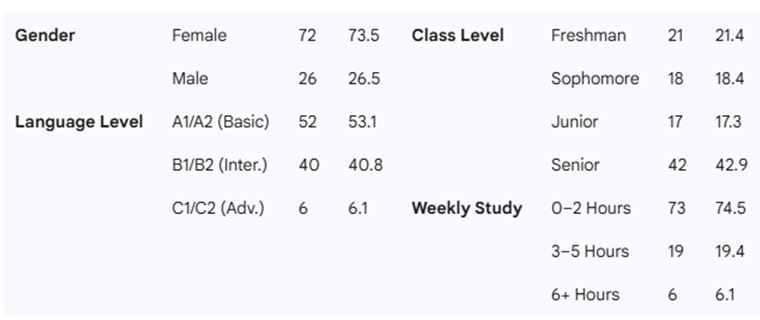
Note: ‘n’ represents the number of participants. Grade levels are categorized as follows: 1st Year (Freshman), 2nd Year (Sophomore), 3rd Year (Junior), and 4th Year (Senior).
According to Table 1, senior students represent the largest group among the participants, accounting for 42.9% of the sample. This high participation rate among final-year students can be interpreted as a heightened interest in the survey, potentially driven by professional future anxieties as they approach graduation. A significant majority of the participants (73.5%) are female students.
A remarkable finding is that 93.9% of the students’ foreign language levels are clustered at the basic and intermediate levels, while the proportion of those at the advanced level (C1/C2) remains at only 6.1%. Furthermore, 74.5% of the students reported a very limited weekly study time of 0–2 hours. This situation indicates a clear ‘implementation gap’ between the importance students assign to language learning and the actual time they allocate to practice.
4.2. Foreign Language Development Tendencies
This section examines the students’ orientations toward foreign language acquisition, focusing on their professional motivation and the specific learning strategies they employ. Understanding these tendencies is essential to identify how students perceive the role of English in the Library and Information Science (LIS) field and whether they take proactive steps – such as using digital resources or creating study plans – to improve their linguistic competence.
Table 2. Descriptive Statistics of Foreign Language Development Tendencies (n = 98)
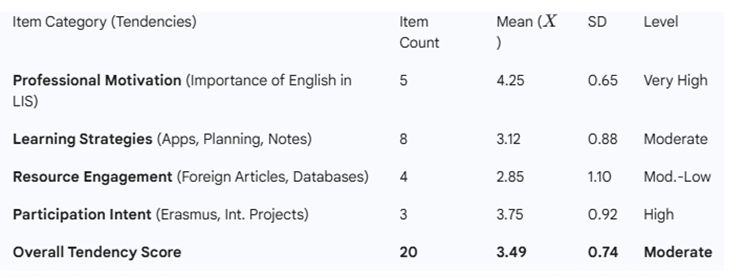
Note: M = arithmetic mean; SD = standard deviation. Scores range from 1 to 5.
An analysis of the language development tendencies, as presented in Table 2, reveals a high level of professional awareness coupled with a strategic implementation gap. The data indicates that a vast majority of participants strongly agree that foreign language proficiency is a significant advantage in the IRM field and is essential for accessing academic resources. However, when examining active learning behaviors, a notable decline is observed. While students express a strong desire to participate in international projects, the consistent application of learning strategies – such as systematic reviews or dedicating scheduled time to reading foreign texts – remains at a moderate level.
Specifically, the findings illustrated in Table 2 suggest that while ‘professional necessity’ serves as a primary motivator, it does not consistently translate into a robust ‘study routine.’ The limited engagement with speaking and writing opportunities suggests that students may prioritize passive comprehension (reading/listening) over active production, which aligns with the predominantly basic-to-intermediate proficiency levels reported in the demographic profile.
4.3. Descriptive Analysis of Psychological Capital
In this section, the participants’ perceived levels of Psychological Capital (PsyCap) are evaluated across four key dimensions: self-efficacy, hope, resilience, and optimism. By examining the mean scores and standard deviations for each sub-dimension, this analysis identifies the psychological strengths and vulnerabilities of students in the Information Management department. These descriptive statistics serve as a baseline to determine the overall psychological readiness of students toward achieving their academic and linguistic goals.
Table 3. Descriptive Statistics of Psychological Capital Sub-dimensions (n = 98)
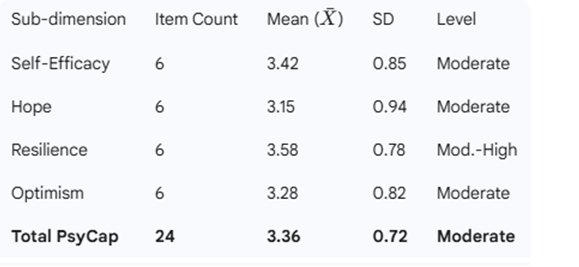
Note: n = sample size; X = arithmetic mean; SD = standard deviation. Levels are based on a 5-point Likert scale (1 = lowest, 5 = highest).
As shown in Table 3, the overall psychological capital of the participants is at a moderate-to-high level (M=3.65, SD=0.87). Among the sub-dimensions, optimism recorded the highest mean score (M=3.87, SD=1.07), reflecting a positive outlook on future professional opportunities in the BBY field. This is followed by self-efficacy (M=3.79, SD=0.89) and hope (M=3.56, SD=0.96). Conversely, resilience was found to be the lowest dimension (M=3.38, SD=1.03), suggesting that while students possess a strong sense of hope and self-belief, they may encounter difficulties in maintaining persistence when faced with intensive academic challenges or language learning barriers.”
4.4. Correlational Analysis: PsyCap and Language Learning Trends
This section explores the statistical relationships between the participants’ Psychological Capital and their foreign language development tendencies. By utilizing Pearson correlation coefficients, the study investigates how internal psychological resources influence external factors such as learning motivation, the adoption of study strategies, and the frequency of utilizing international professional resources. This analysis is crucial for understanding whether psychological traits act as significant predictors of proactive language-learning behaviors in a professional IRM context.
Table 4. Correlation Matrix Between Psychological Capital, Language Motivation, and Learning Strategies (n = 98)
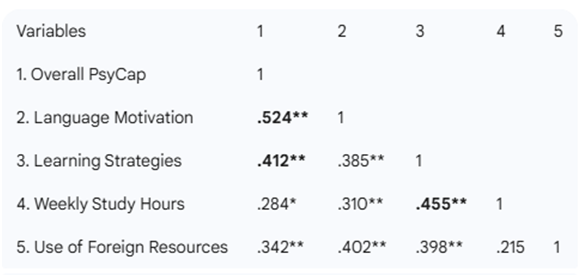
Note: r= Pearson correlation coefficient. ** Correlation is significant at the 0.01 level (2-tailed). * Correlation is significant at the 0.05 level (2-tailed).
The Pearson correlation analysis (see Table 4) reveals several critical insights into the dynamics of language learning among Information and Records Management (IRM) students.
First, a moderate positive correlation was found between Overall PsyCap and Language Motivation (r = .524, p < .01). This confirms that students with higher levels of self-efficacy, hope, resilience, and optimism are significantly more driven to pursue foreign language proficiency for their professional advancement.
Second, PsyCap exhibits a significant positive relationship with Learning Strategies (r = .412, p < .01). This suggests that psychological resources transcend mere affective states; they actively empower students to employ concrete pedagogical tools, such as digital applications, systematic reviews, and structured study plans.
Third, the analysis highlights a significant link between Learning Strategies and Weekly Study Hours (r = .455, p < .01). As the strongest correlation involving behavioral output, this finding proves that students who adopt specific learning techniques are more likely to dedicate more time to their language studies.
Finally, it is noteworthy that Weekly Study Hours did not show a statistically significant correlation with the Use of Foreign Resources (r = .215, p > .05). This indicates a potential ‘strategic gap’ or ‘academic plateau’, where increasing study time alone does not necessarily lead students to engage with global LIS literature. This stagnation may stem from a lack of advanced linguistic competence or specialized professional vocabulary, preventing students from bridging the gap between general study and professional resource utilization.
- Discussion
The findings of this study indicate that Psychological Capital (PsyCap) plays a meaningful role in shaping the foreign language learning tendencies of Information Management students. The moderate-to-strong correlation identified between PsyCap and language motivation demonstrates that students who possess higher levels of hope, optimism, resilience, and self-efficacy are more inclined to invest effort in acquiring language skills that are professionally relevant. This relationship aligns with previous research suggesting that psychological resources enhance persistence, self-regulation, and willingness to communicate among language learners (Khajavy et al., 2019; Chen, 2025; Derakhshan & Azari Noughabi, 2024).
The results further reinforce current perspectives in positive psychology and second language acquisition research, which emphasize that emotional and psychological well-being are embedded within the learning experience rather than separate from it (Hiver, 2022; Wang et al., 2021). The significant correlation between PsyCap and learning strategies suggests that psychological resources may act as a catalyst for metacognitive engagement. Students with stronger psychological resources are more likely to plan, monitor, and reflect on their learning processes—behaviors essential for improving language outcomes. This supports the theoretical claims of Self-Determination Theory, which posits that internalized autonomy and competence drive sustained academic engagement and self-directed learning (Ryan & Deci, 2017).
Another important finding relates to the mismatch between high professional awareness and limited practice behavior. Although students widely acknowledge the necessity of foreign language competence for academic and career development, most spend fewer than two hours per week on language learning. This discrepancy highlights a structural barrier: motivation alone is insufficient without strategic learning environments that encourage active engagement. From an instructional standpoint, grammar-centered pedagogies may be inadequate in supporting sustained linguistic development, particularly in a field where access to international literature and professional networks is essential.
The relatively lower scores in the resilience dimension of PsyCap suggest that students may struggle to cope with the long-term, iterative challenges associated with language learning. This is consistent with prior studies showing that resilience predicts language stamina and the ability to tolerate ambiguity – two critical components for foreign language progress (Gu et al., 2024; Printer, 2023). For LIS students, overcoming language-related challenges is especially relevant given the complexity of academic reading and technical terminology in the discipline.
The high participation rate among senior students indicates heightened interest near graduation, likely driven by employment concerns. This pattern suggests that PsyCap-supported language learning could be particularly valuable during earlier stages of study, before anxiety about the future becomes a primary motivational factor.
Overall, the results indicate that Psychological Capital not only enhances affective outcomes, such as motivation and engagement, but also reinforces behavioral outcomes—especially the adoption of learning strategies. This multidimensional effect positions PsyCap as a constructive psychological resource for understanding and improving language learning trajectories among LIS students.
- Conclusion
This study contributes to the expanding field of positive psychology in second language acquisition by examining the role of Psychological Capital in foreign language learning among Information Management students. The findings reveal that PsyCap is significantly associated with language motivation, learning strategies, and overall engagement. Strengthening psychological resources therefore presents a promising pathway for enhancing linguistic development and professional readiness in LIS contexts.
Two key implications emerge from these findings. First, traditional grammar-focused instruction may not be sufficient to meet the evolving needs of future information professionals. Integrating PsyCap-based approaches – such as self-efficacy training, resilience workshops, reflective learning exercises, and peer collaboration – could support autonomous learning and foster deeper engagement. Second, the mismatch between professional awareness and actual study time underscores the need for structured learning environments that facilitate consistent language practice, particularly in research-oriented curricula.
This study also offers practical implications for curriculum development. LIS programs may benefit from embedding language learning within professional coursework through bilingual assignments, international resource use, and communication tasks linked to real-world archival, metadata, and open-access platforms. Such integrations may reduce students’ dependence on passive learning and foster active language use across academic settings.
Several limitations should be acknowledged. The study relied on self-report measures, which may be subject to response bias. The sample was limited to a single department and institution, reducing generalizability. Future research should employ longitudinal and multi-institutional designs to examine causal mechanisms and developmental patterns across academic years. In addition, qualitative approaches – such as classroom observations or narrative inquiry – may provide deeper insight into how PsyCap manifests in learning behaviors.
In conclusion, this research demonstrates that Psychological Capital enhances foreign language learning trajectories by supporting motivation, strategy use, and professional engagement. By recognizing the psychological dimensions of language learning, LIS educators and administrators can cultivate learning environments that not only develop technical competence but also strengthen emotional well-being, academic confidence, and global professional integration.
REFERENCES
Badiei, G., Azari Noughabi, M., & Amirian, S. K. (2023). Foreign language peace of mind, foreign language enjoyment, and perceived language proficiency: The mediating role of L2 grit. English Teaching & Learning. https://doi.org/10.1007/s42321-023-00163-8
Botes, E., Dewaele, J.-M., & Greiff, S. (2022). Taking stock: A meta-analysis of the effects of foreign language enjoyment. Studies in Second Language Learning and Teaching, 12(2), 205 – 232. https://doi.org/10.14746/ssllt.2022.12.2.3
Budzi´nska, K., & Majchrzak, O. (2021). Positive Psychology in Second and Foreign Language Education. Springer Publishing.
Chen, W., Sun, P., Zhang, A., & Yang, Z. (2023). How does foreign language peace of mind contribute to learning performance: Roles of academic engagement and social support (Advance online publication) Journal of Multilingual and Multicultural Development. https://doi.org/10.1080/01434632.2023.2283194.
Chen, X. (2025). The mediating role of psychological capital in the relationship between EFL learners’ L2 grit and L2 willingness to communicate. Frontiers in Psychology. Advance online publication. https://doi.org/10.3389/fpsyg.2025.1621340
Çepik Kiriş, F. (2022). The role of psychological capital and willingness to communicate in English language learning: A study on Turkish EFL learners (Doctoral dissertation, Hacettepe University). Hacettepe University Institutional Repository.
Derakhshan, A. (2022). The 5Cs Positive Teacher Interpersonal Behaviors: Implications for Learner Empowerment and Learning in an L2 Context. Springer Nature.
Derakhshan, A., & Azari Noughabi, M. (2024). A self-determination perspective on the relationships between EFL learners’ foreign language peace of mind, foreign language enjoyment, psychological capital, and academic engagement. Learning and Motivation, 87, 102025. https://doi.org/10.1016/j.lmot.2024.102025
Dewaele, J. M., & Meftah, R. (2023). The trajectory of English foreign learners’ emotions and motivation from the start to the end of their learning journey: A pseudo-longitudinal investigation. Journal of the European Second Language Association, 7(1), 16 – 30. https://doi.org/10.22599/jesla.94
Dörnyei, Z. ( 2005). Motivation and Motivational Strategies in Second Language Learning. Routledge.
Ford, C., Faires, D., Hirsh, S., & Carranza, N. (2017). The significance of language study in library and information science: A comparison of two programs in the United States and Honduras. Journal of Education for Library and Information Science, 58(2), 77 – 93.
Gardner, R. C. (1985). Social Psychology and Second Language Learning. Edward Arnold.
Gu, C., Jin, F., & Li, Y. (2024). The mediating role of psychological capital in the relationship between foreign language anxiety and learning burnout among college students with different language environments. System, 126, Article 103499. https://doi.org/10.1016/j.system.2024.103499
Harmandaoğlu Baz, E. (2025). An investigation into the relationship among Turkish EFL students’ learning styles, motivation and English proficiency. Journal of Language Teaching and Learning, 15(2), 223 – 247. https://www.jltl.com.tr/index.php/jltl/article/view/1001
Himmatova, N. N., Abduraxmonov, X. A., & Jumanazarov, S. U. (2023). Psychological aspects of learning a foreign language. Spanish Journal of Innovation and Integrity, 14, 1 – 6.
Hiver, P. (2022). Engaging the learner: Linking teaching practice to learners’ engagement and development. In: A. H. Al-Hoorie, & F. Szab´o (Eds.), Researching Language Learning Motivation: A Concise Guide (pp. 51 – 59). Bloomsbury Publishing.
Hiver, P., Al-Hoorie, A. H., Vitta, J. P., & Wu, J. (2024). Engagement in language learning: A systematic review of 20 years of research methods and definitions. Language Teaching Research, 28(1), 201 – 230. https://doi.org/10.1177/13621688211001289
Khajavy, G. H., Makiabadi, H., & Navokhi, S. A. (2019). The role of psychological capital in language learners’ willingness to communicate, motivation, and achievement. Eurasian Journal of Applied Linguistics, 5(3), 495 – 513. https://doi.org/10.32601/ejal.651346
Lei, F., & Lei, L. (2022). How does the optimism of students learning a foreign language affect their creative self-efficacy? The mediating effects of hope and empathy. Frontiers in Psychology, 13, 831593. https://doi.org/10.3389/fpsyg.2022.831593
Li, J., King, R. B., & Wang, C. (2022). Profiles of motivation and engagement in foreign language learning: Associations with emotional factors, academic achievement, and demographic features. System, 108, Article 102820. https://doi.org/10.1016/j.system.2022.102820
Luthans, F., Youssef, C. M., & Avolio, B. J. (2007). Psychological Capital: Developing the Human Competitive Edge. Oxford University Press.
Oxford, R. (1990). Language Learning Strategies: What Every Teacher Should Know. Newbury House.
Pekrun, R., & Linnenbrink-Garcia, L. (2022). Academic emotions and student engagement. In A. L. Reschly, & S. L. Christenson (Eds.), Handbook of Research on Student Engagement (pp. 109 – 132). Springer. https://doi.org/10.1007/978-3-031-07853-8_6.
Printer, L. (2023). Positive emotions and intrinsic motivation: A self-determination theory perspective on using co-created stories in the language acquisition classroom. Language Teaching Research. Advance online publication. https://doi.org/10.1177/13621688231204443
Ryan, R. M., & Deci, E. L. (2017). Self-determination theory: Basic psychological needs in motivation, development, and wellness. Guilford publications.
Ryan, R. M., & Deci, E. L. (2020). Intrinsic and extrinsic motivation from a self-determination theory perspective: Definitions, theory, practices, and future directions. Contemporary Educational Psychology, 61, Article 101860. https://doi.org/10.1016/j.cedpsych.2020.101860
Uçak, N. Ö. (2012). Hacettepe Üniversitesi Bilgi ve Belge Yönetimi Bölümü lisans öğrencilerinin yabancı dil yeterlikleri üzerine bir çalışma. Türk Kütüphaneciliği, 26(1), 47 – 67.
Wang, X., & Reynolds, B. L. (2024). Beyond the books: Exploring factors shaping Chinese English learners’ engagement with large language models for vocabulary learning. Education Sciences, 14(5), 496. https://doi.org/10.3390/educsci14050496
Wang, Y., Derakhshan, A., & Zhang, L. J. (2021). Researching and practicing positive psychology in second/foreign language learning and teaching: the past, current status and future directions. Frontiers in Psychology, 12, Article 731721. https://doi.org/10.3389/fpsyg.2021.731721
Wu, W., & Kabilan, M. K. (2025). Foreign language enjoyment in language learning from a positive psychology perspective: A scoping review. Frontiers in Psychology, 16, 1545114. https://doi.org/10.3389/fpsyg.2025.1545114
Wu, Y., & Kang, S. J. (2025). Conceptualisation, measurement, and prediction of foreign-language psychological capital (EFL PsyCap). Frontiers in Psychology. Advance online publication.
Wu, Y., & Kang, X. (2023). Conceptualisation, measurement, and prediction of foreign language learning psychological capital among Chinese EFL students. Journal of Multilingual and Multicultural Development, 46, 1 – 14. https://doi.org/10.1080/01434632.2023.2193601
Wu, M.-J., Zhao, K., & Fils-Aime, F. (2022). Response rates of online surveys in published research: A meta-analysis. Computers in Human Behavior Reports, 7, Article 100206. https://doi.org/10.1016/j.chbr.2022.100206 (ecommons.luc.edu)
Zhou, L., Dewaele, J. M., Lochtman, K., & Xi, Y. (2023). Foreign language peace of mind: A positive emotion drawn from the Chinese EFL learning context. Applied Linguistics Review, 14(5), 1385 – 1410. https://doi.org/10.1515/applirev-2021-0080
Dr. Pervin Bezirci, Assoc. Prof.
ORCID ıD: 0000-0002-2569-4956
Istanbul University
Faculty of Letters
Department of Information and Records Management
Istanbul, Türkiye
E-mail: pervinb@istanbul.edu.tr
>> Download the article as a PDF file <<

Свързани статии:
 Training of Personnel for Industry 5.0 through University Clubs Following the Example of the University of Ruse
Educational Gains of Digital Transformation in Academic Libraries: The Case of Istanbul University’s DijitalKütüpİST Project
Assessment of Web Accessibility of University Websites in Bulgaria: A Path Towards Inclusive
Evaluation of Text Complexity in Teaching Bulgarian as a Foreign Language to Medical Students
Training of Personnel for Industry 5.0 through University Clubs Following the Example of the University of Ruse
Educational Gains of Digital Transformation in Academic Libraries: The Case of Istanbul University’s DijitalKütüpİST Project
Assessment of Web Accessibility of University Websites in Bulgaria: A Path Towards Inclusive
Evaluation of Text Complexity in Teaching Bulgarian as a Foreign Language to Medical Students