



Plamen Kasovski, Mirena Todorova
Todor Kableshkov University of Transport, Sofia, Bulgaria
https://doi.org/10.53656/isct-2025.02

Pages 21-30
Abstract. The main study that is considered in the report on the capacity of railway elements is: classification and assessment of methods for determining the capacity of railway infrastructure. Capacity is generally understood as the maximum amount of requests that can be served in a given period of time under a given transport technology, and for railway infrastructure is the maximum number of trains that can safely and efficiently pass through a certain section or station in a given period of time, depending on the parameters of the infrastructure, the technology of operation and the way in which trains are run. key to the development of schedules, investment planning and increasing the efficiency of the system. Capacity analysis is important for planning, managing and optimizing rail operations. Methods for determining railway infrastructure capacity are grouped into three main categories: analytical, graphical and simulation. Analytical methods use mathematical dependencies that take into account the type of line, the way traffic is controlled, the type of train schedule and the type of mathematical expression. The graphical approach includes visualization of traffic through schedules and analysis of intervals between trains. Simulation methods, assisted by modern software, simulate real conditions and interactions in the system, predicting capacity and workload. The integration of technologies such as AI, IoT and GPS systems allows adaptive control in real time. An evaluation of the considered methods has been developed depending on the purpose of their application – operational management, optimization, forecasting or strategic planning. Each method has different accuracy and data requirements. Evaluation of methods for measuring and optimizing railway capacity is essential to increase the efficiency and reliability of rail traffic.
Keywords: processing capacity, carrying capacity, methods, rail transport
- Introduction
Rail capacity encompasses several key aspects that are essential for the overall functioning and efficiency of the system. These aspects include technical, operational, economic and regulatory factors. The technical aspects relate to the physical characteristics of the infrastructure, such as the number of tracks, signaling, type and condition of the track, facilities and trains. The operational aspects cover the organization of train traffic, timetables, safety, traffic management and coordination between the different actors in the rail system. Economic aspects include the costs of maintenance, operation, investment and return on investment in railway infrastructure and services. Regulatory aspects are related to the regulatory requirements, standards, rules and policies that determine the conditions for the safety, operation and management of railway capacity. These interrelated aspects form the overall picture of capacity. Its evaluation and optimisation must be taken into account in order to achieve effective management of railway infrastructure. Capacity includes the ability of the railway infrastructure to maintain a certain volume of traffic for a given period of time. The implemented changes and restructuring of railway transport require a new look and approach to determining the maximum and necessary capacity and transport capacities of the elements of the railway network.
- Methods for determining the capacity of the railway infrastructure
The methods can be grouped into three main categories: analytical, graphical and simulation.
2.1. Analytical methods
Analytical methods use mathematical dependencies that take into account the type of line, the way traffic is controlled, the type of train schedule and the type of mathematical expression.
2.1.1. Determination of the maximum capacity.
The maximum capacity of a railway element (subsystem) [1, 2, 3] shall be determined according to the period of the train schedule. Where the timetable period, i.e. the passage time of one train, per pair or group of trains, is set for the limiting interstation, then the maximum capacity obtained shall be maximum for the entire railway section. Limiting is the interstation that has the longest scheduling period of the adopted train passage scheme.
The maximum capacity is determined [1, 2, 3] according to the formula:

 – maximum capacity
 – the period of the timetable for the movement of freight trains in the limiting interstation under the respective capacity scheme, in the case of a traffic safety system and with the relevant characteristics of the train (min);
k – the number of pairs of trains missed in one period of the timetable;
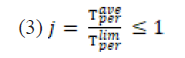
 – the maximum coefficient of use of the limiting distance depending on certain traffic factors, which shall be determined by the formula:

varies in the range of 0.66 < η < 0.96, and practically for the larger number of cases it changes in the range of 0.76 – 0.86. The closer it gets to one, the greater it will be Nm (maximum capacity);
 is the ratio of the number of passenger trains to the number of freight trains in the section with the corresponding volume of the intended services, number of pairs of trains/day;



2.1.2. Regression method for determining maximum capacity.
Where a rapid determination of the maximum capacity of railway sections for a given ratio of freight and passenger trains is required, the following formulas derived for our operating conditions may be used [1, 2, 3]:
For single-road sections:
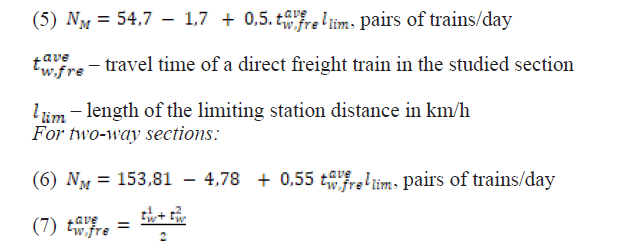
The half-sum of the travel times of a direct freight train in both directions in the limiting interstation with length Llin, (km) shall be obtained. These are correlation dependencies on the maximum capacity of the sections depending on the length of the limiting interstation in kilometers and the travel time on it in minutes.
2.1.2. Required capacity
The required capacity is the number of trains obtained under the parameters (weight or composition of trains, unevenness, etc.) of the maximum capacity, depending on the proposed volume of transport for a considered period of time, for which it is realized. The required capacity [1, 2, 3] is determined for the same network element and the required transport capacity, expressed respectively in net or gross tonnes for a year or other period considered. It can also be determined in an analytical way, as it is compared with the maximum capacity for the considered: element, period and operating conditions:
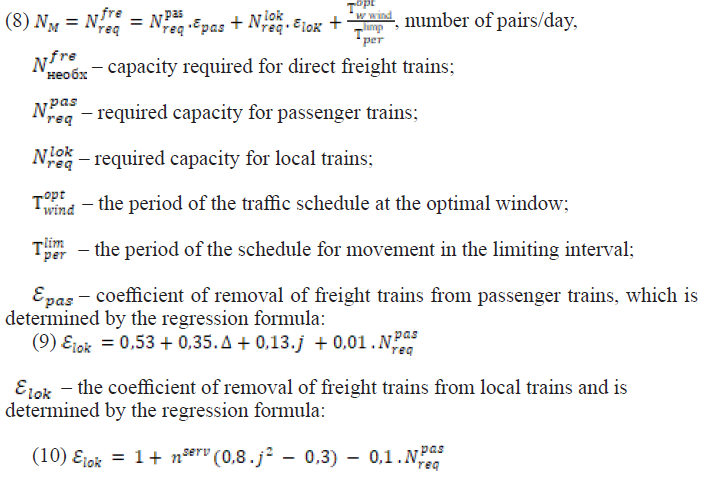
When we need repair or construction technology with a longer „window“ than the base duration of 240 minutes, the movement of trains will be with less additional losses. If the object and the optimal duration of the window are firmly known, it will be firmly connected to the GDV and from it in both directions in corridors parallel to the respective train group, a connection will be made to the base „window“. This will make it possible to increase the duration of the „windows“ for medium and current repairs.
2.1.3. Railway infrastructure train capacity reserves
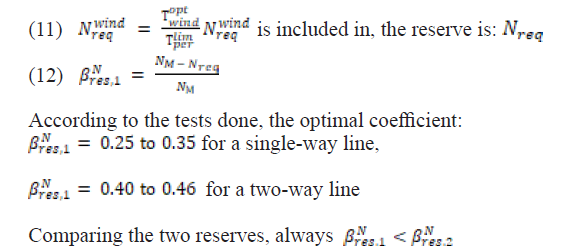
The maximum capacity reserve [1, 2, 3] is determined depending on the use of the time for the implementation of repair and restoration works („windows“). When the time for the „window“ is used for repair work, i.e.:
2.1.4. Maximum and required transport capacity
The maximum and required carrying capacity of a railway section shall be determined in gross tonnes or millions of gross tonnes realised for one year or other period of time considered, depending on the average gross weight of the trains, the maximum and required capacity and the utilization factor [1, 2, 4, 5].
They can be determined by the same dependency but using the relevant parameters. The maximum transport capacity is determined by the dependence – formula:

 – the maximum and required transport capacity (gross t.km/day);
 – the average gross weight of freight trains;
 – the average gross weight of passenger trains;
 – the coefficient of use of the gross weight of cargo passenger trains;
 – the coefficient of use of the gross weight of passenger trains;
 – length of the section.
The required transport capacity when the window time is used for repair work is determined in a similar way using the data for the specific section.
2.2. Graphical methods for determining the maximum capacity of trains.
The graphical method for determining the maximum capacity of trains per day shall be based on a visual representation of the movement of trains in relation to the time, using a train schedule. Once all trains, intervals, speeds and stops have been plotted, the schedule can be analyzed to determine the maximum number of trains that can pass through the line within a day. Capacity is a function of the minimum intervals between trains, their average speed and the stay at stations [6]. Through graph analysis, the time zones with the highest load can be identified and additional trains can be scheduled with minimal risk of overloading. This method helps to understand how various factors, such as intervals, speeds, and downtime, affect the maximum capacity of the railway [7].
The International Union of Railways (UIC) imposes a uniform method for calculating capacity, which is contained in the UIC leaflet code 406 ‘Capacity’. This is the methodology based on graphical compression of train paths within certain sections to determine the occupancy time. This compression takes into account the minimum times, which depend on the way of ensuring the movement and characteristics of the train (Figure 1.1).
Capacity consumption is characterized by the value of the infrastructure occupied (percentage of time window). UIC code 406 gives certain values corresponding to the number of roads [8]. If the occupancy of the infrastructure is higher than or equal to this determined value, the analysed section of the line must be considered as congested infrastructure and no additional train routes must be added to the schedule. If it is lower than the typical value, the capacity can be used and supplemented with new routes, and this procedure can be repeated until the infrastructure occupancy reaches the congestion level. The basic formula for determining capacity consumption according to UIC Code 406 [8] is:
(14)  – total consumption time [min];
A – passenger trains;
B – freight trains;
C – maneuverable/special;
D – reserves (buffers).
If for a given schedule A = 600 minutes, B = 120 minutes; C = 30 min and D = 90 min is the total time of infrastructure use: k = 840 min and determination of capacity consumption by the formula:
(15) 
K – power consumption [%];
U – selected time window [min] (1440 min)
K= 840/1440.100 = 58.33%
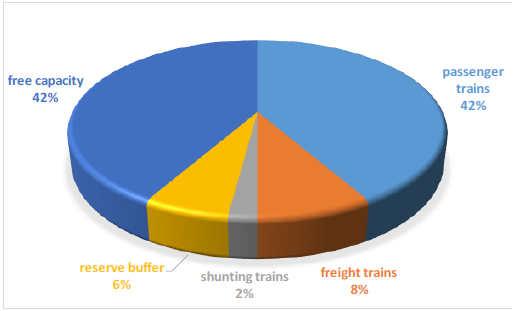
Fig. 1. Breakdown of maximum capacity by train type
This breakdown shows that the infrastructure is highly oriented towards passenger traffic, with minimal buffers. A load of up to 60% is desirable → a sustainable schedule; between 60–80% is acceptable but requires careful planning; over 80% – the system becomes unstable, especially without buffers. The consumption of capacity K is 58.33% of what is available for one day. This indicates that there is still a reserve of about 41.67% for additional trains or maintenance.
It turned out that the problem with the introduction of new routes does not represent a limiting factor for the occupancy of the infrastructure. There is almost always the possibility of inserting a train route into the timetable, but only until the stability of the timetable is affected [9]. On the basis of this standard infrastructure capacity, consumption values cannot be determined. Therefore, the capacity utilization limits of train infrastructure are set out in UIC leaflet 406 must not be exceeded in order to comply with the time buffer and ensure schedule stability.
2.3. Simulation methods
With the development of computer technology, new opportunities for graph construction and estimation have emerged, especially through simulation tools [10]. Over the past two decades, a number of different software solutions for railway infrastructure, node planning and train scheduling have been implemented. Simulation models reproduce the real object, i.e. the system as a whole, in a model through which many processes are carried out on the basis of fixed input data and variables that represent stochastically occurring processes can be studied [11]. Based on a review of the results, it may be possible to make adjustments to the model that will meet all the requirements. Therefore, simulation models play an important role in the design and engineering stages of complex system implementation, and they can help to avoid hidden defects through very early detection [12], while respecting parameters that can affect track capacity and quality of transport services [13, 14].
A study of the impact of new traffic management systems on traffic capacity and safety can be carried out by:
- a) Modeling of different scenarios: Simulating an increase in traffic (more trains), a change in routes and capacity of lines after the implementation of new technologies. This estimates how many more trains can be missed under these conditions [15];
- b) Simulation of dynamic train allocation: optimization algorithms and artificial intelligence (AI) can simulate how new systems will change the distribution of trains in the network, reducing the time intervals between trains and increasing capacity [16];
- c) By (ABM – Agent-Based Modeling) in rail transport – this is a powerful approach to classify and evaluate methods for determining infrastructure capacity, especially in the context of modern management systems such as ERTMS/ETCS, CBTC and AI-based traffic Multi-agent modeling simulates individual „agents“ – trains, dispatchers, stations, traffic lights, passengers – who interact with each other according to certain rules in real time [13, 14];
(d) IoT sensors and GPS systems: They can collect data on the current state of the network to feed into AI models for optimization [16];
(e) By using platforms such as Apache Kafka and Apache Spark, real-time data can be analysed and capacity forecasts and adjustments can be made on the fly [16].
Conclusion
The methods considered can be characterized by the following indicators:
Complexity of the method: analytical methods use formulas and normative values, which makes them the most accessible for application; graphic methods use a time-space graph, which is illustrative, but must be built in advance, which defines them as medium complexity of application because it requires drawing; and simulation simulations simulate real processes with dynamic data, which requires knowledge of a given modeling language or software product;
Input parameters: analytical and graphical methods require data on the train schedule and parameters of the sections, and simulation methods require, in addition to the described data, data on delays, speed reductions, etc., which makes this method the most difficult in terms of dialing the input parameters;
Analysis time and application costs: in all three methods, the analysis time is close, except for the graphical method, where it is slightly longer. In terms of costs, they can be defined as low in the analytical method, low to medium in the graphical method and high in the simulation method;
Possibility of application in different scenarios: analytical methods are determined on the basis of a coherent theory and consider specific situations, which makes them difficult to adapt to variations of the situations under consideration and it is more difficult to identify problem areas in capacity management; the graphical ones allow for the application of small changes in the train schedule and there is a good visualization of the conflict points; Simulation systems allow testing of multiple alternatives and, by loading the network in different ways, help determine the elements with lower capacities.
There is no single „best“ method for all situations. Analytical methods are optimal for initial analysis, quick assessments, and strategic planning when detailed data are lacking. Graphical methods provide clarity and illustrations and are used for operational analysis; While simulation tools are necessary for in-depth research, they allow for detailed analysis and optimization opportunities. The integration of AI and IoT is also a trend that will make calculations more accurate and adaptable. A combination of approaches is recommended, because this will provide reliable forecasts and recommendations to support decision-making in rail capacity management.
References
[1] RAYKOV, R., Improvement of the Methodology for Determining and Analyzing the Capacity of the Railway Network, Journal of Railway Networking. Mechanics Transport Communications, vol. 1, no. 0051, pp. 1–16, 2005, ISSN 1312-3823.
[2] RAYKOV, R., Organization and Management of Traffic in Railway Transport. Sofia, Tehnika, 1985. 344 p.
[3] RAZMOV, T., Analysis of Transport Systems through Discrete Event Modeling, Sofia, Academic Journal Mechanics Transport Communications, 2013, vol. 11, no. 3, article ID 0781, pp. 1–12. ISSN 1312-3823.
[4] STOILOVA, S., Railway Capacity Research, Proceedings of the Fourteenth International Scientific and Technical Conference „Transport, Ecology – Sustainable Development“ ECO Varna’08, Varna, 2008. Varna: Technical University of Varna, 2008, pp. 77–83. ISSN 2367-6299.
[5] STOILOVA, S., Organization and Management of Railway Transport, Sofia, MP Publishing House of the Technical University – Sofia, 2010, 241 p., ISBN 978-954-438-808-9.
[6] RAZMOV, T., VARADINOVA, Y., Achievement of an effective and efficient management of the railway network through the re-engineering of NRIC, International Scientific Conference „Change Management“, dedicated to the 20th anniversary of the Faculty of Business and Management of the University of Ruse „Angel Kanchev“, Ruse, University of Ruse, 2014, pp. 164–179, ISBN 978-954-712-611-4.
[7] GAŠPARÍK, J., ABRAMOVIĆ, B., HALÁS, M., New Graphical Approach to Railway Infrastructure Capacity Analysis, Traffic&Transportation, 2015, vol. 27, no. 4, pp. 283–290, ISSN 0353-5320. doi 10.7307/ptt.v27i4.1627.
[8] LEAFLET UIC CODE 406 – Capacity 2nd Edition. Paris: International Union of Railways (UIC); 2013, 46 p., ISBN 978-2-7461-2187-4.
[9] HALÁS, M. HALÁS, M., Progressive steps of railway infrastructure capacity detection. [PhD thesis in Slovak]. Žilina: University of Žilina, Faculty of Operation and Economics of Transport and Communications, Department of Railway Transport; 2014.
[10] ARNE HANSEN, I, PACHL, J., Railway timetable and traffic. Hamburg: Eurailpress; 2008, 230 p., ISBN 978-3-7771-0371-6.
[11] ABRAMOVIĆ, B, ŠIMUNEC, I. Optimization of railway traffic on Varaždin – Golubovec railway line. Proceedings of the 20th International Symposium EURO – ŽEL 2012; 2012 June 5-6; Žilina, Slovakia. University of Žilina; 2012, ISBN 978-80-554-0537-7.
[12] STOPKA, O, KAMPF, R, KOLÁŘ, J, KUBASÁKOVÁ, I, SAVAGE, CH. Draft guidelines for the allocation of public logistics centres of internation importance. Communications: Scientific Letters of the University of Zilina, 2014, vol. 16, no. 2, pp. 14–19, ISSN 1335-4205.
[13] KENDRA, M, BABIN, M, ŠULKO, P. Interaction between railway infrastructure parameters and quality of transportation services. Proceedings of the BulTrans-2013; 2013 Sofia, October 16-18, 2013, Sofia, Technical University of Sofia Publishing House, 2013, pp. 233–237, ISSN 1313-955X.
[14] KENDRA, M, BABIN, M. Infrastructure and operation parameters and their impact to the track capacity. Horizons of railway transport. 2012; vol. 3, no. 1, pp. 52–63, ISSN 1338-2896.
[15] ATANASOV, K., TODOROVA, M. „Imitation Model of a Railway Section“ Sofia, „Young Forum – 2020“ of the academic journal „Mechanics Transport Communications“, 2020, vol. 9, no. 1, „Young Forum – 2020“, article ID 1931, pp. 47–53, ISSN 2367-6612.
[16] MCKINSEY & COMPANY, International Union of Rail Transport (UIC) „The Road to AI-Enabled Railway Companies“ 2024, 48 p. https://uic.org/com/IMG/pdf/uic_layout_web_05032024.pdf.
Plamen Kasovski, PhD student
Department of Technology, Organization and Management of Transport
Todor Kableshkov University of Transport
158 Geo Milev Str., 1574 Sofia, Bulgaria
E-mail: pkasovski@vtu.bg
Mirena Todorova, Prof., PhD
ORCID iD: 0000-0002-4138-1861
Department of Technology, Organization and Management of Transport
Todor Kableshkov University of Transport
158 Geo Milev Str., 1574 Sofia, Bulgaria
E-mail: mtodorova@vtu.bg