

Veselin Mitev
University of Mining and Geology “St. Ivan Rilski”, Sofia, Bulgaria
https://doi.org/10.53656/igc-2025.27

Pages 290-302
Abstract. This paper aims to present the results of a socio-economic analysis of the Bulgarian mining industry and its importance to the national economy and to society during the period 2018 ÷ 2023 based on an analysis of available branch and statistical information. It presents the relative shares of the Bulgarian mining industry in the Bulgarian economy by key indicators for the period 2018 ÷ 2023. On this basis, the importance of the mining industry for the national economy, the national energy, employment and wages, and corporate social responsibility of enterprises in the branch is justified. Changes in environmental protection and restoration costs in the mining industry, the number of occupational accidents and lost calendar days due to occupational accidents in the Mining and quarrying subsector during the period 2018 ÷ 2022 have been analysed. All the researched data for the analysed period emphasise the important socio-economic importance of the Bulgarian mining industry to the national economy and to society.
Keywords: socio-economic analysis; Bulgarian mining industry; employment; corporate social responsibility
JEL: L60; L71
Introduction
According to Rong Yan (2023), “socio-economic research holds immense importance in unveiling the complex dynamics of human progress within societies and economies”. On the other hand, according to Escosura (2021), “by using rigorous analysis and robust methodologies, socio-economic research aims to uncover patterns, trends, and causal relationships in societies and economies, shedding light on the underlying drivers of progress”. According to Gasper (2002), “understanding the dynamics of human progress requires a holistic approach that recognizes the interaction between social and economic factors”.
The Bulgarian mining industry is of strategic importance for the national economy of the Republic of Bulgaria. It is an important factor for the economic stability and mineral independence of the country and is of great importance for the national economy, society, regions, and municipalities with developed mining.
Bulgaria also takes a leading position in the European mining industry, ranking among the top producers of copper, gold and lignite coal in Europe. The increased global production and consumption of metallic, non-metallic, energy, and construction raw materials proves to be a favourable factor for the development of the extraction and processing of a number of types of underground natural resources, and, hence, for the sustainable development of the Bulgarian mining industry.
̤According to Shterev et al. (2023), at this stage, there is good legislation, good examples, and practices both in the EU and in Bulgaria that regulate and create prerequisites for the development of the sector.
Research data and methods
The sources of information for the study are: national and international databases with scientific information, statistical data of the National Statistical Institute of the Republic of Bulgaria1, its INFOSTAT information system, the Ministry of Economy, and the Ministry of Energy.
The methods used in the development of this study are: research of scientific literature and statistical information, analysis and synthesis, systemic approach, the method of inter-economy comparisons, and graphical methods for time series analysis.
The aim of this study is to present the results of the socio-economic analysis of the Bulgarian mining industry for the period 2018 ÷ 2023, as well as its importance to the national economy and to society, based on an analysis of the available branch and statistical information.
Main economic indicators of the Bulgarian mining industry
Table 1 presents the relative shares of the Bulgarian mining industry in the Bulgarian economy for the period 2018 ÷ 2023. The table is built based on data from the INFOSTAT information system of the National Statistical Institute (NSI). The following sectors are not included in the data for Bulgaria: „State governance“ (O); „Unidentified activities of households as employers and undifferentiated activities of households in the production of goods and services for own consumption“ (T); „Activities of extraterritorial organisations and services“ (U).
Table 1. Relative shares of the mining industry in the Bulgarian economy by key economic indicators for the period 2018 – 2023
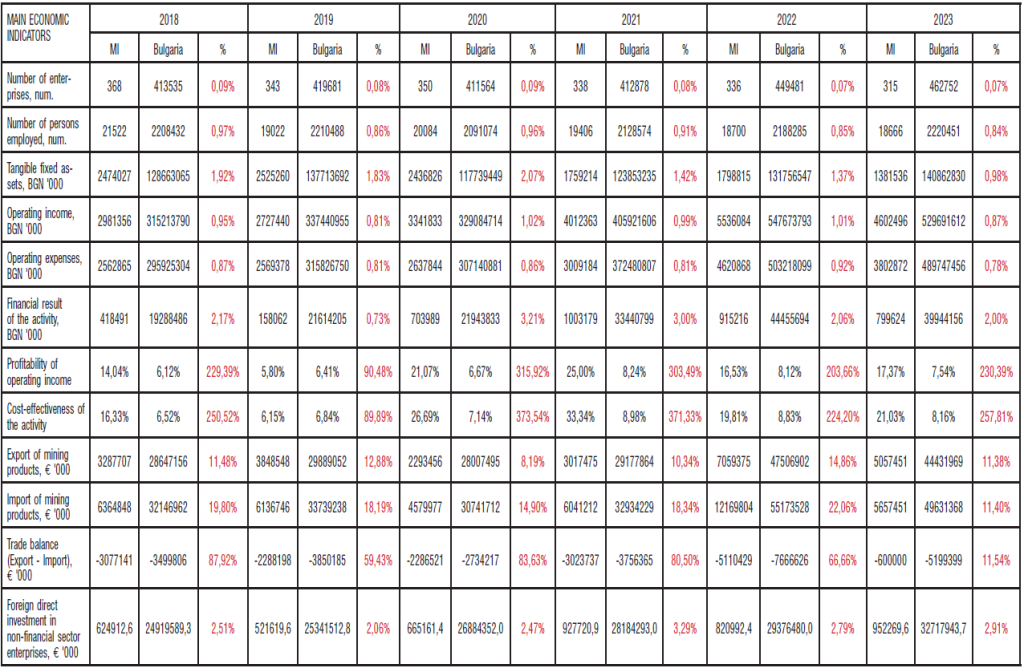
Note: The abbreviation MI in the table refers to the Mining Industry
Source: per INFOSTAT data, compiled by the author.
https://infostat.nsi.bg/infostat/pages/module.jsf?x_2=242
https://infostat.nsi.bg/infostat/pages/reports/query.jsf?x_2=250
https://infostat.nsi.bg/infostat/pages/reports/query.jsf?x_2=782
https://infostat.nsi.bg/infostat/pages/reports/query.jsf?x_2=789
https://infostat.nsi.bg/infostat/pages/reports/query.jsf?x_2=1947
https://infostat.nsi.bg/infostat/pages/reports/query.jsf?x_2=2166
The data in Table 1 show the following change in the relative shares of the mining industry in the Bulgarian economy by basic economic indicators during the analysed period:
– The number of mining enterprises among enterprises in the country decreased from 0.09% in 2018 to 0.07% in 2023.
– The relative share of employed persons was 1% in 2018, decreasing to 0.84% in 2023.
– The value of tangible fixed assets during the period decreased from 2% to 1%.
– Revenues from operations during the period varied around 1% of the total for the country.
– Operating expenses during the period varied around 0.8% of the total for the country.
– The financial result of the activity during the period varied between 2 and 3% of the total for the country.
– The profitability of revenues and expenses from the activity was significantly higher than the national average. It ranged from 2.5 to 3.7 times higher than the national average.
– Exports of mining products during the period varied between 8 and 15%, and imports of mining products between 11 and 22%.
– The trade balance (Export – Import) for both the industry and the country remained negative throughout the analysed period.
– Foreign direct investment during the period varied between 2.1 and 3.3% of the total for the country.
It is noteworthy that the small number of mining enterprises and employees in the subsector realised significantly higher profitability of revenues and expenses than the national average.
In 2023, 315 enterprises operated in the mining industry, producing output worth 3.897 billion leva, according to NSI data. With operating revenues of around BGN 4.603 billion, enterprises in the extraction industry managed to generate BGN 1.930 billion of value added. The gross value added reached 49.5% of the produced output.
Microenterprises predominated (212 units) in the subsector in 2023. Small enterprises were 71 units, medium-sized enterprises were 23 units, and large enterprises were only 9 units.
The mining industry is an important employer, providing employment for 18.666 thousand people in 2023. Personnel costs reached 841.599 million leva in 2023.
Despite the decrease in the value of tangible fixed assets during the analysed period, the profitability of revenues and expenses increased. This is only possible through their more efficient use. Similar results are observed in other sectors of the national economy for example, the sector „Manufacture of textile clothing“ (Terzieva, 2024).
The mining industry occupies an important place in the Bulgarian economy, as it is at the heart of the mineral raw material chain and is a major supplier to many other sectors.
The raw materials mined in Bulgaria in 2023 mainly included lignite coal, lead-zinc, copper, and polymetallic ores, gypsum, limestone, bentonite, kaolin, quartz sands, refractory clays and marble, etc.
In 2023, the Bulgarian mineral and raw materials industry exported production worth 5.058 billion euro.
The importance of the Bulgarian mining industry for the energy sector
The mining industry in Bulgaria generated about 5% of GDP by 2022 and provided about 40% of the country’s energy production based on solid fuels – as much as the production of the Kozloduy Nuclear Power Plant. In 2024, brown and lignite coal production decreased by 28.6% compared to 2023, and by 58.3% compared to 2022. Coal accounted for 96.4% of total solid fuel production and in 2023 it accounted for 33.30% of the energy mix of electricity produced.
The sharp contraction in solid fuel production is a result of the decarbonisation of the Bulgarian energy sector in line with the implementation of the Recovery and Resilience Plan and the Green Deal. This has led to serious imbalances in the Bulgarian energy system in recent years.
Employment and wages in the „Mining and Quarrying“ subsector
The mining industry provided over 18 000 direct and 120 000 indirect jobs and is ranked fourth in terms of wage levels in 2023. In 2024, according to preliminary data from the National Statistical Institute, it rose to second place after the IT sector. The average monthly net salary in the mining industry exceeded 3 000 BGN in 2024, and in each year of the analysed period it increases by an average of 10%.
The change in the average gross annual salary in the „Mining and Quarrying“ subsector and for the Republic of Bulgaria for the period 2018 ÷ 2024 is presented in Figure 1.
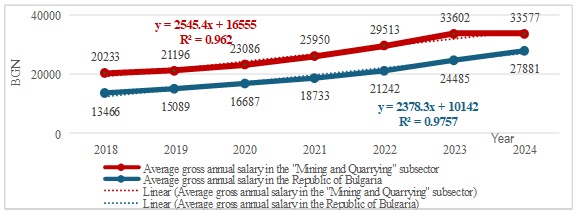
Figure 1. Change in the average gross annual salary in the „Mining and Quarrying“ subsector and for the Bulgaria for the period 2018 ÷ 2024
Source: The graph is based on NSI data, 2025, https://infostat.nsi.bg/infostat/pages/reports/query.jsf?x_2=567
The data in Figure 1 shows that the average gross annual wage in the „Mining and Quarrying“ subsector throughout the period 2018 ÷ 2024 was significantly higher than the average annual wage for the country. In their changes during the analysed period, clearly expressed very large correlation dependencies are observed, characterised by high coefficients of determination. The average gross annual salary in the „Mining and Quarrying“ subsector for the period 2018 ÷ 2024 increased by 13 344 BGN or 65.95%, and in 2024 it decreased by 25 BGN or 0.01%.
Of the ten municipalities with the highest average gross monthly salary of employees for 2023, four were traditional mining. Figure 2 presents the ten municipalities in Bulgaria with the highest average gross monthly salary of employees for 2023. The figure is based on data from the Institute for Market Economics (IME), with municipalities with traditional mining marked in red.
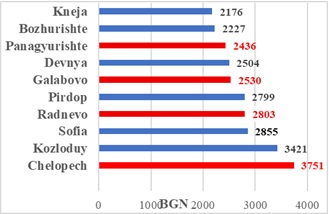
Figure 2. The ten municipalities with the highest average gross monthly salary of employees for 2023
Source: The graph is based on IME data, 265 stories about economics. https://265obshtini.bg/map/534
The settlements with traditions in the mining industry with high income per capita are: Chelopech; Radnevo; Galabovo; Panagyurishte; Etropole; Madan and Zlatograd.
The high profitability achieved is based on the increase in labour productivity, which allows mining companies to pay high wages. According to (Geshkov, 2024) “The basis of increasing labour productivity is effective human resource management.”. According to (Shterev & Milusheva, 2024) “High profitability provides an opportunity for enterprises to increase competitiveness and develop innovative projects”.
Corporate social responsibility
Mining companies in the branch are among the most socially responsible companies. They invest significant funds in training, improving working conditions, and social benefits for their employees. The mining subsector is also key to regional development. It provides jobs, generates high revenues for local municipalities, and supports related industries. The social impact of the mining business on local communities is significant thanks to investments in local infrastructure, improving working and leisure conditions, and providing financial support for socially significant social and cultural projects.
Large and medium-sized companies in the mining industry traditionally implement a number of charitable and donation programs and projects in the communities where they operate.
Investment in environmental protection
The change in environmental protection and restoration costs in the mining industry during the period 2018 ÷ 2022 is presented in Figure 3.
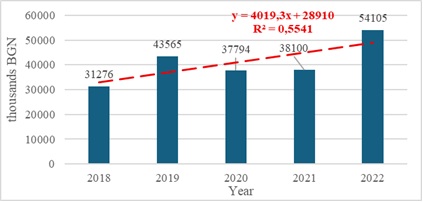
Figure 3. Environmental protection and restoration costs in the mining industry during the period 2018 ÷ 2022
Source: The graph is based on INFOSTAT data compiled by the author.
https://infostat.nsi.bg/infostat/pages/reports/query.jsf?x_2=1695
In 2022, environmental protection and restoration costs in the mining industry accounted for 1.79% of the country’s total.
Environmentally related expenditures in the mining industry have been stable and increasing throughout the period. The derived development trend of the indicator shows that it is growing, and the coefficient of determination justifies a large correlation dependence.
The structure of environmental protection and restoration costs in the mining industry in 2023 is presented in Figure 4.
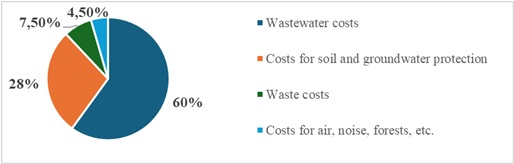
Figure 4. Structure of environmental protection and restoration costs for the mining industry in 2023
Source: The graph is based on INFOSTAT data compiled by the author.
https://infostat.nsi.bg/infostat/pages/reports/result.jsf?x_2=1695
The increase in environmental protection and restoration costs in the mining industry is primarily a result of increasing environmental requirements and strict regulations for enterprises in the Mining and Quarrying subsector. European Union policies (the Green Deal and the waste and water management directives) have a significant impact on the priorities and scale of funding for such projects. Bulgarian legislation further increases the requirements for mining enterprises.
A significant part of the costs of environmental protection and restoration come from voluntary commitments made by businesses. It is also necessary to ensure the implementation of the ESG criteria by which mining companies will be reported.
In recent years, mining companies have implemented a number of good practices, green technologies, and projects to reduce the harmful impact of mining activities on environmental components.
Occupational safety and health
Despite the high risk of injury, mining enterprises are experiencing a steady decline in occupational injuries and lost working days due to occupational accidents. This is due to investments in improving production technologies, working conditions, and personnel training.
No deaths were recorded during the analysed period, and the change in the number of occupational accidents in the Mining and Quarrying subsector is presented in Figure 5.
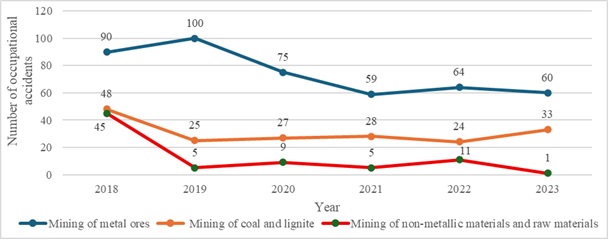
Figure 5. Change in the number of occupational accidents in mining enterprises during the period 2018 ÷ 2023
Source: The graph is based on NSI data, 2025.
The data in Figure 5 shows that the most significant decrease in the number of occupational accidents was achieved in the mining of non-metallic materials and raw materials. A smaller decline was recorded in the mining of metal ores and coal. This is due to the higher risk of occupational accidents in these two mining activities.
Figure 6 presents the change in lost calendar days due to occupational accidents in the mining industry.
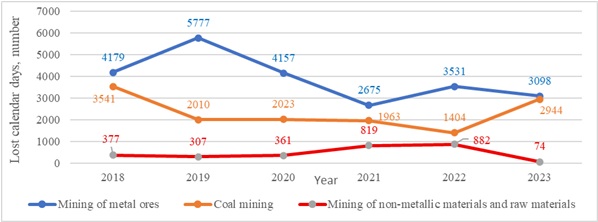
Figure 6. Change in lost calendar days due to occupational accidents in mining enterprises during the period 2018 ÷ 2023
Source: The graph is based on NSI data, 2025.
According to Maintaining healthy and safe working conditions, reducing injuries and morbidity, improving the psycho-climate, and managing all other elements related to human resources, directly or indirectly brings direct or long-term benefits to the existence of the company, its competitiveness, efficiency, ability to bring profit and return on investments.
The decrease in lost calendar days due to work accidents is a signal for improving the occupational environment, staff training, the so-called „golden“ safety rules introduced in the industry, and improving production technologies. All of those lead to a decrease in the severity of work accidents.
Conclusion
The mining industry is a specific sector, because the number of enterprises in 2023 was relatively small (315), but they managed to generate production and added value, which in absolute terms exceeded the production of many other sectors.
The number of enterprises in the mining industry was only 0.07% of all operating companies in the country in 2023, but they generated 0.87% of the total revenue from operations in the national economy and 2.00% of the generated financial result of the activity.
Mining enterprises in Bulgaria in 2023 realised a 230.39% higher profitability of sales revenue than the average and a 257.81% higher of cost-effectiveness of the activity than the average. Due to their high efficiency, mining enterprises provide favourable working conditions and high wages, compared to most other sectors of the economy.
The export of mining products in 2023 constituted 11.38% of the country’s total exports, and the import of mining products was 14.40% of the country’s total imports of goods and services. The trade balance here was also negative and accounted for 11.54% of the country’s negative trade balance in 2023.
Foreign direct investment in mining enterprises in 2023 accounted for 2.90% of that in the non-financial sector.
The importance of the mining industry for Bulgaria’s energy sector is that by 2022 it produced nearly 40% of the country’s energy production based on solid fuels. 2023 and 2024 saw a sharp decline in solid fuel production, which was the result of the decarbonisation of the Bulgarian energy sector in accordance with the implementation of the Recovery and Resilience Plan and the Green Deal. The consequences of this are the loss of the country’s energy independence, difficult balancing of the national energy system, electricity deficit during the dark part of the day and the winter period, which increases the import of electricity and a strong imbalance in the National energy system. These adverse consequences for the National energy system necessitate the postponement or reasonable implementation of some of the measures from the Recovery and Resilience Plan. At this stage of implementation of green technologies in Bulgaria, they do not allow for a drastic reduction in the production of electricity from our coal-fired power plants.
Employment in the Bulgarian mining industry provided over 18 thousand direct and 120 thousand indirect jobs, employed in suppliers, services, logistics, subcontractors and local businesses. Labour wages rose from the fourth place in 2023 to the second place in 2024 after the IT sector. This generated high incomes for the population, high revenues for local municipalities and the country’s budget, and supported related industries.
The social impact of the mining business on local communities has been significant thanks to investments in local infrastructure, improving working and leisure conditions, and providing financial support for socially significant social, cultural, and infrastructure programs and projects.
Environmental protection and restoration costs in the mining industry have been stable and increasing throughout the period.
Despite the high risk of injury in mining, there was a steady decline in occupational injuries and lost working days due to occupational accidents during the analysed period. There has also been a decrease in the severity of work accidents.
Acknowledgements
This study was conducted in connection with the implementation of a contract for financing a research project „Socio-Economic Analysis of the Mining Industry in Bulgaria“ – No МТФ – 203 – 01.04.2025 of the University of Mining and Geology „St. Ivan Rilski“ – Sofia.
NOTES
- National Statistical Institute. (2025). Statistical Yearbook 2024 – https://www.nsi.bg/file/30262/God2024.pdf
References
Escosura, L. P. (2021). Augmented human development in the age of globalization. The Economic History Review, 74(4), 946 – 975. https://doi.org/10.1111/ehr.13064.
Gasper, D. (2002). Is Sen’s capability approach an adequate basis for considering human development? Review of Political Economy, 14, 435 – 461. https://doi.org/10.1080/0953825022000009898.
Geshkov, M. (2024). The application of social networks in contemporary human resource management. Industrial Growth Conference 2024, 290 – 299. https://doi.org/10.53656/igc-2024.34.
Yan, R. (2023). The importance of socio-economic research: Unveiling the dynamics of human progress in societies and economies. Neuroscience and Psychiatry: Open Access, 6(3).
Shterev, N. & Milusheva, V. (2024). Competitiveness of textile producers in Digital business era. Strategies for Policy in Science & Education, 32(3s), 29 – 41. https://doi.org/10.53656/str2024-3s-3-com.
Shterev, N., Milusheva, V., Biolcheva, P., Ivanov, I. & Geshkov, M. (2023). Razvitie na minnata promishlenost v Bŭlgariya prez perioda 1990 – 2020 g.: Obzor. Minno delo i geologiya, (5 – 6), 50 – 63.
Terzieva, A. (2024). Research of the investment activity in the enterprises of the “manufacturing of textile clothing” sector. Industrial Growth Conference 2024, 234 – 245. https://doi.org/10.53656/igc-2024.21.
Assoc. Prof. Veselin Mitev, DSc.
ORCID iD: 0000-0001-9905-6490
University of Mining and Geology “St. Ivan Rilski”
Prof. Boyan Kamenov St.
1700 Sofia, Bulgaria
E-mail: v.mitev@mgu.bg

Свързани статии:
 PUBLIC ADMINISTRATION THROUGH THE AGES: HISTORICAL MODELS, INSTITUTIONAL TRANSFORMATIONS, AND CONTEMPORARY PARADIGMS
DIGITAL CHALLENGES IN ONLINE RETAILERS: IDENTIFYING BARRIERS TO SUSTAINABLE TRANSFORMATION
AGILE TALENT IN MODERN BUSINESS ORGANIZATIONS – A BIBLIOMETRIC ANALYSIS
EXPLORING CONSUMER PERCEPTIONS OF DIGITAL MARKETING PRACTICES WITHIN INDUSTRY 4.0: AN EMPIRICAL STUDY ON THE INTERPLAY OF PERSONALIZATION, AUTOMATION, AND TRUST FORMATION
