



Blagoyka Paleva-Kadiyska, Vitan Galabov
Todor Kableshkov University of Transport, Sofia, Bulgaria, Technical University, Sofia, Bulgaria
https://doi.org/10.53656/isct-2025.19

Pages 235-244
Abstract. The functional approach (method) for structural-dimensional synthesis of mechanisms has been applied for type synthesis of guidance mechanisms with a four-bar topological structure. According to the method, their typological structures are synthesized by superimposing a three-bar conditioned open kinematic chain, including a base (fixed link), an initial and an end link, with a control functional generator mechanism of a different type, kinematically connecting the base, with the end link of the chain at a relative stand the initial link.
The type synthesis also includes a possible replacement of some links and the kinematic lower pairs assigned to them in the structure of the mechanism, with profiled kinematic higher pairs. This completely determines the type of mechanism. In this sense, a topological structure of a mechanism with kinematic higher pairs means that these pairs are reduced to kinematic lower pairs. Thus, guidance cam mechanisms with two moving links, after kinematically replacing the cam pair with two kinematic lower pairs, have a four-bar topological structure, as do the mechanisms analysed in this article.
The purpose of this study is to apply the functional method for structural-dimensional synthesis of mechanisms for type synthesis of guidance planar mechanisms with a four-bar topological structure, including a three-bar conditionally open kinematic chain and a control functional generator mechanism of a different type.
A type systematics of guidance planar mechanisms with a four-bar topological structure was carried out in two stages: determination of the types of three-bar conditionally open kinematic chains; determination of the types of control functional generator mechanisms. Guidelines/Directives are given for the preliminary and final determination of the type structure of a guidance mechanism before the engineer proceeds to its dimensional synthesis.
Keywords: type synthesis; topological synthesis; cam mechanisms
- Introduction
The terminology used in publications related to the synthesis of mechanisms is not unambiguously stated (unalterable). Researchers [1, 2], mostly European, divide the synthesis of mechanisms into two stages: 1) structural synthesis, including the selection of a structural diagram of the mechanism, which clarifies the type of mechanism, the number of links and kinematic pairs, their type, and alignment; 2) kinematic synthesis, in which the geometric parameters of the mechanism diagram in its project position are determined according to given geometric and kinematic conditions.
Sandor and Erdman [3] divide the field of mechanism synthesis into two categories: 1) type synthesis, in which a presumed type of mechanism is determined (lever, cam, gear, or other type) and includes the subcategory of integer (Diophantine, number) synthesis [4, 5]; 2) dimensional (dimensioning) synthesis, in which the mechanism diagram is dimensioned [6]. The terms dimensional and kinematic synthesis are often seen as synonyms [7]. Kinematic synthesis is often complemented by dynamic synthesis under given dynamic conditions.
In integer synthesis, the configurations of mechanisms are defined topological, but not dimensional. Therefore integer and topological synthesis are perceived as synonyms. In topological synthesis, topological structures of mechanisms are built, determined by the number of their links, the number of their kinematic lower pairs (without distinguishing between rotating and sliding), and their alignment [6, 7, 8]. These structures are represented as non-dimensional lever mechanisms with only kinematic lower pairs.
Methods for generating topological kinematic structures of mechanisms can be divided into four types [9], based on: – the groups of Assur [1]; – closed kinematic chains in Franke and Gruebler notation [10]; – closed kinematic chains in graph notation [11]; – combinations of the above methods [12].
Type synthesis is usually identified with the systematization (classification) of mechanisms. Instead of type synthesis, the term typological synthesis is often used. Most authors consider topological synthesis to be the first phase of the typological synthesis of mechanisms. In type synthesis, typological structures of mechanisms are built, determined by the number of their links, the number and type of their kinematic pairs (lower and higher), and their arrangement [6, 8].
The type synthesis also includes a possible replacement of some links and the kinematic lower pairs assigned to them in the structure of the mechanism, with profiled kinematic higher pairs. This completely determines the type of mechanism. In this sense, a topological structure of a mechanism with kinematic higher pairs means that these pairs are reduced to kinematic lower pairs. Thus, guidance cam mechanisms with two moving links, after kinematically replacing the cam pair with two kinematic lower pairs, have a four-bar topological structure, as do the mechanisms analysed in this article.
In Bulgarian technical terminology, the concepts of kinematic (structural and dimensional) and dynamic synthesis have been adopted. The terms topological and typological synthesis also appear in scientific publications, as well as in this article, as stages of structural synthesis.
After a critical analysis of the methods for structural synthesis, Galabov [9] proposes a functional approach for the structural-dimansional synthesis of mechanisms. According to the method, the mechanisms are built from interconnected conditionally open kinematic chains (OKC) with different functional purposes, in which they form closed chains of control functional generator mechanisms (CFGM), the frame (base) of which are movable links of the chains. According to the method, the typological structure of elementary guidance mechanisms is formed by superimposing a three-bar conditionally open kinematic chain, consisting of a frame (base), an initial link and an end link, connected in series with kinematic lower pairs, with a control functional generator mechanisms of a different type, which kinematically connects the frame with the end link, respectively, as the input and output link of the control functional generator mechanism, with a relative base the initial link.
The purpose of this study is to apply the functional method for structural-dimensional synthesis of mechanisms for type synthesis of guidance planar mechanisms with a four-bar topological structure, including a three-bar conditionally OKC and a CFGM of a different type.
- Type classification of planar lever mechanisms with a four-bar topological structure
To determine the structures of the anisomorphic functional generator and guidance four-bar mechanisms, according to the now classic approach for structural synthesis of mechanisms based on closed loops, we start from a structural graph of a quadrilateral closed kinematic chain (Fig.1 – first row). Lines indicate the links, and circles indicate the kinematic lower pairs, without distinguishing between rotating (R-pairs) and sliding (P-pairs). This graph illustrates the topological structure of four-bar lever mechanisms. By introducing all possible combinations without repetitions of rotating  and sliding
  kinematic pairs, four anisomorphic type structures (from I to IV) of four-bar closed kinematic chains are obtained (Fig.1 – second row).
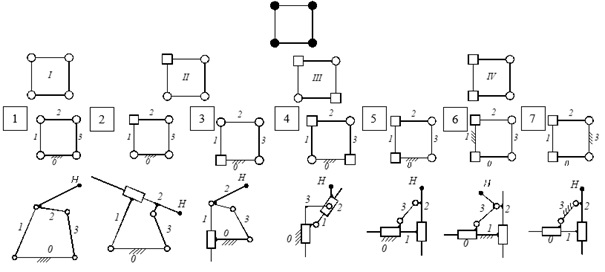
Figure 1. Anisomorphic structures of four-bar mechanisms
From these chains, with different choices of the base (link assumed to be fixed), the type structures of seven types of four-bar mechanisms are obtained (Fig.1 – third row). With the initial and final link (links 1 and 3) kinematically connected to the fixed link 0, the first 5 type structures of functional generator four-bar lever linkages are obtained. The next two structures (5 and 6) have bases, respectively, links 1 and 3. Next to each structure, in the last row of Fig. 1, a kinematic diagram (dimensioned type structure after dimensional synthesis) of a linkage functional generator mechanism is given: 1) four-bar mechanism; 2) slotted link mechanism; 3) slider-crank mechanism; 4) tangent mechanism; 5) sinusoidal mechanism; 6) ellipsograph mechanism; 7) Oldham coupling mechanism.
Guidance four-bar mechanisms are obtained if the executive links are those with a common planar movement (links with number 2 for diagrams 1 to 5), which, with their so-called characteristic point H describe desired trajectories. For the mechanisms of diagrams 6 and 7, the units with common planar motion are 3 and 1, respectively. The trajectories of all points of the sinusoidal mechanism (diagram 5) are circles with a radius equal to the length of the crank 3, since the link 2 performs a circular translation. The trajectories of the points on the plane of link 3 of the ellipsograph mechanism (diagram 6) are ellipses.
- Type classification of planar guidance mechanisms with a four-bar topological structure
According to the functional method for structural-dimensional synthesis of mechanisms [9] the type structure of the considered class of mechanisms is synthesized by superimposing a three-bar conditionally OKC, consisting of base 0, initial link 1 and end link 2, connected in series with kinematic lower pairs (Fig.2, first row), with a CFGM, which kinematically connects base 0 with end link 2, respectively, as input and output links of the OKC with relative base initial link 1.
The type synthesis of these mechanisms involves two stages.
Stage 1 – Determination of the types of three-bar conditional OKC
Four anisomorphic structures of three-bar OKC are possible, which can be denoted by the symbols of the kinematic pairs between the links: RR, RP, PR and PP. The chains have two degrees of freedom, and if they remain open, two controlled motors are required, one for each moving link. The choice of the OKC structure depends on the specific problem and the possibilities for structural decoupling of motion. Chains with RR structures have a universal purpose. They are suitable for mechanisms designed to generate trajectories close to an arc of a circle, cycloid, epicycloid, hypocycloid, ellipse, straight line segment, polygons with rounded vertices or with cuspate points, etc.. Considering also the favorable design and performance characteristics of R-pairs, OKC with RR-structure are preferable except in cases where the trajectory is close to rectilinear with a relatively large stroke. In such cases, chains with PR-structure usually have the advantage.
For helical trajectories, chains with RP-structure are preferable. This structure, with length l1 = 0 of initial link 1, is suitable for curves described in polar coordinates. It allows for decoupling (independence) of the equal rotation of links 1 and 2 from the rectilinear translation of link 2. But in this case, two CFGMs are needed. Each of them, independently of the other, changes one of the polar coordinates of the characteristic point H, describing the target trajectory [9].
The PP-structure is also suitable for curves described in Cartesian coordinates. It allows for decoupling of the rectilinear translations of link 1 relative to frame (base) link 0 and of link 2 relative to link 1. And in this case, two CFGMs are needed, each of which, independently of the other, changes one of the Cartesian coordinates of point H. In both decoupled of OKC structures, it is possible to drive two cams and links 1 and 2, respectively, with one motor and functional generator mechanism (for example, a gear). But in this case, the mechanism no longer has a four-bar topological structure.
A precise choice of one of the selected competitive structures can be made after dimensional the OKC, determining the transfer functions of the CFGM, and their kinematic diagrams. These are tasks of the dimensional synthesis of this class of mechanisms that remain to be solved.
Stage 2 – Determination of the types CFGM
The elementary way to close a three-bar OKC is to connect the fixed link 0 with the end link 2 with a binary link 3 (the last column in Fig.1). A guidince four-bar linkage is formed, in which a linkage CFGM is built. The structure of these elementary linkages can be considered topological if the dimensions and the difference between the rotating and sliding pairs are ignored.
Different types of guidance mechanisms with a four-bar topological structure are presented in four columns in Fig.2 with RR, RP, PR, and PP structures of conditional OKC, respectively. CFGM on the second row in Fig.2 (diagrams 1, 2, 3, and 4) is cam mechanism with an input cam fixed to the base 0 and an end link 2 with a roller. By changing the positions of the cam and the roller, a mechanism with an output profiled link is obtained (inverse cam mechanism).
CFGM on the third row in Fig.2 (diagrams 5, 6, 7, and 8) has two cams. The input link is the cam fixed to the frame 0, and the other cam is fixed to the end link 2. If the cams are formed along the centroids of the relative motion with respect to the relative position 1 of the CFGM, then the is a centrode mechanism. If the profile of the cam contacting link 2 is rectilineal, a control cam mechanism with a flat output link will result – a plate slider or a flat-face. When the positions of the cam and slotted link are changed, the profile of the cam towards base 0 is rectilineal. An inverted cam mechanism is obtained.
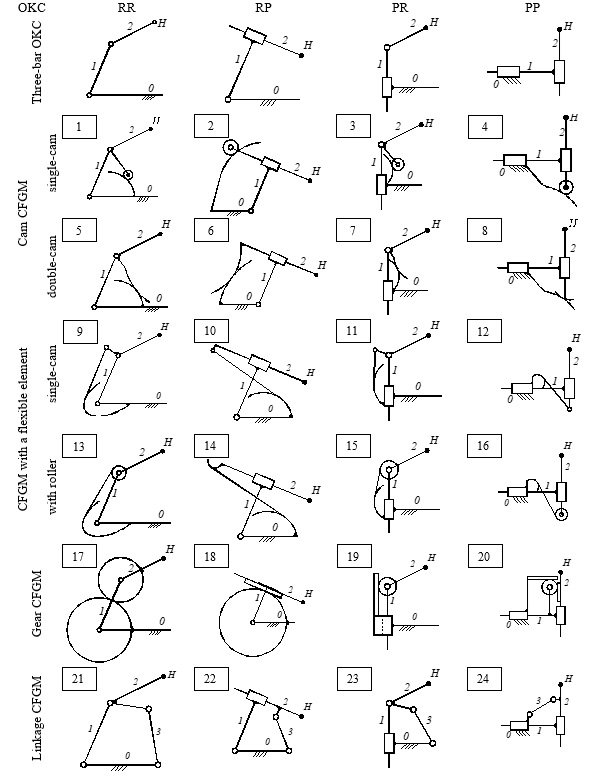
Figure 2. Anisomorphic three-bar OKC and guidance mechanisms with a four-bar topological structure
The CFGM in the fourth row in Fig.2 (diagrams 9, 10, 11, and 12) are mechanisms with a flexible inextensible element (tape, cord, timing belt, multi-strand steel rope, etc.), hingedly connected to the end link 2. If the cam is fixed to link 2, and the flexible link is joined to frame 0, then an inverse mechanism with a flexible element (band mechanism) is obtained.
The CFGM on the fifth row in Fig.2 (diagrams 13, 14, 15 and 16) is a band mechanism with a roller end link 2. By changing the positions of the cam and the roller, an inverse mechanism with a flexible element with roller input link 0 is obtained. If the roller is non-circular, a double-cam band mechanism is obtained.
The CFGM of the sixth row in Fig.2 (diagrams 17, 18, 19, and 20) is a gear mechanism with two circular gears (diagram 17) or with non-circular gears, with a gear and a rack (diagrams 18 and 19) or a gear and two racks (diagram 20).
The possibilities for generating different trajectories with guidance mechanisms are unusually large, even with CFGMs with a constant transfer ratio. For example, with different transfer ratios i of the CFGM and ratios α = l1/ l2 of the lengths l1 and l2 of links 1 and 2, 84 typical trajectories are obtained, of which: • λ = 1 and > 1 the curves of Gvido–Grandi, of which at = 4 four–leaf clover; • λ = 2 and = 3 the curves of Steiner; • λ = 3 and = 4 the asteroid; • = 1/2 Pascal‘s snails, of which at λ = 1/2 the cardioid; • = 2 different ellipses, at λ = 1 a straight line segment, and at l2 = 0 a circle, etc.
Curves with cuspate points are obtained at λ = – 1, and at λ = – ( – 1)2 – curves with flat (rectifiable) points. The geometric meaning of the sign (–) means that flat points are obtained when the links of a conditional OKC are folded.
CFGM of the sixth row in Fig. 2 (diagrams 21, 22, 23, and 24) are four-bar mechanisms. They can be considered as particular cases of functional generator mechanisms with a kinematic higher pair, for example, a cam mechanism with a cam profiled along an arc of a circle. They can also be considered as particular cases of band mechanisms, in which the cams are folded into points (joints) and the flexible element is replaced by a connecting lever. If the two points are extremely distant, then they define the axes of two R-pairs of the connecting lever, as can be seen from diagrams 21, 22, 23, and 24. In the RR-structure of a conditional OKC, the following is obtained: a four-bar mechanism (diagram 21); in the RP-structure – a slider mechanism with one slider (diagram 22); in the PR-structure – a crank-slider mechanism (scheme 23); in the PP-structure – an ellipsographic mechanism (diagram 24).
With an infinitely distant center of rotation between links 0 and 3, a second slider appears in the slotted lever mechanism of diagram 22. A slotted lever mechanism with two sliders (in particular, tangential) is obtained, located between joints (Fig.1, diagram 4). When changing the base (from link 0 to link 1) of the ellipsographic mechanism (diagram 24), a sinusoidal mechanism is obtained (Fig.1, diagram 5). If the base is link 3, then an Oldham coupling mechanism is obtained (Fig.1, diagram 6) with a gear ratio of 1.
The choice of CFGM depends on the specific problem and the possibilities for structural decoupling of motions. If there is no requirement for the accurate generation of a given trajectory, it is logical to seek a solution with a lever CFGM. The engineer may choose such a choice of CFGM if a stable, relatively large-sized mechanism is required, dictated by target trajectories with relatively large sizes. Examples of this are the main mechanisms of specialized robots, heavily loaded manipulation mechanisms of lifting and handling machines, etc.
On the other hand, lever CFGMs are usually preferred as micro mechanisms and even grippers, due to their relatively smaller mass compared to other types of CFGMs. Driving the grippers with a linear motor predetermines the introduction of a slider as an input link and a crank-slider CFGM. When synthesizing such and other guiding lever four-bar mechanisms, for a given input-output force ratio, it is possible that the intermediate joint between the crank and the connecting rod on the CFGM may be unacceptably distant from a technical viewpoint. Then it is appropriate to replace this joint with a slider, and then perform dimensional synthesis again. The probability of obtaining a successful technical solution is now significantly higher.
Engineers most often turn to cam-type CFGMs for incorporation into structures of strictly guidance CFGMs with relatively small sizes. Typical examples are magnetic tape memory mechanisms in storage devices. The same applies to gear CFGMs of robots in microtechnology, with the exception of those with gear racks, when they are used for translations over significant distances, for example, in some manipulators and metal-cutting machines.
Various manipulation mechanisms of specialized robots and lifting and handling machines incorporate CFGMs with flexible links, as they enable them to transmit movements and forces over significant distances. A number of applications of these CFGMs are also found in various devices and robots, including robots in microtechnology.
The question of choosing the type of CFGM remains open in cases where several types of CFGM, determined after preliminary selection, successfully compete as the first stage of the typodimensional synthesis method. According to the method, a joint dimensional synthesis of competing types of mechanisms with a common mathematical model is performed. The prospective kinematic diagrams are determined, from which a final choice is made by type and size of the CFGM according to an objective function, which is composed of quantitative estimates and weight coefficients of selected optimization criteria. But this is not the subject of this article.
Conclusion
The functional method for structural-dimensional synthesis of mechanisms for their type synthesis of the considered class of guidance mechanisms with a four-bar topological structure has been applied. According to the method, the type structure of elementary guidance mechanisms is synthesized from the stratification (lamination) of a three-bar conditionally OKC. The kinematic chain is composed of a fixed link, an initial link, and an end link. They are connected in series with kinematic lower pairs, with a CFGM of a different type, which kinematically connects the base with the end link, respectively, as the input and output link of the CFGM with a relative fixed link, the initial link.
A type classification of planar guidance mechanisms with a four-bar topological structure has been done. Two stages of type-dimensional synthesis are distinguished: (1) determination of the types of three-bar conditionally OKC; (2) determination of the types of CFGMs.
Recommendations are given for preliminary and final determination of the typological structure of a conditionally OKC and the type of the CFGM. This guides the engineer to the most appropriate typological structure of a guidance mechanism according to the technical problem set, before proceeding to its dimensional synthesis.
REFERENCES
[1] ARTOBOLEVSKY I. I., LEVITSKYI N. I., CHERKUDINOV S.A. Synthesis of plane mechanisms. Moscow, Fizmatgiz, 1084 p., 1959 (in Russian).
[2] LICHTENHELDT, W. , LUCK, K., Konstruktionslehre der Getriebe, Akad.-Verlag, Berlin, 354 p., 1979.
[3] ERDMAN, A. G., SANDOR, G. N., Mechanism Design: Analysis and Synthesis, Prentice-Hall Inc., New Jersey, Vol. 1, 1984, 2-nd Edition, 1991, ISBN 978-0-13-573536-7.
[4] JOHNSON, R. C., TOWFIGH, K., Application of Number Synthesis to Practical Problems in Creative Design , ASME Paper No. 65 -WA / MD -9, 1965.
[5] TISCHLER, C. R., SAMUEL, A. E., HUNT, H. K., Kinematic Chains for Robot Hands – I Orderly Number Synthesis, II – Kinematics Constrains, Classification, Connectivity and Actuation, Mech. Mach. Theory, Vol. 30, No 8, pp. 1193-123, 1995, ISSN 0094-114X. DOI 10.1016/0094-114X(95)00045-8.
[6] ERDMAN, A. G., (editor) Modern Kinematics, John-Wiley & Sons, Inc. New York, 604 p., 1993, ISBN 978-0-471-55459-2.
[7] TERMINOLOGY for the Theory of Machines and Mechanisms, Mech. Mach. Theory, Vol. 26, No. 5, pp. 453-539, 1991, ISSN 0094-114X, doi 10.1016/0094-114X(91)90054-2.
[8] OLSON, D.G., RILEY D. R., ERDMAN, A. G., A Systematic Procedure for Type Syntsesis of Mechanisms with Literature Revew, Mechanism & Macine Theory, Vol. 20 (4), pp. 285-295, 1985, ISSN 0094-114X, doi 10.1016/0094-114X(85)90032-1.
[9] GALABOV V., Structural & Dimensional Synthesis of Mechanisms, DSc-technical sciences dissertation, TU – Sofia, 491 p., 1998. (in Bulgarian).
[10] CROSSLEY, F. R. E., A Contribution to Gruebler’s Theory in the Number Synthesis of Planar Mechanisms, Trans. ASME, J. of Eng. for Industry, Ser.B, Vol. 86, No 1, pp. 1 – 8, 1964, ISSN 0022-0817, doi 10.1115/1.3670494.
[11] CROSSLEY F. R. E., The Permutation of Kinematic Chains of Eight Members or Less from the Graph Theoretic Viewpoint, Developments in Theoretical and Applied Mechanics, Pergamon Press, Oxford, Vol. 2, pp. 467 – 486, 1965.
[12] KONSTANTINOV, M., Strukture der Mechanismen und Roboter, Wissenschaftliche Zeitschrift der Technischen Universitat Dresden, 38, Heft 5/6, pp. 159-167, 1989.
Prof. Vitan Galabov, DSc.
ORCID iD: 0009-0001-1527-6099
Technical University-Sofia
8, Kl. Ohridski Blvd., 1000 Sofia, Bulgaria
E-mail: vgalabov@abv.bg
Dr. Blagoyka Paleva-Kadiyska, Assoc. Prof.
ORCID iD: 0000-0002-8514-4542
Todor Kableshkov University of Transport
158, Geo Milev St., 1574 Sofia, Bulgaria
E-mail: paleva-kadiyska.bl@abv.bg; bip-kadiyska@vtu.bg

Свързани статии:
 Classification and Evaluation of Methods for Determining Railway Infrastructure Capacity
Integrating the Valorization of External Transport Costs into the Efficiency Assessment of Road Infrastructure Investment Prioritization
Performance Management in Automotive Companies: Trends, Technologies, and Workforce Strategies in 2025
Prediction of Train Derailment Locations Using Artificial Neural Networks
Classification and Evaluation of Methods for Determining Railway Infrastructure Capacity
Integrating the Valorization of External Transport Costs into the Efficiency Assessment of Road Infrastructure Investment Prioritization
Performance Management in Automotive Companies: Trends, Technologies, and Workforce Strategies in 2025
Prediction of Train Derailment Locations Using Artificial Neural Networks