

Ilian Minkov
University of Economics, Varna, Bulgaria
Vladi Kurshumov
University of Economics, Varna, Bulgaria
https://doi.org/10.53656/igc-2025.01

Pages 11-19
Abstract. An important element and prerequisite for market recognition of business organizations in the dynamically changing business environment is the company motto (slogan), an element of their official company culture. The purpose of the report is to identify the role of the motto in the Bulgarian business organizations’ official culture, announced on the Internet and its place in the communication policy pursued by them. The results of the study show that the company motto has an ambiguous role in the official culture of Bulgarian companies, and in B2C-oriented sectors it has a significantly more important position than in B2B businesses.
Keywords: motto; official culture; business organizations; Internet
JEL: M14, M31
Introduction
Business organizations develop their economic activities in a dynamically changing environment under the influence of established market principles. It is important for every organization to have recognition among consumer segments, which in turn ensures the necessary market presence and maintains a high level of competitiveness. An important element and prerequisite for market recognition is the company motto (slogan). It can be defined as an expression or sentence describing the idea of the organization’s existence and its competitive advantages. The role of the company motto is extremely important for the correct positioning of the offered products and services, as it is part of the portfolio of the official corporate culture of companies and a tool of their communication policy.
It makes an impression that at present there is a lack of sufficient research focusing on the degree of use of the motto and its position in the official corporate culture of organizations in Bulgaria. Some studies conducted by us in individual sectors of the Bulgarian economy can be noted, as well as the two large-scale studies by K. Dimitrov et al. of companies that are members of large employer organizations (Dimitrov et al., 2018; Dimitrov et al., 2024), which are aimed at studying the publicized corporate culture and the place of the motto in it. In this regard, the aim of the paper is to identify the role of the motto in the Bulgarian business organizations’ official culture, disclosed on the Internet and its place in the communication policy pursued by them.
Literature Review
Some authors define the company slogan as a “weapon of choice” in the context of market wars between automotive giants (Schoenberger, 2012). Dass, Kohli & Acharya (2023) pay attention to the brand alignment between the brand identity and the company slogan, proving the positive influence of factors such as slogan’s clarity, creativity of the transmitted message and the inclusion of product benefits. The approach to studying the company slogan adopted by Briggs & Janakiraman (2017) is interesting, in which the authors link its recognition to the nature of the information that consumers use when making a purchase decision. In this sense, the influence of the recognition of the advertising slogan on the brand assessment is greater when individuals do not make a purchase decision based on external sources of information. At the same time, managers will get a greater return on investment in advertising slogans when selling products with a low level of engagement.
The company motto can be considered one of the key elements that form the brand identity (Abdollahnezhad et al., 2024; Kohli et al., 2007). As a tool for communication with consumers, the motto performs multiple functions, including informational and identification. The information function consists of the ability of the company, through its motto, to inform consumers about the most essential aspects of its business activity and the products and services offered, i.e. key message delivery. When the motto finds a place in the minds of consumers and they begin to identify it with the products and services of a company, the identification function manifests itself. Gaikwad (2025) completes the functional purpose of slogans, adding that they: develop brand recall, reinforce advertising promotions, accelerate brand positioning, boost uniformity by providing a unified message in different marketing campaigns, encourage the consumer to take action, develop brand storytelling, etc. In addition, the main two goals of the motto are 1) increasing brand recognition and 2) creating, maintaining or changing the brand image or perceptions, i.e. its positioning or repositioning (Kohli et al., 2007). The effective manifestation of the above functions, however, depends exclusively on the linguistic characteristics and linguistic features of the motto. In their study, Hodges, Estes, and Warren (2024) concluded that shorter slogans, composed of simpler and more frequently used words, including those with abstract meanings and that do not contain brand names, are more liked by consumers, but less memorable. At the same time, relatively long slogans, consisting of more complex, specific and less commonly used words, including brand names, are less liked by consumers, but stand out as more memorable. A similar thesis is supported by Kohli, Leuthesser, Suri (2007), who, however, recommend avoiding the rule of simplifying slogans, which, in their opinion, does not have the desired effect on consumers. According to these authors, slogans that encourage consumers to process information more deeply have a greater chance of standing out and being remembered among the many vague commercial messages that people are exposed to every day. An important factor for success in this case is the managers’ confidence that consumers truly understand the message being delivered. In this sense, as Miljković (2025) claims, when formulating a slogan it is important to identify and analyze consumer behavior, needs, desires, psychological characteristics, habits and other social and demographic features in advance, and company slogans can be divided into the following groups: 1) slogans related to a psychological factor; 2) slogans related to emotions; 3) slogans containing a humorous component; 4) related to consumer needs; 5) those that distinguish the characteristics of a given product and 6) those that undergo change but retain the brand identity (Miljković, 2025).
In summary, a company motto is an important element of the overall organizational culture and through its effective planning, it can be a powerful tool for developing a business organization and stimulating sales. The process of building a company motto is of a strategic nature for companies and should be adequately integrated into their communication strategy.
Methodological tools and research results
The methodology of the study is consistent with the scientific goal set in the paper, on the basis of which the specific research methods were selected. The methodological tools used include determining relative quantities, the method of comparison and content analysis. The study is focused on the following areas:
– Establishing the relative share (in %) of companies whose web pages disclose information about their motto.
– Determining the rank of the motto among other elements of publicized official culture, disclosed on the Internet.
– Revealing the main accents in the content of the companies’ mottos from the studied economic sectors.
The study is conducted under the following restrictive conditions:
– It is carried out based on data from the official websites of the companies included in the sample.
– The sample includes only business organizations that disclosed at least one element of publicized culture1 on their websites. These are 12 beer manufacturers, 8 courier service companies, 23 construction companies, 37 meat processing companies, and 22 insurance companies.
– Bulgarian economy sectors covered by the research, are those in which the publicized online official culture is a component of the companies’ communication policy. The findings and conclusions are valid only for these sectors, and not for Bulgarian business as a whole.
– The results show that the motto is not among the priority elements of the official culture of Bulgarian business organizations, with its average level of disclosure being 26.04 %. Nevertheless, significant differences can be identified between individual sectors, with the range between those with the highest and lowest level of disclosure being almost 60 % (Fig. 1).
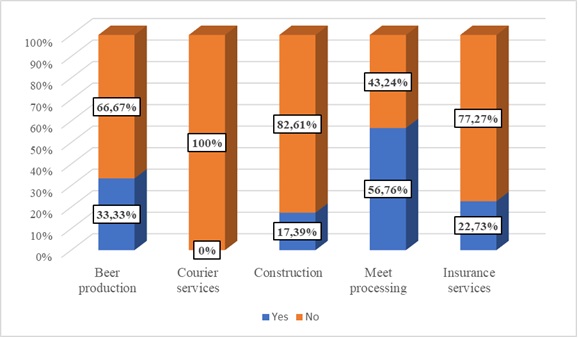
Figure 1. Relative share (in %) of organizations that have announced a company motto
In this regard, if a conditional distinction is made between the degree of publicity of the motto as very high, high, medium and low2, then some trends can be outlined for the studied sectors of the Bulgarian economy.
First, no sector reports a high level of proclamation of a company motto. This is evidence that for companies in the Bulgarian economy as a whole, the use of the slogan and its advertising impact is not perceived by managers as a particularly important part of the organizations’ communication policy.
Secondly, only in the meat processing sector a high level of slogan disclosure is observed, as this is done by over half (56,76 %) of the researched enterprises. We believe that this is completely natural having in mind their orientation towards end customers and their desire to differentiate themselves from competitors. A significant factor is the market structure of the sector, characterized by a large number of companies operating under conditions of monopolistic competition.
Third, in the remaining business activities, a medium or low level of motto disclosure is registered, with no company in the courier services sector publicizing a motto on its website. This confirms the conclusion made above about motto’s relatively more peripheral role in the official publicized culture of companies in the majority of Bulgarian business.
Another direction of the research is determining the rank of the motto among the other elements of the companies’ official corporate culture (Table 1).
Table 1. Rank (position) of the motto among other elements of publicized culture
| Rank
Sectors |
Towards all elements of culture |
Towards the secondary elements of culture |
| Beer production | 2 | 2 |
| Courier services | 7 | 4 |
| Construction | 6 | 3 |
| Meat processing | 1 | 1 |
| Insurance services | 6 | 3 |
Overall, the results obtained are consistent with the findings made so far. In the meat processing sector, where the highest level of disclosure was reported, the motto ranks first. At the same time, in the sectors “Construction”, “Insurance services” and “Courier services” it occupies the penultimate or last position in importance among the other elements of the official publicized culture, relevant to its identified low degree of proclamation. It is striking, however, that among beer producers, the motto is positioned in second place, while at the same time only a third of the companies have announced it on their websites. In view of this, in order to seek an answer to this question, as well as to establish the actual lag of significance/insignificance of the motto in each of the studied sectors, the range (in percentage points) between the degree of its disclosure and the first-ranking element of culture can be determined (Fig. 2).
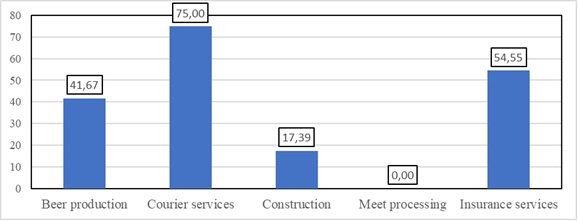
Figure 2. Difference (in percentage points) between the degree of disclosure of the motto and the first ranked element of culture
The average level of “distance” of the motto from the first-ranking element of the official culture is 37.72 points, logically it is most significant in the courier3 (75) and insurance4 (54,55) service sectors. Two things stand out:
- The large distance between the degree of motto disclosure in Beer production sector compared to the first ranked element5 (41,67 points) despite the fact that in this sector the motto occupies the second place. This result explains the discrepancy noted above, since in the sector there is clearly one very significant element, with a high degree of disclosure, while the following ones are of much lower importance for the transmission of strategic messages to stakeholders.
- 2. The relatively low difference to the leading elements in the „Construction“ sector – only 17,39 points, considering the penultimate position of the motto among the other elements in the official culture portfolio. This feature is a result of the low level of disclosure of official culture on the Internet for this sector as a whole, therefore even the leading elements have a low relative share among the companies that have disclosed them. For these reasons, it can be stated that for the construction business, the motto is actually almost as insignificant as the other elements of culture.
Regarding the content analysis of real proclaimed company slogans, their messages are presented in Table 2.
Table 2. Motto/ creed/ slogan of the companies in the studied sectors of the Economy
| Sector | Motto/Creed/Slogan |
| Beer production | “Independent, close-knit family” (Britos EOOD)
“We create a better world” (Zagorka AD) “Every sip has a story” (Kamenitza AD) “We think differently” (Glarus Craft Brewing) |
| Construction | “We build buildings that inspire” (Spedstroy EOOD)
“To construct the future, you need to dive deep” (Hydroremont – IG OOD) “What needs to be done” (Perinov and sons EOOD) „Discover the road” („BGLand.Co” AD) |
| Meat processing | “From our family to your family” (Dimitar Madzharov – 2 EOOD)
“Pleasure from things made with love” (Karol Fernandez Meat OOD) “The power of good food” (Tandem-V OOD) “The art of creating standards” (Sami-M EOOD) “I know what I eat” (Borimes OOD) “Try and you will repeat” (“Bozmov” EOOD) “To the client with love” (Elko Mes OOD) “The table tells the story …” (Lotos OOD) “Delicious, clean, native …” (Bilyana OOD) “The taste above all” (Vlanel OOD) “The heavy word for light food” (Gala Invest Holding AD) “Quality and tradition” (Elit Mes Minev – Rodopa – V.T. OOD) “The best guest at the table” (Intermes OOD) “Quality from the Balkans” (KOOP Doverie Lesidren) “100% Good food, Good mood!” (Maleventum Maron OOD) “And you will be satisfied!” (Lalov and Vachev EOOD) “For the grill masters” (O Skari OOD) “Fresh Bulgarian meat from the farm to your table” (Mesoni OOD) “Tried and tested” (Pleven Mes OOD) “Quality raw materials – high quality product” (R.A-03-Bobi OOD) “Sausages prepared with love” (Stefanov-Ivan Stefanov-04 EOOD) |
| Insurance services | “With care for you” (Bulgaria Insurance)
“Affordable security” (OZK-Insurance) “Building on solid foundations” (Euroins) “Insurers creating trust” (Groupama Zastrahovane) “We help you succeed and grow!” (Bulgarian Export Insurance Agency) |
It is evident that the messages conveyed in company slogans are specific to each of the studied sectors of the economy, determined by the nature and characteristics of their business activities. Nevertheless, there are also significant differences in the advertising slogans of companies from each sector, dictated by their desire to differentiate themselves from competitors and create a unique image of their products/services in consumers perception. In this regard, some slogans emphasize a better future, others – on the emotions and experience of customers, others – on the quality of the products/services offered, etc. In our opinion, each message expresses in a direct and immediate way the philosophy contained in the mission and values of the respective organization.
Conclusion
The results of the study show that the company motto has an ambiguous role in the official corporate culture of Bulgarian business organizations. In B2C-oriented sectors, it has a significantly more important role than in B2B businesses, given the differences in the importance of advertising in each of them. The important thing is that regardless of sector affiliation, the motto is always a reflection of the priorities set in the company’s value system. In connection with its role in the communication policy of companies, the subject of future research is the question of the impact of the motto on consumer perceptions, and the impact on the market and economic results of companies.
NOTES
- The elements of the publicized company culture are divided into primary ones – mission, vision and values, and secondary ones – business credo, motto, company history, CSR and code of ethics.
- Low level of disclosure (0% – 25%); medium level of disclosure (25.01% – 50%); high level of disclosure (50.01% – 75%); very high level of disclosure (75.01% – 100%).
- In this sector, CSR is a leading element
- In this sector, a leading element is the company history
- In this sector, a leading element is the company history
References
Abdollahnezhad, F., Reza, А., Bahrololoum, H., & Rajabi, M. (2024). Bibliometric analysis of brand slogan in event tourism. Sports Business Journal, 4(2), 13 – 33. https://doi.org/10.22051/sbj.2024.46243.1138.
Briggs, E., & Janakiraman, N. (2017). Slogan recall effects on marketplace behaviors: The roles of external search and brand assessment. Journal of Business Research, 80, 98 – 105. https://doi.org/10.1016/j.jbusres.2017.07.010.
Dass, M., Kohli, C., & Acharya, M. (2023). An investigation into slogan design on creating slogan–brand alignment: message clarity and creativity enhance while jingles and rhymes weaken alignment. Journal of Advertising Research, 63(2), 43 – 60. https://doi.org/10.2501/JAR-2023-004.
Dimitrov, K. V., Dimitrov, K. R., & Slavova, P. (2024). Organizational leadership through a proclaimed culture. Publishing complex – UNWE. https://econpapers.repec.org/paper/pramprapa/124214.htm. [In Bulgarian
Dimitirov, K., Ivanov, I. B., & Geshkov, M. (2018). Proclaimed firm culture in the virtual realm – tendencies and challenges. Publishing complex – UNWE. [In Bulgarian]
Gaikwad, V. V. (2025). Slogans – an effective tool in FMCG advertising. Asian Journal of Management and Commerce, 6(3s), 6 – 10. https://www.doi.org/10.22271/27084515.2025.v6.i3Sa.783.
Hodges, B., Estes, Z., & Warren, C. (2024). Intel inside: The linguistic properties of effective slogans. Journal of Consumer Research, 50(5), 865 – 886. https://doi.org/10.1093/jcr/ucad034.
Kohli, C., Leuthesser, L., & Suri, R. (2007). Got slogan? Guidelines for creating effective slogans. Business Horizons, 50(5), 415 – 422. https://doi.org/10.1016/j.bushor.2007.05.002.
Miljković, J. (2025). Slogans and colours as means of communication. SCIENCE International journal, 4(1), 93 – 100. https://doi.org/10.35120/.
Schoenberger, А. (October 10, 2012). Slogan wars: Audi, BMW, Lexus, Mercedes. Brainchild Gropus. https://www.thebrainchildgroup.com/blog/2012/10/slogan-wars-luxury-cars/.
Ilian Minkov, PhD
ORCID iD: 0009-0000-3426-1880
Industrial Business and Logistics Department
University of Economics – Varna
77, Knyaz Boris I Blvd.
9002 Varna, Bulgaria
E-mail: minkov@ue-varna.bg
Vladi Kurshumov, PhD
ORCID iD: 0009-0002-1153-4828
Industrial Business and Logistics Department
University of Economics – Varna
77, Knyaz Boris I Blvd.
9002 Varna, Bulgaria
E-mail: vl_kurshumov@ue-varna.bg