



Krasimira Dimitrova
Technical University of Varna, Bulgaria
https://doi.org/10.53656/igc-2025.07

Pages 73-86
Abstract. This publication reflects the results of a scientific study dedicated to Bulgaria’s transition to sustainable decarbonized transport and is part of a series of scientific studies dedicated to sustainable development and the circular economy in the context of Industry 5.0. The study is based on official statistical data and covers the period from 2013 to 2023. The main objective of the study is to analyze the state of road transport in Bulgaria, to identify the main problems creating challenges and barriers to achieving the goals set within the framework of the European Green Deal and to propose effective measures to achieve significant progress in reducing greenhouse gases generated by road transport.
Keywords: greenhouse gas emissions; road transport; new zero-emission vehicles; sustainable decarbonized transport; motor energy
JEL: Q53, Q57, R11
Introduction
According to the European Commission (EC), transport generates a quarter of greenhouse gas emissions in the EU. Road transport has the largest share of greenhouse gas emissions from transport as a whole – nearly 71%. Passenger cars alone generate 12% of all carbon dioxide (CO₂) emissions in the European Union (EU). The transition to sustainable and decarbonised transport is critical for fulfilling the country’s commitments under the European Green Deal and climate neutrality by 2050. In March 2023, the European Council adopted new rules to further reduce CO₂ emissions from new passenger cars and light commercial vehicles, revising the 2019 EU regulation. Reducing the use of fossil fuels in transport is key if the EU wants to achieve climate neutrality by 2050. The Alternative Fuels Infrastructure Regulation – part of the Fit for 55 package – sets specific targets for the deployment of such infrastructure in the EU in the coming years. Fit for 55 package is a set of policy initiatives and laws to achieve the target of reducing emissions by at least 55% by 2030 and includes key initiatives to support the decarbonisation of road, air and maritime transport (European Commission, 2021). The revised rules set new targets for progressive emission reductions. From 2030 to 2034, emissions have to be reduced by 55% for new passenger cars and by 50% and for new light commercial vehicles compared to the 2021 targets. In the context of Fit for 55, from 2035 all new passenger cars and light commercial vehicles will have to be zero-emission (European Commission, 2025).
The main focus of this research is on road transport. As emissions from transport have been increasing since 2014, the sector is becoming one of the main challenges to the EU’s overall decarbonisation goals. This sector is particularly problematic for Bulgaria, as it generates a significant share of greenhouse gas emissions.
Current status of road transport in Bulgaria
Greenhouse gases are a group of gases that contribute to global warming and climate change. The Kyoto Protocol, (United Nations, 1998) an environmental agreement adopted by many of the parties to the United Nations Framework Convention on Climate Change (UNFCCC) (United Nations, 1992). Seven main types of greenhouse gases are monitored under the Kyoto Protocol and the Paris Agreement (United Nations, 2015), which aim to coordinate the response of countries around the world to climate change: Carbon dioxide (CO2), Methane (CH4), Nitrous oxide (N2O), Hydrofluorocarbons (HFCs), Perfluorocarbons (PFCs), Sulphur hexafluoride (SF6), Nitrogen trifluoride (NF3). As greenhouse gases have different global warming potential, their impact is typically converted into a CO2 equivalent to make comparisons meaningful (European Parliament, 2023).
Based on a selection of data from Eurostat Air emissions accounts related to road transport by NACE Rev. 2 activity, an analysis of greenhouse gases emitted by road transport in Bulgaria for the period 2014 ÷ 2023 has been made. The statistics are based on the Statistical Classification of Economic Activities (NACE), are comparable across Europe and at the global level. The use of NACE is mandatory within the European Economic Area for all statistics presented by economic activities, as established by Regulation (EC) No 1893/2006 (European Parliament, 2006).
For the purposes of this study, the unit of measurement used is Tonnes per capita (t/capita or tCO2e/capita), which indicates the average amount of greenhouse gases per person in a given country per year. This unit of measurement provides a more objective picture of the amount of greenhouse gases. It allows for comparisons between countries of different sizes and can be used to assess sustainability.
A comparison of the values of the average amount of greenhouse gases generated by road transport per person for Bulgaria and for the entire EU was made. The results show that the values of this indicator for Bulgaria at the beginning and at the end of the research period are above the average for the EU Member States. A summary of the results is shown in Figure 1 and Figure 2. The carbon intensity of the transport sector in the country is 1.5 times higher than the average in the EU, measured in tCO2e/capita.
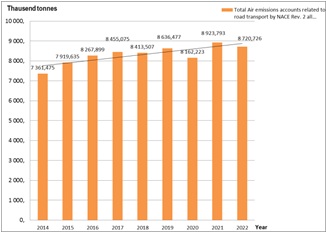
Figure 1. Total Air emissions accounts related to road transport by NACE Rev. 2 all activity in Bulgaria for the period 2014 ÷ 2023 [Thousand Tonnes] Author). Selection from (Eurostat, 2025)
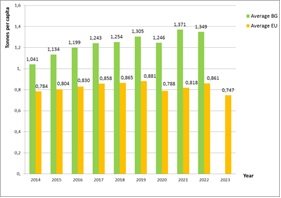
Figure 2. Air emissions accounts related to road transport by NACE Rev. 2 activity in Bulgaria for the period 2014 ÷ 2023 [tCO2e per capita] (Author). Selection from (Eurostat, 2025)
The analysis shows that during the period under review, Bulgaria has observed a trend towards an increase in the total amount of greenhouse gases generated by road transport (Figure 1) The trend is similar in the distribution of greenhouse gases from road transport per capita, while the average values of this indicator for the EU Member States remain relatively constant with a decreasing trend (Figure 2). The data show that at present, transport in Bulgaria is highly dependent on fossil fuels: Over 95% of vehicles use petrol and diesel as fuel. The average age of cars is over 15 years, with high emissions and low energy efficiency. The share of electric vehicles is low.
The total number of motor vehicles registered in Bulgaria during the period is shown in Figure 3. and Figure 4 shows the total number of new zero-emission electric vehicles, registered in Bulgaria for the period 2013 ÷ 2023.
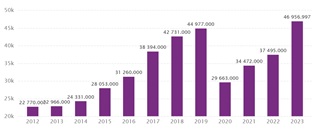
Figure 3. Bulgaria’s Motor Vehicles Sales from 2012 to 2023 in the chart (CEIC Data, 2024)
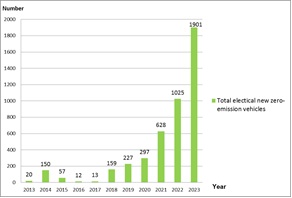
Figure 4. Total number of new zero-emission vehicles of electricity motor energy in Bulgaria for the period 2013 ÷ 2023 (Author). Data selection from (Eurostat, 2025)
Electric vehicles registered in 2023 are 4.05% of the total number of registered vehicles. Figure 5 shows the New zero-emission vehicles registered in Bulgaria by type of vehicle and type of electricity motor energy for the period 2013 – 2023. The classification is according to NACE Rev. 2.
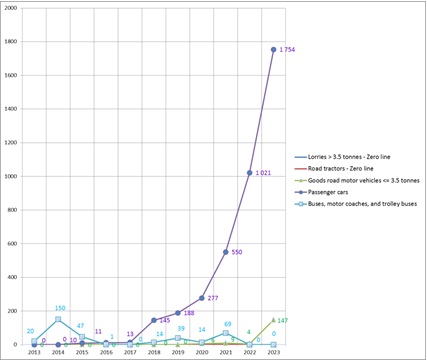
Figure 5. New zero-emission vehicles registered in Bulgaria by type of vehicle and type of electricity motor energy for the period 2013 ÷ 2023 (Author). Data selection from (Eurostat, 2025)
The following figures 6 ÷ 10 show the distribution of vehicles by type, according to the NACE Rev. 2 classification. The graphs show the percentage ratio of electric vehicles to the total number of vehicles. A comparison is made between the values for Bulgaria and the average values for the EU by type of vehicle.
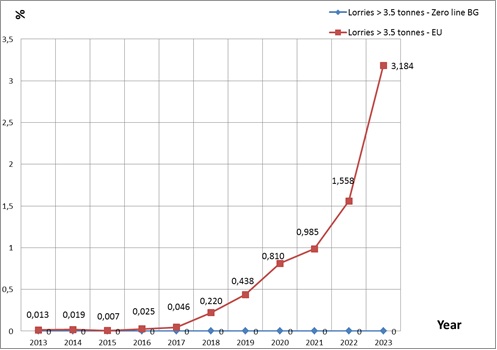
Figure 6. Comparison between Bulgaria and EU by electric Lorries > 3.5 tonnes for the period 2013 ÷2023. (Author). Data selection from (Eurostat, 2025)
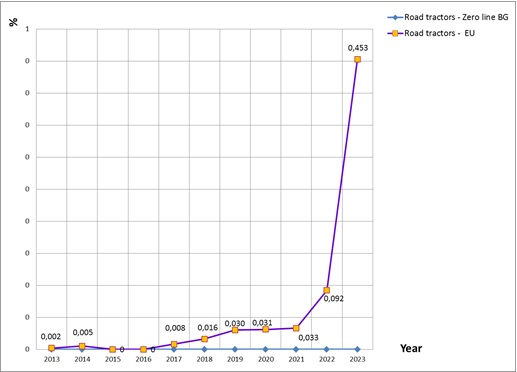
Figure 7. Comparison between Bulgaria and EU by electric Road tractors for the period 2013 ÷ 2023. (Author). Data selection from (Eurostat, 2025)
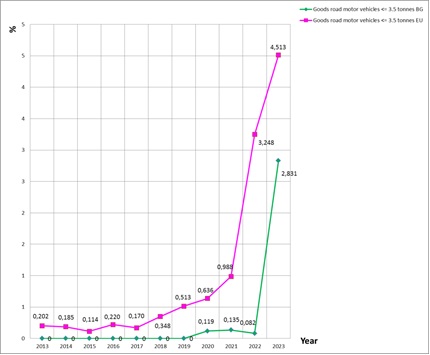
Figure 8. Comparison between Bulgaria and EU by electric Goods road motor vehicles <= 3.5 tonnes for the period 2013 ÷ 2023. (Author). Data selection from (Eurostat, 2025)
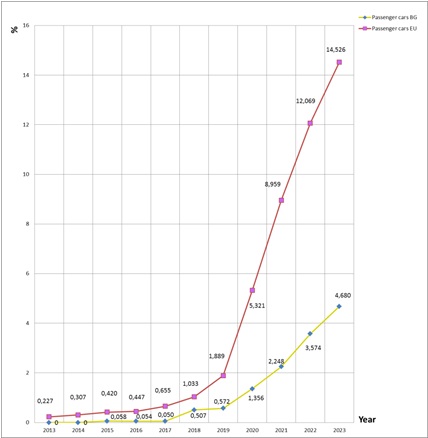
Figure 9. Comparison between Bulgaria and EU by electric Passenger cars for the period 2013 ÷ 2023. (Author). Data selection from (Eurostat, 2025)
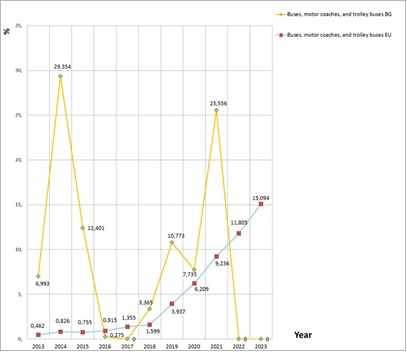
Figure 10. Comparison between Bulgaria and EU by electric Buses, motor coaches, and trolley buses for the period 2013 ÷2023. (Author). Data selection from (Eurostat, 2025)
Problems and challenges facing the decarbonization of road transport in Bulgaria
Although measures are being implemented to reduce greenhouse gas emissions from the transport sector, there are a number of problems and challenges in Bulgaria that must be quickly overcome in the next few years in order for Bulgaria to meet its commitments to achieve zero greenhouse gas emissions by 2050. These problems and challenges can be summarized as follows:
Infrastructure problems
Insufficient network of charging stations, especially outside the big cities. According to Country Report – Bulgaria (2025) Bulgarian regions perform relatively poorly in terms of access to alternative fuels infrastructure. Indicators for access to alternative fuels infrastructure are based on calculations by the Directorate-General for Regional Policy and the Joint Research Centre, using data from the European Alternative Fuels Observatory, Eurostat. Currently, there are 2772 electric charging stations in Bulgaria (Figure 11). Another serious problem is the slow administrative procedure for building new infrastructure. According to the experts, the capacity of existing facilities, the lack of centralized information, and the difficulties of connecting to the electricity grid continue to hinder the mass adoption of electric vehicles.
Economic and social barriers
Along with infrastructure problems, there are also economic and social barriers such as high initial costs for purchasing electric vehicles, which are beyond the financial capabilities of most Bulgarians, lack of incentives for their purchase, consumer distrust of the reliability and range of electric vehicles, and insufficient service facilities for the maintenance of electric vehicles, which creates uncertainty outside of large cities.
Regulatory inconsistencies – lack of a coherent state policy for the development of electric mobility in the country and lack of binding quotas and standards for zero-emission vehicles.
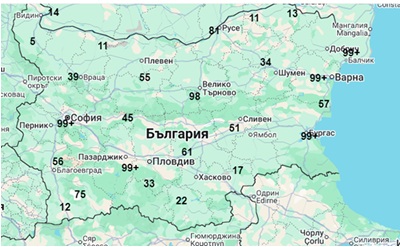
Figure 11. Charging stations in Bulgaria1
Development prospects
Improving access to alternative fuel infrastructure in urban centres across the country and introducing more incentives for purchasing electric vehicles could help to achieve more sustainable mobility and reduce emissions. Introducing tax breaks, simplified procedures for building charging stations and mandatory quotas for clean transport in the public sector could accelerate the transformation towards carbon neutrality. One of the key factors for the future of electromobility is the perception of electric vehicles as part of an ecosystem, requiring commitment and coordination between different stakeholders.2 Shifting more freight from road transport to other modes of transport can also make a significant contribution to the decarbonisation process. To achieve this, maximum use should be made of funding opportunities such as the National Recovery and Resilience Plan (Council of Ministers of the Republic of Bulgaria, 2022) it provides for funding for charging infrastructure and electric buses, proposes subsidy mechanisms for electric vehicles, Municipal pilot projects for electrification of urban and intercity public transport. There is potential to combine funding opportunities offered by national and European funds.
Conclusion
The analysis made in this scientific study aims to initiate a larger-scale scientific and practical work related to the transition to sustainable decarbonized road transport in Bulgaria, including the active participation of students and doctoral students. Our country has the opportunity to use this transition not only as a response to climate challenges, but also as a tool for modernizing the transport system, improving air quality and promoting technological innovations. Achieving these goals requires targeted efforts, intersectoral coordination and the active participation of both the legislative and executive authorities, as well as business and citizens. Universities and research organizations play an important role in this process, which are the drivers of technological innovations aimed at the decarbonization of road transport and increasing the environmental sustainability of Bulgaria.
NOTES
- https://vsichkotok.bg
- https://bg.profiland.net/articles/zaryadni-stancii
References
Council of Ministers of the Republic of Bulgaria. (2022). Bulgaria’s National Recovery and Resilience Plan – BNRRP. https://www.mlsp.government.bg/uploads/3/baneri/natsionalen-plan-za-vzstanovyavane-i-ustoychivost-na-republika-blgariya/bg-finalrrp-2022-04-06-08-30-tca.pdf. [In Bulgarian]
CEIC Data. (2024). Bulgaria Motor Vehicles Sales. https://www.ceicdata.com/en/indicator/bulgaria/motor-vehicles-sales.
European Commission. (2025). Clean and sustainable mobility. https://www.consilium.europa.eu/bg/policies/clean-and-sustainable-mobility/#goals [In Bulgarian]
European Commission. (2021). ‘Fit for 55’: delivering the EU’s 2030 Climate Target on the way to climate neutrality: Communication from the Commission to the European Parliament, the Council, the European Economic and Social Committee and the Committee of the Regions Empty. https://eur-lex.europa.eu/legal-content/EN/TXT/HTML/?uri=CELEX:52021DC0550.
European Parliament. (2006). Regulation (EC) No 1893/2006 of the European Parliament and of the Council of 20 December 2006 establishing the statistical classification of economic activities NACE Revision 2 and amending Council Regulation (EEC) No 3037/90 as well as certain EC Regulations on specific statistical domains Text with EEA relevance. EUR-Lex. https://eur-lex.europa.eu/eli/reg/2006/1893/oj/eng.
European Parliament. (2023). Climate change: the greenhouse gases causing global warming. https://www.europarl.europa.eu/topics/en/article/20230316STO77629/climate-change-the-greenhouse-gases-causing-global-warming.
Eurostat. (2025). Air emissions accounts related to road transport by NACE Rev. 2 activity. https://ec.europa.eu/eurostat/databrowser/view/env_ac_ainah_rd/default/table?lang=en&category=env.env_air.env_air_aa.
United Nations. (1992). United Nations Framework Convention on Climate Change. https://unfccc.int/files/essential_background/background_publications_htmlpdf/application/pdf/conveng.pdf.
United Nations. (1998). Kyoto Protocol to the United Nations Framework Convention on Climate Change. https://unfccc.int/resource/docs/convkp/kpeng.pdf.
United Nations. (2015). Paris Agreement. https://unfccc.int/files/essential_background/convention/application/pdf/english_paris_agreement.pdf.
Assoc. Prof. Krasimira Dimitrova, PhD Eng.
ORCID iD: 0000-0001-8533-156X
Department of Industrial Management
Technical University of Varna
1, Studentska St.
9010 Varna, Bulgaria
E-mail: krasimira.dimitrova@tu-varna.bg

Свързани статии:
 ROLE AND PLACE OF THE COMPANY MOTTO IN THE OFFICIAL CULTURE OF BUSINESS ORGANIZATIONS IN BULGARIA
TECHNOLOGICAL INNOVATIONS AND SUSTAINABLE DEVELOPMENT OF EUROPEAN SMALL AND MEDIUM-SIZED ENTERPRISES IN THE FOOD INDUSTRY
PUBLIC ADMINISTRATION THROUGH THE AGES: HISTORICAL MODELS, INSTITUTIONAL TRANSFORMATIONS, AND CONTEMPORARY PARADIGMS
DIGITAL CHALLENGES IN ONLINE RETAILERS: IDENTIFYING BARRIERS TO SUSTAINABLE TRANSFORMATION
