



Dr. Silvia Ilieva-Sinigerova, Assoc. Prof.
Corresponding author
ORCID iD: 0000-0002-6585-7107
Department of Theory of Sport
National Sports Academy “Vassil Levski”
Sofia, Bulgaria
E-mail: silviya.sinigerova@nsa.bg
Dr. Leyla Dimitrova, Assoc. Prof.
Department of Foreign Language
National Sports Academy “Vassil Levski”
Sofia, Bulgaria
E-mail: leyla.dimitrova@nsa.bg
Dr. Veneta Petkova, Assoc. Prof.
Department of Weightlifting, Boxing
National Sports Academy “Vassil Levski”
Sofia, Bulgaria
E-mail: veneta.petkova@nsa.bg
Iskra Spasova, University lecturer
Department of Foreign Language
National Sports Academy “Vassil Levski”
Sofia, Bulgaria
E-mail: iskra.spasova@nsa.bg
Hristo Velchev, Master’s student
Faculty of Sport
National Sports Academy “Vassil Levski”
Sofia, Bulgaria
E-mail: hristo.velchev@pridesport.bg
https://doi.org/10.53656/ctpes-2026.SIS

Pages 102-109
Abstract. The colour of the pieces in chess is traditionally considered a factor that may influence playing strategy and competitive outcomes. In classical chess, 37.27% of games played in classical time-controlled tournaments are won by white pieces, 27.96% by black pieces, and 34.77% end in a draw. The study evaluates the impact of this factor on 10 – 12-year-old chess players in two different forms: classical chess and Chess960. To compare the ratio of the wins, losses, and draws in both types of chess at 10 – 12-year-old chess players’ competitions, and to determine the role of the starting position for the outcome of the game. 46 chess experts from Bulgaria and abroad took part in a survey. A pedagogical experiment was carried out with a control and an experimental group. It included two seven-round tournaments in classical chess and Chess960, in which the ratios of wins, losses, and draws were analysed. Frequency analysis, descriptive statistics, and comparative analysis were applied (Pearson’s chi-square test, Mann-Whitney U test, Kruskal-Wallis nonparametric analysis of variance, and the DSCF nonparametric test for multiple comparisons). The colour of the pieces in classical chess among 10-12-year-old chess players had no statistically significant effect on the outcome (p > 0.05 in all rounds). However, it affected the outcome in some rounds of the Chess960 games, showing an advantage for White (χ² = 13.091, p < 0.001) or for Black (χ² = 12.800, p < 0.001), probably related to the specific starting configuration. Draws were observed only in classical chess tournaments, where the color of the pieces played no role. The colour of the pieces showed no statistically significant advantage in classical chess among the 10 – 12-year-old chess players. In Chess960, the starting configuration can give a significant advantage to one colours.
Keywords: classical chess; Chess960; colour of the pieces; performance; starting configuration; tournament format
- Introduction
The interest in the influence of various factors on the competitive performance of young athletes has increased recently. In intellectual sports, like chess, the roles of cognitive, psychological, and strategic aspects are considered crucial to the development of competitive resilience (Gobet & Campitelli, 2007; Bilalić et al., 2007). The colour of the pieces has long been a subject of statistical analyses, which have shown a particular advantage for the white pieces (de Groot, 2008; Ponnaluri & King, 2017; Chabris & Hearst, 2003). Chess is also considered a classical model for the study of thinking and problem-solving (Bart, 2014; Burgoyne et. al., 2016). Nevertheless, the influence of this factor among children remains insufficiently researched, especially in the context of Chess960, introduced by Boby Fischer, where the starting positions of the pieces are randomly determined. This variant eliminates the preliminary preparation in openings and requires a higher level of creativity (Barthelemy, 2025; Gobet, 2016).
Technologically oriented research analysing the patterns in Chess960 using algorithms has appeared recently. Deo and Dwivedi (2023) examined machine learning for predicting game outcomes and developing openings for each starting position. They used three algorithmic models on data from around 500 games for each Chess960 position to define the trends in the development of opening variants and directions of play. These models gave valuable information for outcome prediction and for understanding the opening part in Chess960.
Research by Ericsson and Lehmann (1996) shows that the development of expertise in cognitive domains, like chess, requires systematic and continuous practice. According to Campitelli and Gobet (2008), the age at which deliberate practice begins is among the key factors in achieving high levels of competitive performance.
Early specialization and children’s cognitive development play a substantial role in the development of strategic thinking and analytical abilities. Hristov (2017) emphasizes that “in many sports today it is already impossible to think about success if specialization does not begin in early childhood” (p. 40). This can also be seen in chess because the ages of 10 to 12 are crucial for the development of spatial imagination, logical sequence, and the ability to predict moves (Howard, 2014).
This study aims to analyse if the colour of the pieces influences the game’s outcome in classical chess and Chess960 among 10 – 12-year-old chess players and to assess the significance of the pieces’ starting position in Chess960.
- Research methods
Study objectives: To compare the ratios of wins, losses, and draws in both types of chess in the performance of 10 – 12-year-old chess players and to assess the importance of the starting position of the pieces to the game’s outcome.
Organization of the study: To collect the information needed and examine the opinion of elite chess competitors and coaches, a survey was conducted from 01.03 to 07.06.2025 among 46 highly qualified experts. The survey was carried out through an online questionnaire consisting of 18 questions covering general information (characterising the profile of the elite competitors and coaches – closed- and open-ended questions), and specialized information (the preferred age group for training and the implementation of Chess960 in the training sessions of 10 – 12-year-old chess players – closed- and open-ended questions).
In addition, a pedagogical experiment was conducted, comprising tournaments in classical chess and Chess960, during which win-loss-draw ratios were recorded. For this purpose, two groups were formed, comprising 44 children with a mean age of 10.2 ± 1.07 years. One group was trained using an experimental methodology that included targeted preparation in Chess960. The children were evenly distributed between the two groups. The tournaments were held before the experimental methodology was applied (one classical chess tournament and one Chess960 tournament) and two months after its application. Each tournament had 7 rounds. A win was awarded 1 point, a draw – 0.5, and a loss – 0 points. The analysis of the pedagogical experiment with a control and an experimental group, including two 7-round tournaments in classical chess and Chess960, was focused on the ratios between wins, losses, and draws.
The data was processed using Jamovi V 2.6.441, a statistical software based on the R programming language2. Frequency analysis, descriptive statistics, and comparative analysis were applied ( Pearson’s chi-square test, Mann-Whitney U test, Kruskal-Wallis nonparametric analysis of variance, and the DSCF nonparametric test for multiple comparisons).
In line with Batchev and Zlatev (2014), metrological accuracy and the control of measurement errors are essential prerequisites for the reliability of empirical data in sports research, including studies of cognitive and motor manifestations in children.
- Results
The specialists’ responses to the question: ‘Do you agree that Chess 960 games end in a draw less often than classical chess games?’ were of great interest to us. The mean rating they gave was 3.96±1.15, which showed that the coaches agreed with this statement. No clear differences were found when their responses were analysed depending on the coaching level (instructors and coaches), U=83.000, p=0.978. Because of the age range (from 23 to 72 years), the surveyed coaches were divided into four age groups. No significant differences were observed in their answers (x2=0.670, p=0.880). The respondents’ coaching experience was in the range of 29 years, which could influence their opinions and attitudes toward innovations such as Chess960. That was the reason for their division into 3 groups, but no differences were found in their opinions regarding the specific question (x2=0.358, p=0.836).
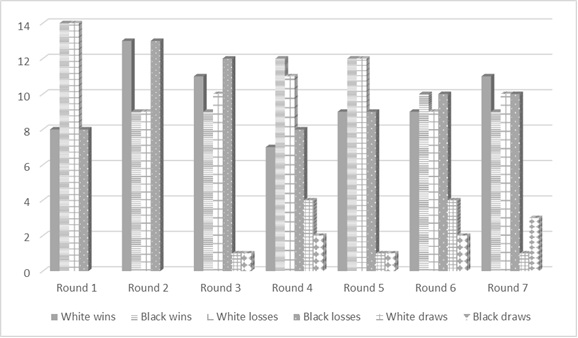
Figure 1. Classical chess – Tournament 1
In the first classical chess tournament, draws began in the third round. Nevertheless, their number was relatively small, as confirmed by the low chi-square values (x2<3.861, p>0.050). No differences were found in the outcomes depending on the colour of the pieces.
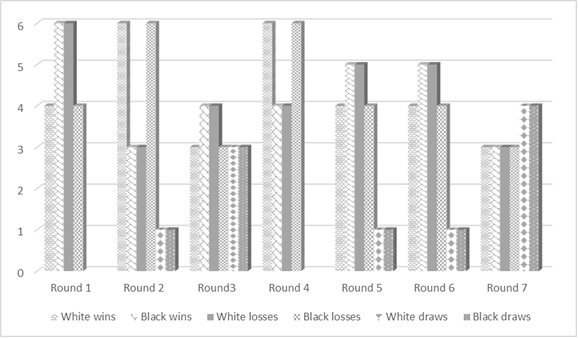
Figure 2. Classical chess – Tournament 2
Twenty competitors participated in the second classical chess tournament (10 from the experimental group and 10 from the control group). Draws occurred in rounds 2, 5, 6, and 7. Round 2 (x2=7.211, p=0.007; W=3.798, p=0.007) and round 6 (x2=12.793, p<0.001; W=5.058, p<0.001) showed significant differences in results depending on the colours of the pieces. In the other rounds, the colour did not affect the outcome of the game (x2<3.040, p>0.050).
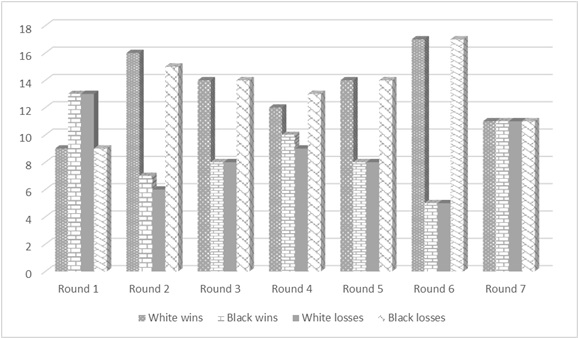
Figure 3. Chess960 – Tournament 1
The first Fischer Random tournament (Figure 3) illustrates the wins and losses of the competitors with both piece colours. The results from all 22 games played in each round showed no draws. Differences in favour of the white pieces could be seen in rounds 2 (x2=7.379, p=0.007) and 6 (x2=13.091, p<0.001).
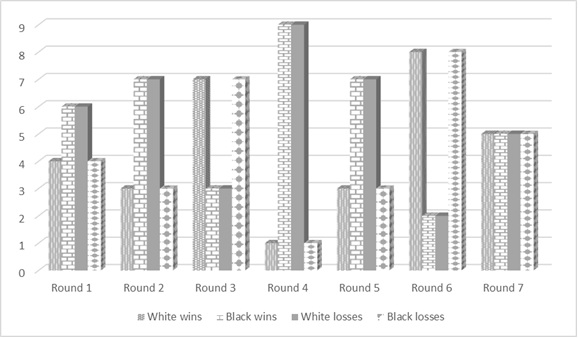
Figure 4. Chess960 – Tournament 2
Twenty participants took part in the second Chess960 tournament (10 from the experimental group and 10 from the control group). Once again, the absence of draws throughout the tournament is noteworthy. The data showed noticeable differences in results by piece colour were observed in round 4, with wins in favor of Black (χ² = 12.800, p < 0.001), and in round 6, with wins in favor of White (χ² = 7.200, p = 0.007).
In classical chess tournaments for 10-12-year-old players, the colour of the pieces had no statistically significant effect on the outcome (p > 0.05 in all rounds). In the tournaments in Chess960, however, in some of the rounds, a considerable advantage for the white (χ² = 13.091, p < 0.001) or black pieces (χ² = 12.800, p < 0.001) was observed, probably related to the starting position of the pieces. Draws were seen only in the tournaments in classical chess where the colour of the pieces had no influence.
- Discussion and Conclusion
The results obtained confirm the data from previous international research, that the colour of the pieces has a limited influence if the players’ abilities are even and a greater influence with specific starting positions (Kaufman, 2021; Haworth et al., 2010).
Chess960 is an innovative format that eliminates the need for preliminary memorizing of the openings and places emphasis on the common principles and creative thinking. This may explain the fluctuations observed in the results between the colours in the rounds, as a random starting configuration can favour one of the parties.
From a pedagogical point of view, the use of Chess960 encourages 10 – 12-year-old chess players to be more creative, adapt quickly, and develop strategic flexibility – key skills for future sports development (Gobet & Campitelli, 2007). In line with Hristov’s view (2017), early specialization should be applied carefully to avoid cognitive and psychological overload in children.
The study supports the necessity for coaches to combine traditional preparation in classical chess with elements from Chess960 to stimulate creativity and competitive resilience.
Pieces’ colour in classical chess gives no statistically significant advantage with 10 – 12-year-old chess players, while the pieces’ starting configuration in Chess960 can provide a significant advantage to one of the colours.
It is also important to consider the high variability within the chosen age group of young chess players. Coaches should be aware of both the general psychological and cognitive development characteristics of this age and the technical aspects of chess training. The positive role of Chess960 in this age group lies in developing creativity and understanding of general chess principles, as well as preventing excessive memorization of opening variations. However, young players with a weak chess foundation may be confused by the wide variety of starting positions and possibilities in Chess960.
Acknowledgement
This study is part of the research project ‘Opportunities for Using Chess960 in the Training Process of 10 – 12-year-old chess players’ with project numbers 159/13.01.2025 and 455/04.02.2025, funded by the National Sports Academy ‘Vassil Levski’.
NOTES
- https://www.jamovi.org
- https://cran.r-project.org
References
Bart, W. M. (2014). On the effect of chess training on scholastic achievement. Frontiers in Psychology, 5, 762. https://doi.org/10.3389/fpsyg.2014.00762.
Barthelemy, M. (2025). Fragility of chess positions: Measure, universality, and tipping points. Physical Review E, 111(1), 014314. https://doi.org/10.1103/PhysRevE.111.014314.
Batchev, V., & Zlatev, B. (2014). Metrological requirements for the development of an “Agility” test. Proceedings of International scientific symposium “Metrology and Metrological”, 342 – 345. https://proceedings.metrology-bg.org/en/issue/2014/. [In Bulgarian]
Bilalić, M., McLeod, P., & Gobet, F. (2007). Does chess need intelligence? – A study with young chess players. Intelligence, 35(5), 457 – 470. https://doi.org/10.1016/j.intell.2006.09.005.
Burgoyne, A. P., Sala, G., Gobet, F., Macnamara, B. N., Campitelli, G., & Hambrick, D. Z. (2016). The relationship between cognitive ability and chess skill: A comprehensive meta-analysis. Intelligence, 59, 72 – 83. https://doi.org/10.1016/j.intell.2016.08.002.
Campitelli, G., & Gobet, F. (2008). The role of practice in chess: A longitudinal study. Learning and Individual Differences, 18(4), 446 – 458. https://doi.org/10.1016/j.lindif.2007.11.006.
Chabris, C. F., & Hearst, E. (2003). Visualization, pattern recognition, and forward search: effects of playing speed and sight of the position on grandmaster chess errors. Cognitive Science, 27(4), 637 – 648. https://doi.org/10.1207/s15516709cog2704_3.
Deo, S., & Dwivedi, N. (2023). Machine learning algorithms to predict Chess960 results and develop opening themes. arXiv. https://doi.org/10.48550/arXiv.2310.18938.
Ericsson, K. A., & Lehmann, A. C. (1996). Expert and exceptional performance: Evidence of maximal adaptation to task constraints. Annual Review of Psychology, 47, 273 – 305. https://doi.org/10.1146/annurev.psych.47.1.273.
Gobet, F. (2016). Understanding expertise: A multidisciplinary approach. Palgrave Macmillan.
Gobet, F., & Campitelli, G. (2007). The role of domain-specific practice, handedness, and starting age in chess performance. Developmental Psychology, 43(1), 159 – 172. https://doi.org/10.1037/0012-1649.43.1.159.
de Groot, A. D. (2008). Thought and choice in chess. Amsterdam University Press. https://www.jstor.org/stable/j.ctt46n0r2.
Haworth, G., Regan, K., & Di Fatta, G. (2010). Performance and prediction: Bayesian modelling of fallible choice in Chess. In: van den Herik, H. J., Spronck, P. (Еds.) Advances in Computer Games (pp. 99 – 110). Springer. https://doi.org/10.1007/978-3-642-12993-3_10.
Howard, R. W. (2014). Learning curves in highly skilled chess players: A test of the generality of the power law of practice. Acta Psychologica, 151, 16 – 23.
Hristov, H. (2017). Osnovni etapi pri podgotovkata na sumisti. Sport & Science, 61(6), 39 – 46. [In Bulgarian].
Kaufman, L. (2021). Chess Board Options: A Memoir of Players, Games and Engines. New in Chess.
Ponnaluri, S. & King, M. J. (2017). Do initial strategies or choice of piece color lead to advantages in chess games? Journal of Emerging Investigators, 1 – 6. https://doi.org/10.59720/16-079.