



Dr. Teodor Georgiev, Chief Assist. Prof.
ORCID iD: 0000-0002-8886-0130
Department of Sport
Sofia University “St. Kliment Ohridski”
Sofia, Bulgaria
Е-mail: teodorjg@uni-sofia.bg
https://doi.org/10.53656/ctpes-2026.TG

Pages 120-128
Abstract. The aim of the study was to evaluate eccentric hamstring strength through a multidimensional analytical approach incorporating absolute strength, relative strength, and body mass-predicted values, in order to identify strength deficits and quantify inter-limb asymmetry. Forty-one non-professional football players performed the Nordic hamstring test, with peak strength recorded separately for each limb. Mean absolute eccentric hamstring strength was 260.5 ± 61.3 N (non-dominant) and 273.9 ± 68.6 N (dominant). Mean body mass-predicted strength was 329.0 ± 33.1 N. When compared against the bilateral mean of measured strength, this reflected a mean deficit of 61.8 ± 31.9 N, with 68.3% of players presenting a clinically relevant strength deficit (>40 N). Mean relative strength was 3.50 ± 0.85 N/kg, and mean inter-limb asymmetry was 11.7 ± 9.3%, with 14.6% of players exceeding the 20% threshold. Most players demonstrated insufficient eccentric hamstring strength alongside notable inter-limb asymmetry, reinforcing the need for structured, multidimensional screening and individually tailored preventive interventions.
Keywords: eccentric hamstring strength; inter-limb asymmetry; football; injury prevention; Nordic hamstring test
- Introduction
Eccentric hamstring strength is widely regarded as one of the most important modifiable risk factors for hamstring strain injuries (Heiderscheit et al., 2010; Opar et al., 2015; Timmins et al., 2016). Lower eccentric hamstring strength and large inter-limb asymmetries are associated with an increased risk of hamstring injury in football players (Opar et al., 2015; Timmins et al., 2016).
Football is one of the most traumatic sports, both at the professional and amateur levels. Hamstring strains are the most common type of muscle injury, accounting for 12% – 24% of all injuries (Ekstrand et al., 2012; Ekstrand et al., 2022) and 37% of all muscle injuries in professional football players (Ekstrand et al., 2011).
A systematic review of more than 3,800 football players, covering over two million hours of sport exposure, found that hamstring muscle injuries occur at a rate of 0.3 to 1.9 per 1,000 hours among male players, with reinjury rates varying widely from 4% to 68% (Diemer et al., 2021).
The primary injury mechanism occurs during the terminal swing or early stance phase of high-speed running, as well as during kicking or stretching movements (such as reaching or striking the ball), when hip flexion and knee extension occur at the same time, placing the hamstring muscles under significant elongation stress (Chumanov et al., 2012; Orchard, 2012). Because the hamstrings cross both the hip and knee joints, this position pushes them close to their maximum length – a state known as passive insufficiency. The peak eccentric (controlling) contraction of the hamstrings occurs when the muscles are at their greatest elongation. At this point, the muscles must produce a peak eccentric contraction, meaning they are actively controlling movement while being stretched This represents the most common mechanism of hamstring injury: eccentric overload during the terminal swing phase of high-speed running. As running velocity increases, the eccentric load and demand placed on the hamstrings increase accordingly (Higashihara et al., 2010).
The injury mechanism highlights eccentric strength as a primary risk factor, and eccentric hamstring strength is among the most extensively investigated and consistently reported risk factors for hamstring strain injuries (Heiderscheit et al., 2010; Hägglund et al., 2013; Guex & Millet, 2013; Al Attar et al., 2017).
Approximately one-third of muscle strains are at high risk of reoccurring within the first two weeks after return to play (Orchard & Best, 2002). This high reinjury rate may be due to an inadequate rehabilitation program (Croisier, 2004), premature return to sport (Schneider-Kolsky et al., 2006), or a combination of both factors. Reinjuries tend to be more severe than the initial injury and are associated with a longer recovery period (Brooks et al., 2006; Heiderscheit et al., 2010).
The high incidence of sports injuries and reinjuries demands attention from health professionals, coaches, and players. Advances in science and technology enable better assessment of hamstring injury risk and the development of evidence-based prevention strategies.
- Methods
This cross-sectional study aimed to evaluate eccentric hamstring strength through a multidimensional analytical approach incorporating absolute strength, relative strength, and body mass-predicted values, in order to identify strength deficits and quantify inter-limb asymmetry.
Measurements were obtained using a custom-built device, developed and calibrated according to the methods described by Opar et al. (2013), Cutler et al. (2018), and Georgiev (2025).
Participants were non-professional football players (n=41) participating in the University Football Championship, 16 of whom also compete in the Third League of the Bulgarian Football Union.
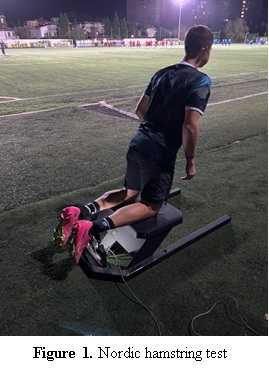
Eccentric hamstring strength was assessed via the Nordic hamstring test (Fig. 1). After a standardized warm-up and two submaximal familiarization trials, each participant completed three maximal efforts, separated by 30-second rest intervals. Peak strength (N) was recorded for each limb, and the highest value across the three trials was used for subsequent analysis.
To control for the effect of body mass, the measured strength values were compared with body mass-predicted values, calculated using the following equation: predicted eccentric strength (N) = 4 × body mass (kg) + 26.1. A deviation of at least 40 N from the expected value was considered a clinically relevant strength deficit or substantially above expected (Buchheit et al., 2016). For each participant, the difference (D) between the measured and predicted values was calculated by subtracting the predicted strength value from the bilateral mean of measured eccentric hamstring strength. Based on a ±40 N threshold, players were classified into one of three categories: strength deficit (D ≤ −40 N), reference range (−40 N < D < +40 N), or above expected strength (D ≥ +40 N).
The method used to calculate and report inter-limb strength asymmetry is a methodologically relevant consideration, as different approaches produce different numerical outcomes that may affect the interpretation of individual athlete profiles, group-level analyses, and cross-study comparisons alike. Following the recommendation of Impellizzeri et al. (2008) and consistent with Opar et al. (2013), inter-limb asymmetry was quantified using a log-transformed limb ratio. Bilateral strength values were used to compute a limb ratio, which was log-transformed, converted to its absolute value, and back-transformed to obtain a direction-independent estimate of asymmetry. The final asymmetry value was expressed as the percentage by which the stronger limb exceeded the weaker limb. This method eliminates the directional bias associated with fixed denominators (e.g., dominant/non-dominant or left/right) and provides appropriate statistical properties for group-level analyses. Inter-limb asymmetry values were classified into four categories: <10%, 10–15%, 15–20%, and >20%. The distribution of players across categories was quantified using frequency analysis.
Data were analyzed in IBM SPSS Statistics 19 and Microsoft Excel. Descriptive statistics (mean, standard deviation, minimum, maximum, and range) were computed for all variables. In addition, frequency analysis and threshold-based categorical distribution analysis were used to examine the prevalence of strength deficits and inter-limb asymmetry categories.
- Results
Table 1 presents the descriptive characteristics of the study sample. The mean age of the participants was 20.95 ± 2.25 years; the mean body mass was 76.86 ± 8.26 kg; the mean height was 181.04 ± 5.57 cm; and the average experience was 12.29 ± 3.16 years.
Table 1. Descriptive characteristics of the study sample
| N | Minimum | Maximum | R | Mean | Std. Deviation | |
| Age (years) | 41 | 19 | 31 | 12 | 20.95 | 2.25 |
| Height (cm) | 41 | 166.5 | 191 | 24.5 | 181.04 | 5.57 |
| Body mass (kg) | 41 | 63.8 | 97.7 | 33.9 | 76.86 | 8.26 |
| Experience (years) | 41 | 9.00 | 24.00 | 15.00 | 12.29 | 3.16 |
Table 2 presents the descriptive statistics for absolute eccentric hamstring strength in both limbs, body mass-based predicted strength values, the difference between measured bilateral mean strength and predicted values, relative strength, and inter-limb strength asymmetry.
Mean absolute eccentric hamstring strength was 260.53 ± 61.32 N for the non-dominant limb and 273.91 ± 68.56 N for the dominant limb. Based on body mass, the mean predicted eccentric hamstring strength was 329.02 ± 33.05 N. Comparing the bilateral mean of measured strength against predicted values revealed a group-level deficit of 61.80 ± 31.89 N, with individual differences ranging from − 126.12 N to +9.60 N (Table 2). As shown in Table 3, 28 players (68.3%) demonstrated a clinically relevant strength deficit, 9 players (22.0%) were within the reference range, and only 4 players (9.8%) exceeded their predicted strength.
Table 2. Descriptive characteristics of eccentric strength and inter-limb asymmetry
| Eccentric strength (N) | Predicted strength values
(N) |
Difference
(N) |
Bilateral
relative strength (N/kg) |
Inter-limb asymmetry
(%) |
||
| Non-Dominant | Dominant | |||||
| Mean | 260.53 | 273.91 | 329.02 | -61.80 | 3.50 | 11.68 |
| SD | 61.32 | 68.56 | 33.05 | 31.89 | 0.85 | 9.26 |
| Min | 141.49 | 159.88 | 276.8 | -126.115 | 1.77 | 0.26 |
| Max | 406.01 | 437.99 | 412.4 | 9.6 | 5.86 | 39.88 |
| R | 264.52 | 278.11 | 135.6 | 135.715 | 4.09 | 39.62 |
When normalized to body mass, mean bilateral relative eccentric hamstring strength was 3.50 ± 0.85 N/kg, with values ranging from 1.77 to 5.86 N/kg (Table 2).
Inter-limb strength asymmetry averaged 11.68 ± 9.26% with individual values ranging from 0.26% to 39.88%, indicating considerable inter-individual variability in strength balance between limbs (Table 2).
Table 3. Frequency analysis of strength deficit and threshold-based categorical distribution analysis for inter-limb asymmetry
| Strength | Inter-limb asymmetry | |||||||
| Strength deficit |
Within expected |
Above expected |
10%< | 10 – 15% | 15 – 20% | >20% | Total | |
| Frequency (n) | 28 | 9 | 4 | 22 | 11 | 2 | 6 | 41 |
| Percent (%) | 68.3 | 22.0 | 9.8 | 53.7 | 26.8 | 4.9 | 14.6 | 100.0 |
When inter-limb asymmetry values were classified into categories, 22 players (53.7%) had asymmetry below 10%, 11 players (26.8%) between 10% and 15%, 2 players (4.9%) between 15% and 20%, and 6 players (14.6%) exceeded 20%. Nearly half of the sample (46.3%) presented with inter-limb asymmetry exceeding 10%, including 14.6% of players whose asymmetry surpassed the 20% threshold. (Table 3).
- Discussion
The main finding of the present study is that this group of non-professional football players demonstrated a substantially insufficient level of eccentric hamstring strength.
When measured eccentric strength was compared with predicted values based on body mass, more than two-thirds of the players (68.3%) exhibited a clinically relevant deficit greater than 40 N, with a mean group deficit of approximately 62 N.
Because eccentric strength is strongly influenced by body mass, absolute strength values (N) should be interpreted with caution when comparing players of different body size or when monitoring the same player over time, during which body mass may change. For this reason, strength values are commonly normalized to body mass and expressed as relative strength (N/kg). In the present sample, mean relative eccentric hamstring strength (averaged across both limbs) was 3.50 N/kg, which is notably below reference values reported for football populations (4.95 ± 0.95 N/kg) (Jeanguyot et al., 2023).
The mean inter-limb asymmetry of 11.7% reflects a moderate imbalance at the group level, but the considerable variability across individuals suggests that certain players may present with a markedly elevated risk profile. Asymmetry is highly prevalent at the individual level: 26.8% of players have asymmetry between 10 – 15%, 4.9% between 15 – 20%, and 14.6% above 20%. Asymmetry in strength between the two legs above 15% is associated with risk of injury (Bourne et al., 2015), while another study reported that asymmetries of 10%, 15%, and 20% did not increase injury risk, and the main risk factor was reduced strength (Opar et al., 2015).
Most players fell below their body mass-predicted strength values, demonstrated low relative strength, and exhibited moderate-to-large inter-limb asymmetries, with individual values approaching 40%. Collectively, these results point to a generally insufficient eccentric hamstring strength profile across the sample. Strength deficits and asymmetry represent distinct but complementary risk factors: an athlete may present with global weakness, strength asymmetry, or both. The current sample appears to reflect a combination of both issues at the group level.
While the literature reports reference value for absolute eccentric hamstring strength of approximately 279 N (Opar et al., 2015), relying on absolute values alone may lead to misleading conclusions. In the present sample, mean absolute strength value is consistent with the reference value, which might suggest an acceptable strength profile. However, when measured strength was compared with body mass-predicted values, a substantial proportion of players showed clinically relevant deficits, and relative strength values were markedly low. These findings emphasise the importance of routine strength screening using both absolute measures and body-mass-normalized measures, combined with inter-limb asymmetry assessment. The integrative analytical framework used in this study enables a more accurate and clinically relevant interpretation of strength profiles. This comprehensive analytical approach enables practitioners to identify athletes with insufficient global strength, those with pronounced inter-limb imbalances, and those presenting both risk factors, thereby facilitating more targeted and individualized preventive strategies.
From a practical standpoint, these findings support the systematic implementation of eccentric hamstring-strengthening interventions in non-professional football. Eccentric-based training has been shown to increase eccentric hamstring strength and reduce hamstring injury incidence (Petersen et al., 2011; van der Horst et al., 2015), and given the proportion of players in this sample presenting with substantially below predicted strength levels, such interventions appear warranted. It should be emphasized that optimal prevention programs are multifactorial and should integrate additional components such as flexibility, neurodynamics, sprint mechanics and exposure, neuromuscular control, and load management, rather than relying exclusively on eccentric strengthening (Timmins et al., 2016; Mendiguchia et al., 2017; Bourne et al., 2017).
The present study has several limitations. First, the cross-sectional design does not permit causal inference regarding the associations between strength deficits, inter-limb asymmetry, and injury risk. Second, the relatively modest sample size and exclusive focus on non-professional male players may limit the generalisability of findings to other populations, including elite, youth, or female athletes. Third, hamstring strength was assessed using a single testing modality (the Nordic hamstring test), which reflects a specific aspect of eccentric hamstring function and may not fully capture hamstring performance across different joint angles, contractions, and velocities. Fourth, no prospective injury data were collected; therefore, the present study cannot directly determine the predictive value of the observed deficits and asymmetries for future injury occurrence. Finally, potentially important confounding factors, including training load, playing position, and recent injury history, were not controlled and may have influenced individual strength values.
- Conclusion
In conclusion, most players in the present study demonstrated insufficient eccentric hamstring strength profile, with a large proportion also demonstrated inter-limb asymmetry. These findings indicate a potentially elevated injury risk profile. Beyond the descriptive findings, the study emphasises the value of a structured, multidimensional analytical approach to interpreting eccentric strength data. The combined interpretation of absolute strength, body mass-predicted values, relative strength and inter-limb asymmetry provides greater clinical value than any single metric alone. Incorporating this analytical approach into routine screening enables more precise athlete profiling and supports the design of prevention strategies tailored to individual strength characteristics.
Future research should build on the present findings through longitudinal and prospective designs to determine whether the observed strength deficits and inter-limb asymmetries predict subsequent hamstring injury risk. Larger and more diverse samples, including elite, youth, and female players, are needed to improve the generalisability of the findings. Future studies should also incorporate multiple assessment modalities and testing conditions to evaluate hamstring function across varying joint angles, contraction velocities, and movement tasks. Finally, intervention studies are warranted to examine whether correcting the identified deficits and asymmetries through targeted training leads to meaningful reductions in injury incidence and improvements in performance.
REFERENCES
Al Attar, W. S. A., Soomro, N., Sinclair, P. J., Pappas, E., & Sanders, R. H. (2017). Effect of injury prevention programs that include the Nordic hamstring exercise on hamstring injury rates in soccer players: A systematic review and meta-analysis. Sports medicine, 47(5), 907 – 916. https://doi.org/10.1007/s40279-016-0638-2.
Bourne, M. N., Opar, D. A., Williams, M. D., & Shield, A. J. (2015). Eccentric knee flexor strength and risk of hamstring injuries in rugby union: A prospective study. The American journal of sports medicine, 43(11), 2663 – 2670. https://doi.org/10.1177/0363546515599633.
Bourne, M. N., Williams, M. D., Opar, D. A., Al Najjar, A., Kerr, G. K., & Shield, A. J. (2017). Impact of exercise selection on hamstring muscle activation. British journal of sports medicine, 51(13), 1021 – 1028. https://doi.org/10.1136/bjsports-2015-095739.
Brooks, J. H., Fuller, C. W., Kemp, S. P., & Reddin, D. B. (2006). Incidence, risk, and prevention of hamstring muscle injuries in professional rugby union. The American Journal of Sports Medicine, 34(8), 1297 – 1306. https://doi.org/10.1177/0363546505286022.
Buchheit, M., Cholley, Y., Nagel, M., & Poulos, N. (2016). The effect of body mass on eccentric knee-flexor strength assessed with an instrumented Nordic hamstring device (Nordbord) in football players. International Journal of Sports Physiology and Performance, 11(6), 721 – 726. https://doi.org/10.1123/ijspp.2015-0513.
Chumanov, E. S., Schache, A. G., Heiderscheit, B. C., & Thelen, D. G. (2012). Hamstrings are most susceptible to injury during the late swing phase of sprinting. British journal of sports medicine, 46(2), 90. https://doi.org/10.1136/bjsports-2011-090176.
Croisier, J.-L. (2004). Factors associated with recurrent hamstring injuries. Sports medicine, 34(10), 681 – 695. https://doi.org/10.2165/00007256-200434100-00005.
Cutler, C. R., Hamilton, A. L., Hough, E., Baines, C. M., & Clark, R. A. (2018). Open-source 3D printed sensors forhand strength assessment: Validation of low-cost load cell and fabric sensor-based systems. Australian occupational therapy journal, 65(5), 412 – 419. https://doi.org/10.1111/1440-1630.12494.
Diemer, W. M., Winters, M., Tol, J. L., Pas, H. I. M. F. L., & Moen, M. H. (2021). Incidence of acute hamstring injuries in soccer: A systematic review of 13 studies involving more than 3800 athletes with 2 million sport exposure hours. The Journal of orthopaedic and sports physical therapy, 51(1), 27 – 36. https://doi.org/10.2519/jospt.2021.9305.
Ekstrand, J., Bengtsson, H., Waldén, M., Davison, M., Khan, K. M., & Hägglund, M. (2022). Hamstring injury rates have increased during recent seasons and now constitute 24% of all injuries in men’s professional football: The UEFA Elite Club injury study from 2001/02 to 2021/22. British journal of sports medicine, 57(5), 292 – 298. https://doi.org/10.1136/bjsports-2021-105407.
Ekstrand, J., Hägglund, M., & Waldén, M. (2011). Epidemiology of muscle injuries in professional football (soccer). The American journal of sports medicine, 39(6), 1226 – 1232. https://doi.org/10.1177/0363546510395879.
Ekstrand, J., Healy, J. C., Waldén, M., Lee, J. C., English, B., & Hägglund, M. (2012). Hamstring muscle injuries in professional football: The correlation of MRI findings with return to play. British journal of sports medicine, 46(2), 112 – 117. https://doi.org/10.1136/bjsports-2011-090155.
Georgiev, T. (2025). A method to assess eccentric hamstring strength in 15 to 16-year-old football players. Series on Biomechanics 39(1), 92 – 100. https://doi.org/10.7546/SB.01.12.2025
Guex, K., & Millet, G. P. (2013). Conceptual framework for strengthening exercises to prevent hamstring strains. Sports medicine, 43(12), 1207 – 1215. https://doi.org/10.1007/s40279-013-0097-y.
Hägglund, M., Walden, M., & Ekstrand, J. (2013.) Risk factors for lower extremity muscle injury in professional soccer: The UEFA injury study. The American journal of sports medicine, 41(2), 327 – 335. https://doi.org/10.1177/0363546512470634.
Heiderscheit, B. C., Sherry, M. A., Silder, A., Chumanov, E. S., & Thelen, D. G. (2010). Hamstring strain injuries: Recommendations for diagnosis, rehabilitation, and injury prevention. The Journal of orthopaedic and sports physical therapy, 40(2), 67 – 81. https://doi.org/10.2519/jospt.2010.3047.
Higashihara, A., Ono, T., Kubota, J., Okuwaki, T., & Fukubayashi, T. (2010). Functional differences in the activity of the hamstring muscles with increasing running speed. Journal of sports sciences, 28(10), 1085 – 1092. https://doi.org/10.1080/02640414.2010.494308.
Impellizzeri, F. M., Bizzini, M., Rampinini, E., Cereda, F., & Maffiuletti, N. A. (2008). Reliability of isokinetic strength imbalance ratios measured using the Cybex NORM dynamometer. Clinical physiology and functional imaging, 28(2), 113 – 119. https://doi.org/10.1111/j.1475-097X.2007.00786.x.
Jeanguyot, E., Salcinovic, B., Johnson, A., Van Dyk, N., & Whiteley, R. (2023). Eccentric hamstring strength in young athletes is best documented when normalised to body mass: A cross-sectional study with normative data of 590 athletes from different age categories. Biology of sport, 40(4), 1079 – 1095. https://doi.org/10.5114/biolsport.2023.125585.
Mendiguchia, J., Martinez-Ruiz, E., Edouard, P., Morin, J. B., Martinez-Martinez, F., Idoate, F., & Mendez-Villanueva, A. (2017). A multifactorial, criteria-based progressive algorithm for hamstring injury treatment. Medicine and science in sports and exercise, 49(7), 1482 – 1492. https://doi.org/10.1249/MSS.0000000000001241.
Opar, D. A., Piatkowski, T., Williams, M. D., & Shield, A. J. (2013). A novel device using the Nordic hamstring exercise to assess eccentric knee flexor strength: a reliability and retrospective injury study. The Journal of orthopaedic and sports physical therapy, 43(9), 636–640. https://doi.org/10.2519/jospt.2013.4837.
Opar, D. A., Williams, M. D., Timmins, R. G., Hickey, J., Duhig, S. J., & Shield, A. J. (2015). Eccentric hamstring strength and hamstring injury risk in Australian footballers. Medicine and science in sports and exercise, 47(4), 857 – 865. https://doi.org/10.1249/MSS.0000000000000465.
Orchard, J. W. (2012). Hamstrings are most susceptible to injury during the early stance phase of sprinting. British journal of sports medicine, 46(2), 88 – 89. https://doi.org/10.1136/bjsports-2011-090127.
Orchard, J., & Best, T. M. (2002). The management of muscle strain injuries: an early return versus the risk of recurrence. Clinical journal of sport medicine, 12(1), 3 – 5. https://doi.org/10.1097/00042752-200201000-00004.
Petersen, J., Thorborg, K., Nielsen, M. B., Budtz-Jørgensen, E., & Hölmich, P. (2011). Preventive effect of eccentric training on acute hamstring injuries in men’s soccer: A cluster-randomized controlled trial. The American journal of sports medicine, 39(11), 2296 – 2303. https://doi.org/10.1177/0363546511419277.
Schneider-Kolsky, M. E., Hoving, J. L., Warren, P., & Connell, D. A. (2006). A comparison between clinical assessment and magnetic resonance imaging of acute hamstring injuries. The American journal of sports medicine, 34(6), 1008 – 1015. https://doi.org/10.1177/0363546505283835.
Timmins, R. G., Bourne, M. N., Shield, A. J., Williams, M. D., Lorenzen, C., & Opar, D. A. (2016). Short biceps femoris fascicles and eccentric knee flexor weakness increase the risk of hamstring injury in elite football (soccer): A prospective cohort study. British journal of sports medicine, 50(24), 1524 – 1535. https://doi.org/10.1136/bjsports-2015-095362.
van der Horst, N., Smits, D. W., Petersen, J., Goedhart, E. A., and Backx, F. J. (2015). The preventive effect of the nordic hamstring exercise on hamstring injuries in amateur soccer players: A randomized controlled trial. The American Journal of Sports Medicine, 43(6), 1316–1323. https://doi.org/10.1177/0363546515574057.

Свързани статии:
 Control and Assessment of the Physical Capabilities of Football Players
Innovative Systems in Physical Education Teaching at the Level of Initial Education
Long-term Trends in Endurance Running Performance in Bulgaria: Comparison with the World Elite and the Patterns of Sport Science Knowledge
Correlation between Anthropometric Indicators and Motor Skills in Female Volleyball Players
