


Svetoslav Tomov, Emilia Dimitrova
Todor Kableshkov University of Transport, Sofia, Bulgaria
https://doi.org/10.53656/isct-2025.23

Pages 275-284
Abstract. With its three metro lines in the city of Sofia, the operator Metropolitan EAD takes the central share in the portfolio of the capital’s urban transport. The implementation of a CBTC system for signaling and train operation on the third metro line in Sofia is undoubtedly the most high-tech transport project ever happened at the territory of the Republic of Bulgaria. The challenges for the implementation of this project are enormous both for the employer – Metropolitan EAD, and for the civil works contractors and in particular for the contractor of the signaling systems. This unique technological leap for the capital’s urban transport had a strong reflection on the national level, placing Bulgaria second in the world and first in Europe with the implementation of the specific software package for the constituent set of subsystems. The main goal is a safe, fast and comfortable transport service for the residents and guests of the capital. This process is accompanied by several new requirements, a need to reconsider the current conventional model and introduce changes in the daily operation, maintenance and management of the urban railway infrastructure. This report provides an analysis of the results in terms of operation, changes in the operator profile and passenger behavior several years after the introduction of urban rail transport with a GoA3 automation level train control system in Sofia. Looking ahead to potential future upgrades to the line and the corresponding additional benefits that can be achieved through them are provided.
Keywords: urban rail transport; passengers’ safety; CBTC; GoA3; signaling system; automatic train control
- 1. Introduction
The automated metro line three in Sofia represents a significant step towards sustainable and intelligent urban transport. It is expected to improve the quality of life, reduce the environmental footprint and increase the efficiency of the transport system in the capital. The key indicators for the quality of the transport service provided are the safety and comfort of passengers, its reliability and speed of movement. Of course, the introduction of technology of such a level for the first time in the country, as the pilot project in terms of the set of systems for automatic train control and line management, has its challenges. The main signaling system implemented on metro line three in Sofia is based on IEEE 1474.1 Standard for Communications-Based Train Control (CBTC) Performance and Functional Requirements [1]. In matter of automatic train operation (ATO) the grade of automation is GoA3. This level of automation is considered as a Driverless Train Operation (DTO) where the personnel still accompany the train but can move away from the cabin [2]. However, at the request of the operator – Metropolitan – the trains have been delivered with separate cabins with a driver control panel and a chair. Therefore, the doors and the departure of the train from the platform are controlled manually from the cabin. With the section of the first eight stations being put into operation in 2020, and then in 2021 four more stations added, the third metro line in Sofia is still considered young. The operation of the line itself and its control systems have not been studied yet. The purpose of the report is to explore the trend of behavior of the line control systems and how automation changes the behavior of passengers and operating personnel. This document provides an analysis of the operational results of the interaction of the set of different signaling subsystems implemented on the line, and the new order that automation leads the transport service to.
- Material and Methods
This article is based on observations made during the actual passenger operation of the line and examines the factors that affect the transport service. The transport service directly depends on the availability and reliability of the main signalling subsystem: Automatic Train Control (ATC) including its Radio/Data Communication System and Interlocking system (IXL), Automatic Train Supervision (ATS), Power Supply/ Distribution (PDC), Platform Screen Doors (PSD), Public Information System (PIS), and the actions of operational and maintenance staff and the behavior of passengers. The scope covered by this report is shown in Figure 1 Areas of observation covered by the report. The trains are only considered with their onboard signalling equipment. All of these could affect the presence of the service and its smoothness.
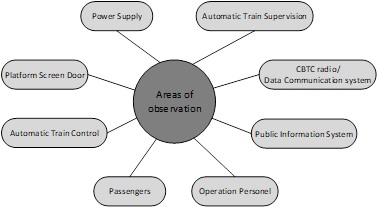
Figure 1. Areas of observation covered by the report
The headway (the time interval between two successive trains moving along the same track in the same direction) offered by the Automatic Train Control (ATC) system is just 90s [3]. The public operation on metro line three in Sofia is available from 05:00h to 23:45h. The rest of the time the line is used for planned or corrective maintenance, training and other non-passengers’ related activities. Due to the current needs of the operator, the headway used is up to 5 min, see Figure 2 Weekday timetable of M3 line in Sofia, July 2025 [4]. However, to follow the timetable strictly there are additional conditions to be considered.
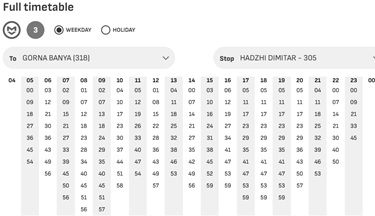
Figure 2. Weekday timetable of M3 line in Sofia, July 2025 [4]
Failures of single components reduce the redundancy but normally should not have an operational effect. However sporadic inconsistencies between different software applications running in parallel could lead to looping and blocking of the entire system. The information about the subsystem’s hardware availability has been obtained via the implemented dedicated Service and Diagnostic (S&D) tool. It is a software application that indicates the hardware alarms for both wayside and onboard signalling equipment and proposes corrective actions to the maintenance personel. Fluctuations in system reliability could come from the simultaneous operation of different but interconnected software applications. The observations about these cases are based on cases registered during the warranty and post-warranty support.
Despite the automation of the line, the human factor, as far as operational and maintenance personnel, as well as the passengers themselves, can cause a malfunction in service. Any time an operator (e.g., train delocalization) or technician intervention is required (e.g., platform screen door issue), there is a risk of misjudged actions that could exacerbate the problem and further delay according to the timetable. Automated operations must guaranty passengers’ safety [5]. As a safety strategy measure there is a half-height platform screen door (PSD) structure at all stations of metro line three. Their main function is to guarantee the passengers’ safety as they have a role of a physical barrier to the track side. In addition, the PSD structure is also supposed to reduce the piston effect when trains enter the station and hold the wave in case of flood from the track side [6, 7]. Trains’ precise positioning according to the openings of the PSD structure is important for maximum comfort during the passenger’s exchange [8]. Passengers on Metro Line 3 in Sofia got used to recognize the opening parts of the PSD structure and to group waiting around them. This optimizes the waiting time of the trains so that the schedule is not delayed.
On Metro Line 3, trains must stop at a fixed point on the platform (a stopping window) with an accuracy of +/- 30 cm [1]. Figuре 3 Stopping accuracy of train B015 on 04 July 20025 at Krasno selo metro station, platform 1, provides a shot of precise train stopping. However, this might not be valid all the time. This is an important moment for the operation, because if a train stops outside the stopping window the train doors will open automatically but platform doors will not. They will wait until the operator opens them manually via the system. If a passenger opens a platform door from the emergency handle at the train side and then leaves this door open, this will lead to a need an operational personel to go to the platform to close it. Until then the train will stay standstill, this will cause delays for this train and very likely for the next coming. The observations here were collected by monitoring of such similar situations during drives and operation. Of course, here the error can become cumulative. For example, when doors on a given platform need to be manually opened, the on-duty station operator opens the doors on the opposite platform. In this case, all trains in the area of the station and its entrances and exits sections will be automatically stopped by the CBTC system, as there is a possibility that a passenger will fall onto the railway tracks. This is already considered as a safety-related case. Such an operation disruption decreases the comfort of the transport service.
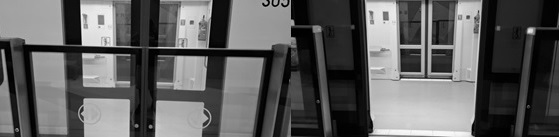
Figure 3. Stopping accuracy of train B015 on 04 July 20025 at Krasno selo metro station, platform 1
Also, in case of obstacles to the platform doors, the time needed for verification by the system extends the train’s dwell time as per the following formula:

where “T [s]” is the train’s dwell time in seconds and “N” is the number (1,2,3) of a platform door reopening and closing in case of obstacle. After the third unsuccessful attempt to close the door, the system considers there is something and remains open waiting for an operational personel to come and check it on the spot.
- Results
Usually at the very opening of the public operation certain hardware may fail more often and some software applications may need more adjustments. The third metro line in Sofia was no exception to this. But more important is how the system behaves after this period has passed. The statistics for hardware availability and software reliability for the first six months of line operation for 2025 are shown in Figure 4 Overview of signaling systems behavior for M3 line in Sofia, January – July 2025. High level of availability the system is achieved by using the full redundancy for both the track side and the on-board equipment. As communication with trains is crucial for the line operation, the radio of the CBTC signalling system is required to achieve availability higher than 99,98%. In fact, the operation of the line has never stopped. This means that key indicator has been achieved at the time of the report. It should also be noted that the planned 100% passenger safety and no incidents have been also met. Given these circumstances, the focus of the observation of transport service on the third metro line falls on the ability to adhere to the time schedule and passenger comfort.
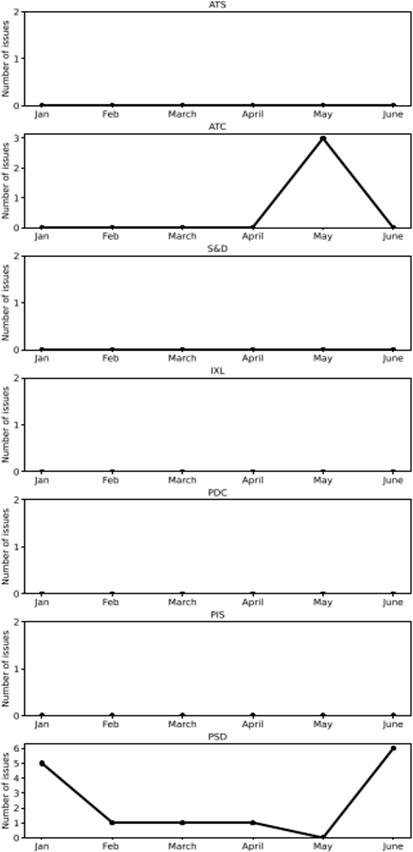
a) Hardware availability
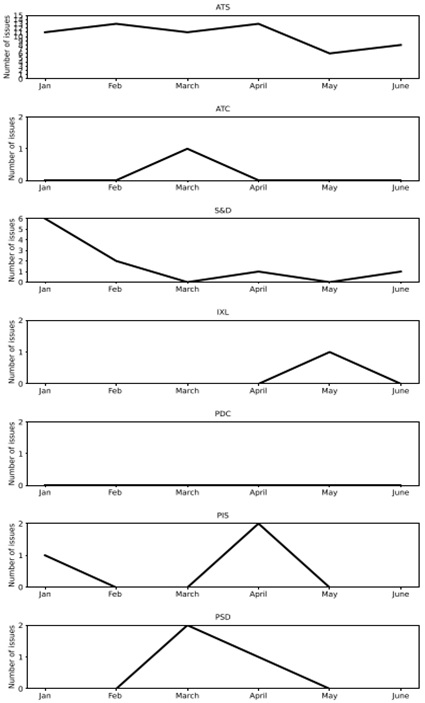
b) Software reliability
Figure 4. Overview of signaling systems behavior for M3 line in Sofia, January – July 2025
The stopping accuracy depends on the tracks conditions, atmospheric influences, the train’s passenger load, the tolerances in the sensors and systems of a given train, the selected train operation mode. Stopping accuracy measured on line three in Sofia is shown in Table 1. Where the values are with a “+” sign, it means that the train has passed the stopping point, i.e. the place where the train doors would be centered relative to the location of the platform doors. Values with a “-“ sign mean that the train has stopped before the stopping point. In any case all measured values are within the norms of the stopping window (+/- 30 cm) and allow normal passenger exchange.
Table 1. Stopping accuracy of train B013 measured on 29th of July 2021
| Metro Station | Platform 1 | Platform 2 |
| 05 | Not in use for the moment | +18 cm |
| 06 | +16 cm | +14 cm |
| 08 | +13 cm | +16 cm |
| 09 | +13 cm | -1 cm |
| 10 | +16 cm | +3 cm |
| 11 | +10 cm | +6 cm |
| 12 | +21 cm | +7 cm |
| 14 | +17 cm | +7 cm |
| 15 | +9 cm | +5 cm |
| 16 | +7 cm | +3 cm |
| 17 | +11 cm | -1 cm |
| 18 | +8 cm | +13 cm |
The observed characteristic operational advantages and disadvantages of the signaling system solution for the third line of the Sofia metro are listed in Table 2.
Table 2. Line M3 in Sofia signaling systems operational observations
| Advantages | Disadvantages |
| The hardware is extremely stable. Also, exchanging a replaceable unit when needed takes a little time and can be done without interfering with operation. | Moving parts of the PSD needs regular maintenance. If this is ignored, it will lead to a disrupted transport service and delays. |
| The implemented pilot software package allows easy monitoring and control of the metro line and supports the work of maintenance personel. | Software is an alive system. The updates close some issues but often bring new ones. |
| The operational staff is provided with a highly functional system with multiple capabilities, including event recording and playback. | High qualified personel is required.
A mistake when solving a small problem can dramatically increase the severity of the situation. |
| Passengers are guaranteed 100% safe and comfortable trips | Passengers’ abnormal behavior could cause disrupted transport service and delays. |
Conclusion
In general, the signaling system of metro line three in Sofia is a high-tech product that meets the requirements for safety, preventing the occurrence of critical situations. The availability and reliability of the transport service seems to be limited to a much smaller scale of hardware failures and replacement. More often, adjustment or restart, tightening is required. More often, restarts, adjustments or simply fixation tightening are required. An important factor is the quality and conditions of the initial installation – dustiness of the room, working without air conditioning, vibrations, etc. A problem with the software of the system is often reflected in a delay in the time schedule. For example, train delocalization requires the train to move at a limited speed of 20 km/h to the next section, and sometimes even longer. Given the automation of the line, the dependence of the quality of the transport service on the behavior of the operator’s staff and on the passengers themselves should be low. However, the fact is that they have their importance and in practice this cannot be ignored. It requires the presence of highly qualified personnel with constant maintenance of knowledge and the implementation of refreshing training. The goal from the passengers’ perspective should be to achieve higher awareness and culture of behavior.
With the future line extension/ branching it is expected that on a certain section on the line there will be an alternate movement of trains for two different destinations. This will lead to decreasing the headway into half [9].
As a next step in the development of the line three control system, future upgrades with already available systems for automatic analysis of aggregate operational information can be envisaged, which provides advice on optimizing line management and maintenance and offers the operation personel preventive actions at an earlier stage, before corrective actions are required.
REFERENCES
[1] METROPOLITAN EAD, Volume 5: Technical specifications. Employer’s requirements, Section 5.8: CBTC – Communication Based Train Control, Sofia, 2019, pp. 19, 26.
[2] SCHNIEDER, L., Communications-Based Train Control (CBTC) Components – Functions – Operations, Germany, 2019, pp. 28 – 29, ISBN 978-3-96245-200-1 (PMC Media House: Bingen am Rhein).
[3] SIEMENS MOBILITY, CBTC – Trainguard MT Enhancing passenger experience through migration and integration of digital services, Germany, 2021, p.3.
[4] URBAN MOBILITY CENTER, Virtual timetable/Sofia, 2025, https://www.sofiatraffic.bg/en/public-transport.
[5] SCHNIEDER, L., Protection of Critical Transport Infrastructure – A holistic approach, Germany, 2019, pp.33-36, ISBN: 978-3-96245-168-4 (PMC Media House GmbH: Bingen am Rhein).
[6] METROPOLITAN EAD, Volume 4: Technical Specifications. Part 4.12: System for automatic platform screen doors (SAPSD), Sofia, 2021, pp.5, 8.
[7] DIMITROV, V., Study of the possibilities for optimisation of positioning of electric vehicles, In: Proceedings of the 12th Electrical Engineering Faculty Conference (BulEF), Varna, Bulgaria: IEEE, 2020, p. 3, ISSN 2603-5359.
[8] PAVLOV, N., DIMITROV, V., Influence of the braking on the comfort during positioning of a metro train. In: Proceedings of the 2019 11th Electrical Engineering Faculty Conference (BulEF). Varna, Bulgaria: IEEE, 2019, pp. 1 – 4. ISSN 2603-5359.
[9] METROPOLITAN EAD, Volume 4: Technical Specifications. Employer’s Requirements, Part 4.8: Communication Based Train Control (CBTC), Sofia, 2021, p. 19.
Svetoslav Tomov, Assist. Prof.
ORCID iD: 0009-0002-6109-0137
Department of Telecommunications and Safety Equipment and Systems
Todor Kableshkov University of Transport
158, Geo Milev St., 1574 Sofia, Bulgaria
E-mail: tomov_svetoslav@abv.bg
Prof. Dr. Emilia Dimitrova
ORCID iD: 0000-0001-6813-0563
Department of Telecommunications and Safety Equipment and Systems
Todor Kableshkov University of Transport
158, Geo Milev St., 1574 Sofia, Bulgaria
E-mail: edimitrova@vtu.bg

Свързани статии:
 Analysis of the Average Speeds of Passenger Trains in Bulgaria on the Main Railway Routes, according to the Annual Train Schedule for 2025
Analysis and Challenges for IoT & AI in Building and Implementing Smart Rail Transport Systems
Study of Brushless Motor Control Methods Based on ai Algorithms
Type Synthesis of Guidance Mechanisms with a Four-bar Topological Structure
Analysis of the Average Speeds of Passenger Trains in Bulgaria on the Main Railway Routes, according to the Annual Train Schedule for 2025
Analysis and Challenges for IoT & AI in Building and Implementing Smart Rail Transport Systems
Study of Brushless Motor Control Methods Based on ai Algorithms
Type Synthesis of Guidance Mechanisms with a Four-bar Topological Structure