


Dimitar Tsankov Dimitrov, BSc. Comp. Syst.
ORCID iD: 0009-0002-5063-9251
Master student in “High Performance Sports” / Sports Theory
National Sports Academy
Sofia, Bulgaria
Е-mail: dimitar.tzankov@gmail.com
https://doi.org/10.53656/ctpes-2026.DD

Pages 19-32
Abstract. Worsened Olympic results for the past decades, and a new draft1 of Bulgaria’s law2 for higher education suggested the need of a methodology, which shows the numerical representation of the phrase “corresponds to the development of world science” („в съответствие с развитието на световната наука“). We present a four step checklist to validate this. From trivial to time-consuming they are: 1) number and average year of the references; 2) histogram analysis of the references; 3) which citations from the list were used and on which page; 4) how many changes were made between two versions of a textbook. The last 2 are exhaustive tasks, when all you have is printed text, but not so much, if you have them in a digital form. We suggest backtracking all Bulgarian textbooks with the first 2 steps and including the other two for the peer review process of the new textbooks.
Keywords: sport science; textbook review checklist
- Introduction
It is no secret that the number of Olympic medals won by Bulgarian athletes has plummeted – from 41 in 1980 and 35 in 1988 to less than 10 since 2008 (Zhelyazkov et al., 2022, p. 25, table. 1). Something like this warrants the need for a thorough review of all the factors, which affect the sports results. One of those factors is the scientific knowledge given to the coaches. The science of Cybernetics (Wiener, 2019) is a tool that can help us analyze complicated systems and the flow of information within the system, in this case – literal information: the scientific knowledge given to the students in the universities. The aim is to look into that, relying on numbers, in this case of pages, of references and years; thus focusing on the big picture, rather than looking in depth for specific statements or claims, related to sports training. In Bulgaria we have one main textbook, focused on “High-performance sports (big sports, Olympic sports).” (Zhelyazkov & Dasheva, 2017, p. 13) and on the surface – there is a new edition every few years. Here we present the above-mentioned cybernetics analysis of the six editions of “Basis of Sports Training” from 2002 to 2022, compared with foreign books from the same period on a similar subject matter. In this textbook, Tsvetan Zhelyazkov holds the position that „the dominant trend in the development of major sports is its two-way link with scientific achievements and technical progress.” (Zhelyazkov & Dasheva, 2017, p. 19) (the text is removed from subsequent editions), and it is unequivocally emphasized that providing the latest training methodology is textbook’s main goal (Zhelyazkov et al., 2022, pp. 25 –26).
- Methodology
For the purpose of this review, we need reference books that are also in the field of sport science. Our selection is relevant for this field of study, it remains to be seen whether the pattern is applicable for other sciences. We expect the main trend, namely: the dominance of new sources over old ones, to be valid for all non-historically oriented books, but only future reviews can tell us if that is the case. The reference books we selected are divided into two main groups: scientific reference books with tens of authors, and books targeted at athletes, which have a few authors. During the preparation, dozens of popular books were considered, and quite a few of them had few or no sources. For this study, we selected the best among the books that did have sources. In the case of scientific reference books, the need for review and synchronization of many authors means that some chapters may have their most up to date reference be a few years prior to the date of publication.
The textbooks under scrutiny are: “Basis of Sports Training” (Zhelyazkov & Dasheva, 2002), “Basis of Sports Training, Second Edition” (Zhelyazkov & Dasheva, 2006), “Basis of Sports Training, Third Edition” (Zhelyazkov & Dasheva, 2011), “Basis of Sports Training Fourth Edition” (Zhelyazkov & Dasheva, 2017), “Basis of Sports Training Fifth Edition” (Zhelyazkov et a., 2020), “Basis of Sports Training Sixth Edition” (Zhelyazkov et al., 2022) supplemented by “Sports Training” (Margaritov, 2017), which relies heavily on (Zhelyazkov & Dasheva, 2006), but is written for another university, as well as the book “Endurance in Elite Sports” (Zhelyazkov, 2009).
It should be noted here that the second edition (Zhelyazkov & Dasheva, 2006) is missing a reference list, while the fifth and sixth editions have identical reference lists (as well as pretty much everything else), so we are only going to review the remaining for some of the steps. All of these were available in paper form and their bibliographies were digitized (using OCR, via an Android Phone using its Camera app). This was the source data for the first two of the steps in our checklist. For step three in the checklist – identifying which sources were used and in which chapter/page, we reviewed only the first and last edition (Zhelyazkov & Dasheva, 2002; Zhelyazkov et al., 2022). For the fourth and final step of the checklist, we went through all 6 editions to determine the type and number of changes made between each edition.
The following popular books on sports were selected for our comparison: “Training Essentials for Ultrarunning: How to Train Smarter, Race Faster, and Maximize Your Ultramarathon Performance” (Koop, 2016); “Training Essentials for Ultrarunning Second Edition” (Koop et al., 2021), “Biochemistry for Sport and Exercise Metabolism” (MacLaren & Morton, 2011); “Anatomy for Runners: Unlocking Your Athletic Potential for Health, Speed, and Injury Prevention” (Dicharry, 2012); “Injury-Free Running, Second Edition: Your Illustrated Guide to Biomechanics, Gait Analysis, and Injury Prevention” (Michaud, 2021); “Developing Speed, Second Edition” (Jeffreys, 2024). All of these were available in digital form and their reference lists were copied for the purposes of the study.
The we also used comparison against the following bigger (in terms of number of citations used) and more specialist-oriented books: “Physical Qualities of Athletes: Fundamentals of Theory and Training Methods, 4-th Edition” (Zatsiorksy, 2019), which is an intact reprint of the 1966 textbook, with an updated biography of the author. In the introduction, he thanks many researchers for their help and mentions some of the monographs on which he bases his work. There is only one official author, but the number of sources (615 for 200 pages) is comparable to the others in this group. The remaining books have between 36 and 67 authors, the name in the references is that of the editor: “History of Exercise Physiology” (Tipton, 2014); “Olympic Textbook of Science in Sport / Volume XV of The Encyclopaedia of sports medicine an IOC Medical Commission Publication” (Maughan, 2009); “Endurance Training Science and Practice” (Mijuka, 2012); “Endurance Training Science and Practice Second Edition: (Mijuka, 2023); :Exercise Metabolism: (McConell, 2022). The Russian textbook (Zatsiorsky, 2019) was available online, as was the Olympic Textbook (Maughan, 2009) – their bibliographies were copied from there. For McConell (2022), a complete reference list, broken down into chapters, is available on the publisher’s website. In the case of Mijuka (2023) and Mijuka (2012), we contacted the editor and asked him to send us the bibliographies. During this communication, he mentioned that they had made changes literally on the day before the print to include the most recent research on the subjects.
Isolating the year from the text: Once we had the bibliographies in text form, they were divided into different pages using Google Sheets. We used Notepad++ as a text editor, for its support of Regular Expressions (RegEx). For example, when we have APA7 Style Reference lists, such as the one in both editions of :Endurance Training Science and Practise” (Mujika, 2012; Mujika, 2023), the RegEx needed to isolate only the year of the references would be (Search->Replace or Ctrl+H); Find what: :.* \((\d\d\d\d)\)*\..*: (without the quotation marks); Replace with: “\1” (without the quotation marks); this may need a bit of manual work or tweaking for multiple references from the same authors and year, that are going to have a/b/c glued to the year. When fully cleaned, all of the years were pasted into column A in the sheet dedicated to that book inside Google Sheets.
- Results
The end results of the step are summarized in Table 1. The number of sources per page in Zhelyazkov’s publications (1.01 – 1.45) is around/above the popular ones (0.45 – 1.31 sources per page). In the competing Bulgarian sport science textbook (Margaritov, 2017), it is only 0.23. For specialist-oriented books, this ratio increases from 3.08 (Zatsiorksy, 2019) up to 6.52 references per page (Tipton, 2014).
Table 1. The textbooks and books we are comparing and basic information about them
| Book | Pages | Refs. | Refs per page | Year of publishing | Avg year (refs) | Publishing year minus avg year |
| Zhelyazkov & Dasheva, 2002 | 432 | 498 | 1.15 | 2002 | 1971 | 31 |
| Zhelyazkov & Dasheva, 2011 | 416 | 605 | 1.45 | 2011 | 1976 | 35 |
| Zhelyazkov & Dasheva, 2017 | 482 | 651 | 1.35 | 2017 | 1978 | 39 |
| Zhelyazkov et al, 2022 | 352 | 489 | 1.39 | 2022 | 1976 | 46 |
| Zhelyazkov, 2009 | 304 | 307 | 1.01 | 2009 | 1982 | 27 |
| Margaritov, 2017 | 465 | 109 | 0.23 | 2017 | 1985 | 32 |
| Koop, 2016 | 352 | 177 | 0.50 | 2016 | 2000 | 16 |
| Koop et al, 2021 | 522 | 401 | 0.77 | 2021 | 2005 | 16 |
| MacLaren & Morton, 2011 | 272 | 241 | 0.89 | 2011 | 1999 | 12 |
| Dicharry, 2012 | 320 | 145 | 0.45 | 2012 | 2002 | 10 |
| Michaud, 2021 | 224 | 294 | 1.31 | 2021 | 2005 | 16 |
| Jeffreys, 2024 | 286 | 270 | 0.94 | 2024 | 2013 | 11 |
| Zatsiorsky, 2019 | 200 | 615 | 3.08 | 1966 | 1955 | 11 |
| Tipton, 2014 | 608 | 3963 | 6.52 | 2014 | 1976 | 38 |
| Maughan, 2009 | 427 | 1509 | 3.53 | 2009 | 1995 | 14 |
| Mijuka, 2012 | 315 | 1275 | 4.05 | 2012 | 2000 | 12 |
| Mijuka, 2023 | 470 | 2389 | 5.08 | 2023 | 2010 | 13 |
| McConell, 2022 | 409 | 2289 | 5.60 | 2022 | 1999 | 23 |
Analyzing only the number of references per page, the editions of “Basis of sports training” appear to be satisfactory, but the relevance of the sources, based on the distance from the year of publication (last column in Table 1) to the average year of the sources, is noticeably greater than the rest. Of the Bulgarian textbooks reviewed, this distance reaches 46 years in (Zhelyazkov et al, 2022), and for none of the other Bulgarian books is less than 25. Only Zatsiorksy (2019) is worse with a 64-year gap, but the actual content of the textbook is unchanged from 1966, which means that the actual gap is only 11 years (1966 – 1955). “History of Exercise Physiology” (Tipton, 2014), due to the nature of the material – a historical review of sport science – also has a significantly lower average year of sources. McConell (2022) also stands out a bit with its 23 years, but there is also a fairly indepth historical review of our understanding of metabolism. The rest are in the range from 10 to 16 years between the average age of the sources and the year of publication.
Second step of the analysis – histogram analysis of the years of the references. From the previous step, we already have a digitized list with a separate column for the year. Our original idea for analysis was to distribute the sources by decade, which shows that Zhelyazkov et al (2022) has the following distribution of sources: 22% from the 60s, 21% from the 90s, and 19% from the 80s, i.e., 87% are from the 20th century. Such a distribution is interesting, but it would distort the data a little depending on which end of the decade the publication is from, and it is also more difficult to automate. It also involves a huge table, so we opted for a method that summarises the same information within three figures using histograms, showing the distance between the source year and the year of publication of the book. For this analysis, Zatsiorksy (2019) is considered to be from 1966, when the text under analysis was written. We explicitly checked that the bibliography of the 2019 edition is identical to that in the Bulgarian translation of the book (Zatsiorsky, 1970). The figures are limited to 125 years before the release data of each book, even though a few sources are even older. The majority of the books have only a few references before 1900 and this seemed like a good way to standardize the chart sizes and simplify the visual comparison. Since the average year of the references (seen in step one) is 10 to 16 years we chose the horizontal (years) to be on a logarithmic scale, this way there is an equal distance between the numbers 1 – 10 and 10 – 100. To automate the counting of row 1 in each column, we have the year of publication of the book in cell 1 of the column, and cells 3 to 128 in column A are the numbers from 0 to 125. There are references, which are more than 125 years old, but they are negligible for most books (except for Tipton (2014), but even then it’s under 3% of all references). The formula we used was =COUNTIF(‘BOOK_TABLE’!A:A,“=“&(C$1-$A3)); where BOOK_TABLE is the actual name of the tab, which holds the data for each book. We standardized the years to always be on column A. This is repeated for each BOOK_TABLE and year.
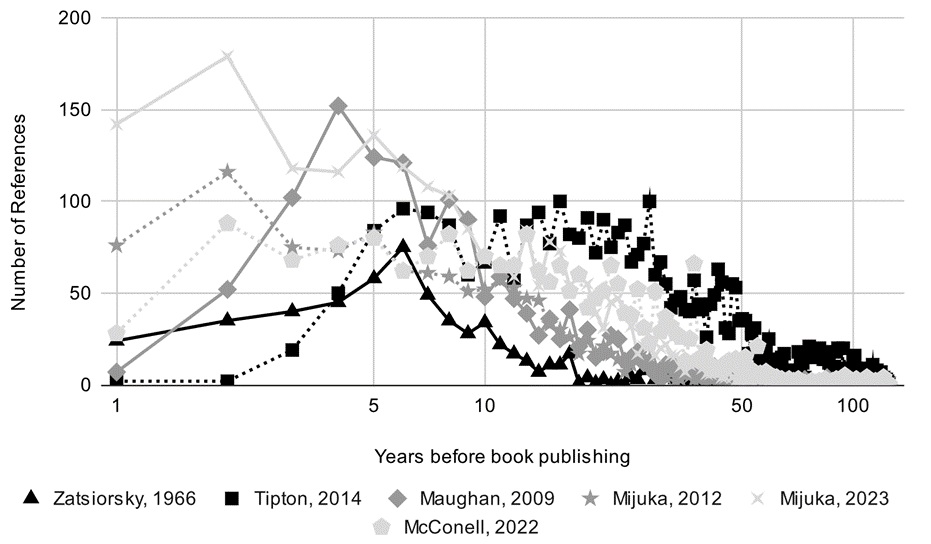
Figure 1. Histogram of the reference books with high number of sources
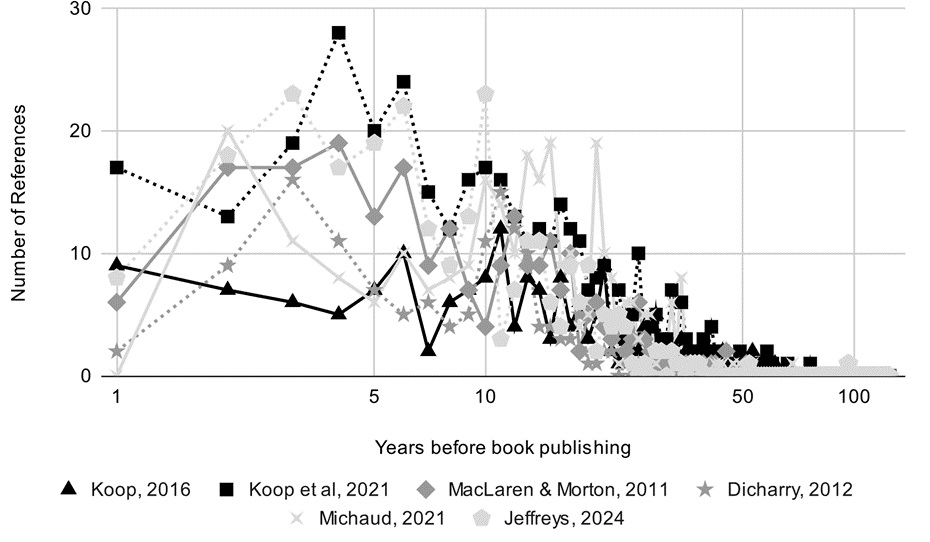
Figure 2. Histogram of the popular books used as a reference
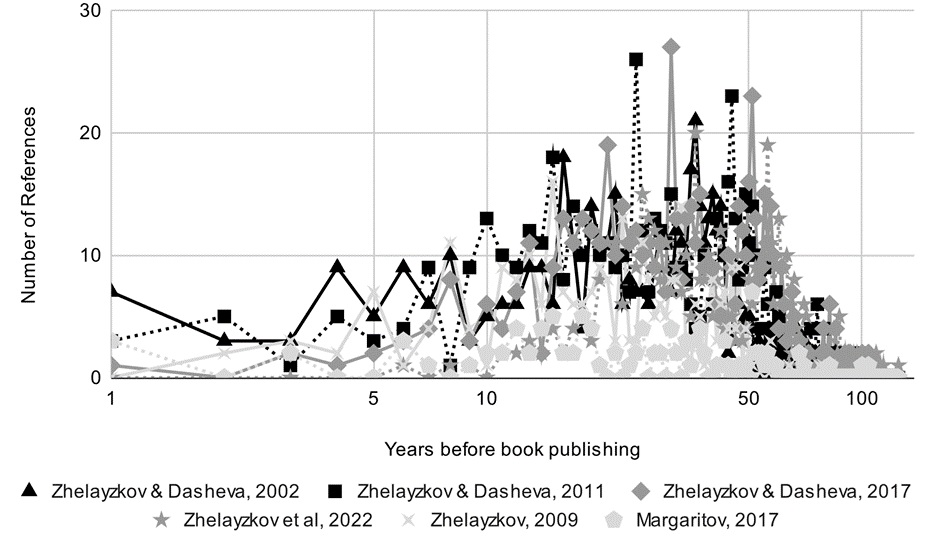
Figure 3. Histogram of the Bulgarian (text)books under investigation
Figure 1 through Figure 3 show the distribution of sources for each year prior to publishing (up to 125 years back). The difference in the distribution of references is quite stark – all international books selected for this comparison have a solid number of references from the past 0 to 10 years, but that is not the case for the Bulgarian books under review. Something already expected by the average year of the references, seen in step one of the checklist.
Step three – “The main text must contain references to every source listed in the bibliography and vice versa.”2 – validation of this requirement was the goal here. Here, only the publications by Zhelyazkov & Dasheva (2002) and Zhelyazkov et al. (2022) are under scrutiny, both of which have over 100 sources mentioned in the text, but missing from the references list (177 and 171 respectively); while of those available in the bibliography, but missing from the text (i.e., pseudo-sources), there are 94 (Zhelyazkov & Dasheva, 2002) and 135 (Zhelyazkov et al, 2022). There is also a third type, which is missing from the above requirements3 – “something is used from the author mentioned”. A good illustration is the 11 lines after the text “Practical verification of the interval method …” (Zhelyazkov et al., 2022, p. 34), followed by a list of names and years totaling 34 citations, from which nothing is actually taken (pseudo-sources). It only mentions that they did studies testing similar hypotheses and got positive results, but not what the setup of any of those studies was or any numeric information related to their end result. There are 248 such sources in the 2002 textbook, and 226 in the 2022 textbook. Some references can be shown many times, thus counted multiple times. If we remove these numbers and leave only the sources that are used (each counted once) as well as included in the reference list, there are 252 (Zhelyazkov & Dasheva, 2002) or 185 (Zhelyazkov et al, 2022) left. Adding the sources used, but missing from the bibliography, the numbers become 330 for the first edition (2002) and 279 for the sixth (2022). Another issue is that many of the sources are books, rather than original sources and only one of them indicates the page that is cited.
There are also statements for which no source is provided. An example are the steps in the endurance training methodology (Zhelyazkov & Dasheva, 2017, p.228), similarly worded 3 steps, though ordered differently, can be found in the Bulgarian translation of Zatsiorsky (1970, p. 130), as well as the Russian one (Zatsiorsky, 2019, pp. 123 – 124). Another possible drawback is when a full book is quoted, rather than the original scientific study: then will appear to be something new, when in reality it isn’t. Two such examples from the current text are the re-print of a 1961 book, originally published in 1948 (Wiener, 2019) as well as the re-print of a 1966 textbook (Zatsiorsky, 2019). Knowing these limitations, let’s see the end result for checklist item number 3: Table 2 shows the number of sources distributed by decades in the first edition (Zhelyazkov & Dasheva, 2002), while Table 3 shows it for the sixth edition (Zhelyazkov et al., 2022), with some sources appearing in more than one chapter. Thus, a source can be counted once per chapter.
Table 2. Distribution of sources used (missing and available in the bibliography, from which something has been taken) by chapter and by year for Zhelyazkov & Dasheva (2002)
| Decade/ Chapter | N/A | 18xx | 190x | 191x | 192x | 193x | 194x | 195x | 196x | 197x | 198x | 199x | 200x |
| I | 2 | 2 | |||||||||||
| II | 1 | 2 | 5 | 6 | 6 | 2 | 2 | ||||||
| III | 1 | 3 | 3 | 3 | 2 | 3 | 4 | 5 | 1 | 5 | 2 | ||
| IV | 1 | 1 | 3 | 3 | 11 | 5 | 14 | 9 | |||||
| V | 2 | 3 | 9 | 14 | 8 | ||||||||
| VI | 1 | 2 | 1 | ||||||||||
| VII | 3 | 3 | 13 | 11 | 4 | 11 | 6 | 1 | |||||
| VIII | 1 | 2 | 27 | 14 | 24 | 8 | 1 | ||||||
| IX | 3 | 5 | 4 | 5 | 2 | ||||||||
| X | 1 | 3 | 6 | 3 | 2 | ||||||||
| XI | 1 | 3 | 1 | 4 | 4 | 1 | |||||||
| XII | 1 | 3 | |||||||||||
| XIII | 1 | 1 | |||||||||||
| XIV | 2 | 2 | |||||||||||
| XV | 5 | 5 | 3 | ||||||||||
| XVI | 1 | 3 | 10 | 15 | |||||||||
| XVI | 2 | 3 | 2 | 1 |
Table 3. Distribution of sources used (missing and available in the bibliography, from which something has been taken) by chapter and by year for Zhelyazkov et al. (2022)
| Decade/ Chapter | N/A | 18xx | 190x | 191x | 192x | 193x | 194x | 195x | 196x | 197x | 198x | 199x | 200x | 201x | 202x |
| I | |||||||||||||||
| II | 1 | 1 | |||||||||||||
| III | 2 | 4 | 1 | 3 | 2 | 2 | 2 | 3 | 6 | 1 | 3 | 1 | |||
| IV | 1 | 2 | 5 | 4 | 9 | 8 | |||||||||
| V | 1 | 1 | 2 | 1 | 2 | 4 | 5 | ||||||||
| VI | 1 | ||||||||||||||
| VII | 1 | 2 | 5 | 2 | 2 | 4 | 1 | ||||||||
| VIII | 1 | 1 | 17 | 7 | 12 | 10 | 2 | ||||||||
| IX | 4 | 3 | 10 | 4 | 5 | 4 | 7 | 1 | |||||||
| X | 1 | 4 | 5 | 3 | 2 | 2 | |||||||||
| XI | 2 | 4 | 1 | 7 | 2 | 1 | |||||||||
| XII | 3 | 2 | 2 | ||||||||||||
| XIII | 2 | 1 | |||||||||||||
| XIV | 1 | 2 | 3 | 3 | 7 | 31 | 21 | ||||||||
| XV | 2 | 4 | 8 | 13 | 2 | ||||||||||
| XVI | 2 | 2 | 10 | 1 | |||||||||||
| XVI | 1 | 1 | 1 | 1 |
The summary of this step is in Table 2 and Table 3. Focusing on the latest edition (Table 3) it is evident that in the first six chapters there is not a single source from this millennium. Not visible in the table, but directly visible in the contents of the textbook, is that 8 of the 17 chapters still have a single author, Tsvetan Zhelyazkov, and they are also the most lagging behind. This huge discrepancy between listed and actual references makes us add Figure 4, which shows the histogram of the references from Table 2 and Table 3 with duplicates removed.
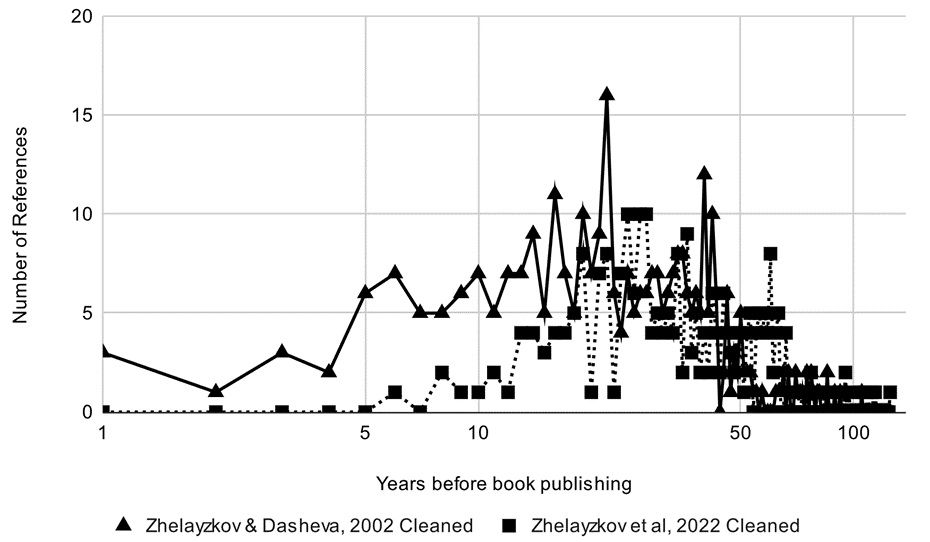
Figure 4. Logarithmic histogram of the references, which are used in the first and the sixth editions, including those missing from the References lists
Step four is the most labor-intensive: comparing 2 editions takes about a week, but in a purely digital format this is a trivial task (e.g., using Diff in Notepad++ or other editor). The details we could provide can easily exceed the limit for this text (12 pages), so we will simplify it to three types of editing: adding text (which is not always something new, based on the source, if there is one); deleting text; and changing text. Each of these can be a single word, such as the change from “High-performance sport (big sport)” (Zhelyazkov & Dasheva, 2011, p. 13) to “High-performance sport (big sport, Olympic sport)” (Zhelyazkov & Dasheva, 2017, p. 13) – addition of “Olympic sport”. An example of deletion could be “Great sporting nations such as the USA, China, Russia, Germany” (Zhelyazkov & Dasheva, 2011, p. 37) to “Great sporting nations such as the USA, Russia, Germany” (Zhelyazkov & Dasheva, 2017, p. 38) – “China” was removed. It could be a whole new chapter added, such as “II. SPECIFIC FEATURES OF THE COMPETITIVE ACTIVITY IN TOP-LEVEL SPORTS” (Zhelyazkov & Dasheva, 2006, p. 34).
Table 4. Number and type of changes between the previous and the edition in Book Name
| Book name | Total | Add | Delete | Change | In chapters |
| Zhelyazkov & Dasheva, 2006 | 188 | 30 | 73 | 85 | 15 out of 18 |
| Zhelyazkov & Dasheva, 2011 | 110 | 60 | 14 | 36 | 10 out of 17 |
| Zhelyazkov & Dasheva, 2017 | 67 | 35 | 7 | 35 | 12 out of 18 |
| Zhelyazkov et al, 2020 | 169 | 2 | 166 | 1 | 17 out of 17 |
| Zhelyazkov et al, 2022 | 1 | 1 | 0 | 0 | 1 out of 17 |
Or it could be the deletion of the same chapter in the fifth edition (Zhelyazkov et al, 2020), along with a bunch of other text. Many of these changes are larger than a few words and smaller than entire pages. That is why, as incorrect as it could be, every change in a paragraph is counted as one operation, regardless of how big or small it is. An interesting case is the chapter on Endurance, which in the third edition (Zhelyazkov & Dasheva, 2011) comes from the separate book on “Endurance in Elite Sports” (Zhelyazkov, 2009) and it remains practically untouched for the next editions. A large number of the changes in Zhelyazkov & Dasheva (2011) – 70 out of 110 – are precisely in the chapter on Endurance. This is presented in Table 4.
- Discussion
The data presented here indicates that the goal, set out in the textbook: „continuous improvement is the main task of sports theory,“ (Zhelyazkov et al., 2022, pp. 25 – 26) is not being met – many of the updates are cosmetic, and the science of sport in Bulgaria, as presented in this textbook, heavily relies on ideas from the 60s, which are now obsolete. This makes it incompatible with the studies released in the past decades. Many ideas have either been discarded completely or have evolved significantly since then. Some of these issues will be the subjects of separate future publications. Though the four step checklist provided here is labor-intensive, making this information public for each textbook, would be an incentive for the authors to stop recycling archaic texts and present up to date science. Based on anecdotes from students at various universities, such reprinting with little to no updates is not unique to the above mentioned textbook. In future publication we plan a review (steps one and two) of a much larger number (around 400) of Bulgarian textbooks with more than one edition made this millennium, then we will have the full scope of this (possibly) systemic issue.
As a bonus: we checked a monographical book “The Anaerobic Threshold” (Grancharov, 1997), which is 88 pages, but has 202 references (it says 201, but there are numbers 8 and 8a) thus, 2.3 refs. per page;. The book itself describes lab tests, which were done between 1984 – 1986, with over a thousand national level athletes of various sports. Step 1 shows that the newest references are from 1987, there are 6 such entries. The story behind this book, as written in its introduction is: the original author has passed away, while working on it, then another author (Ilila Iliev) has stepped in to finish it. The average year of the entries is 1979, thus 18 years before the print date (1997), but given the period when the experiment was done and the passing of the author, it’s likely to be written in 1987-88, thus the average years of the sources is likely to be less than a decade from year of begging written, which can put it above all other books reviewed here. For step 3 – which references were actually used, the official total is 202, but 67 of them do not appear anywhere in the text; a group of 52 are mentioned in the text, but are missing from the reference list. Many of the missing sources are newer than 1987, suggesting they were added by the second author, who never updated the references list. Figure 5 will show how they stack over time, with 2 options – the original bibliography with the assumption it was written in 1988 and the actual sources, compared to the year of print.
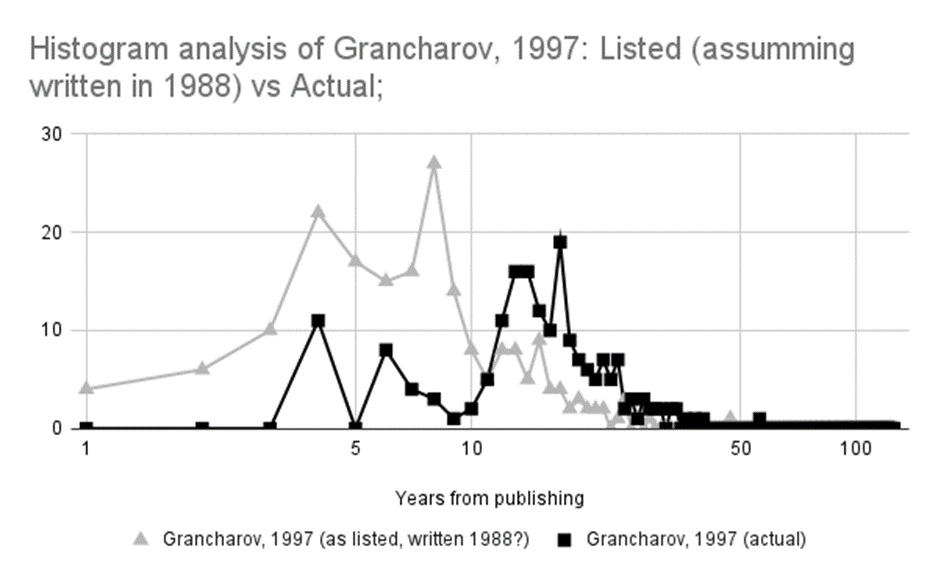
Figure 5. The histogram of “The anaerobic threshold” (Grancharov, 1997) – best case scenario, assuming it was written in 1988 and actual (with unused references removed and missing references added)
- Conclusion
On the question of whether the textbook “Basis of Sports Training” (Zhelyazkov et al., 2022) “corresponds to the development of world science” – the likely answer is: “not even close”, nor does the 2002 edition (Zhelyazkov & Dasheva, 2002) – it still relied on too many older sources, and included very little recent studies, thus even two decades earlier we were lagging behind the world science.
NOTES
- https://parliament.bg/bills/39/254-01-18.pdf / (Чл. 66 (2) 2.) Last retrieved 05.05.2026
- https://ncrrp.org/wp-content/uploads/2020/04/Z2-1-ZAKON_za_visseto_obrazovanie1.pdf / (Чл. 57. (2) 2.) Last retrieved 05.05.2026
- Requested in the reference manual for this publication.
REFERENCES
Dicharry, J. (2012). Anatomy for runners: Unlocking your athletic potential for health, speed, and injury prevention. Skyhorse.
Grancharov, N. (1997). Anaerobniya prag: Sashtnost i prilozhna stoinost v sporta. NSA. [In Bulgarian]
Jeffreys, I. (Ed.). (2024). Developing speed. (2nd Ed.). Human Kinetics.
Koop, J. (2016). Training essentials for ultrarunning: How to train smarter, race faster, and maximize your ultramarathon performance. VeloPress.
Koop, J., Rutberg, J., & Malcolm, C. (2021). Training essentials for ultrarunning. (2nd Ed.). Koop Endurance Services.
MacLaren, D., & Morton, J. (2011). Biochemistry for sport and exercise metabolism. Wiley-Blackwell.
Margaritov, V. (2017). Sportnata trenirovka. University Press “Paisii Hilendarski”. [In Bulgarian]
Maughan, R. J. (Ed.). (2009). The Olympic textbook of science in sport (Encyclopaedia of sports medicine, Vol. 15). Wiley-Blackwell.
McConell, G. (2022). Exercise metabolism. Springer.
Michaud, T. (2021). Injury-free running. (2nd Ed.). North Atlantic Books.
Mujika, I. (2012). Endurance training: Science and practice. Iñigo Mujika.
Mujika, I. (2023). Endurance training: Science and practice. (2nd Ed.). Iñigo Mujika.
Tipton, C. M. (2014). History of exercise physiology. Human Kinetics.
Wiener, N. (2019). Cybernetics or control and communication in the animal and the machine, reissue of the 1961. (2nd Ed.). MIT Press.
Zatsiorsky, V. M. (1970). Fizicheskite kachestva na sportista. Medicina i fizkultura. [In Bulgarian]
Zatsiorsky, V. M. (2019). Fizicheskie kachestva sportsmena: Osnovi teorii i metodiki vospitaniya. (4th Ed.). Sport. [In Russian]
Zhelyazkov, T. (2009). Izdrazhlivostta v elitniya sport. Bolid Ins. [In Bulgarian]
Zhelyazkov, T., & Dasheva, D. (2002). Basis of sports training. Gera Art. [In Bulgarian]
Zhelyazkov, T., & Dasheva, D. (2006). Basis of sports training. (2nd Ed.). Gera Art. [In Bulgarian]
Zhelyazkov, T., & Dasheva, D. (2011). Basis of sports training. (3th Ed.). Gera Art. [In Bulgarian]
Zhelyazkov, T., & Dasheva, D. (2017). Basis of sports training. (4th Ed.). Bolid Ins. [In Bulgarian]
Zhelyazkov, T., Dasheva, D., & Neykov, S. (2020). Basis of sports training. (5th Ed.). Bolid Ins. [In Bulgarian]
Zhelyazkov, T., Dasheva, D., & Neykov, S. (2022). Basis of sports training. (6th Ed.). NSA Press. [In Bulgarian]