


Denitza A. Kurshumova,
Elena P. Somova
University of Plovdiv “Paisii Hilendarski”
https://doi.org/10.53656/str2026-2-5-sus
Abstract. The present study was designed to examine how Bulgarian educators nationwide engage with the UN Sustainable Development Goals (SDGs) by focusing on issues related to their implementation in classroom practice. Method: A survey was completed by 2801 educators from all levels of education from all 28 regions of Bulgaria. Results: Of the 2801 Bulgarian educators, 79.6% reported familiarity with the UN SDGs. The highest rates were among teachers with 21 – 30 and >30 years of experience, as well as those in higher education. Regardless of teaching experience, school type, or school location, 95.2% of teachers agreed that the curriculum should include the SDGs. Only 37.0% of schools reported having sustainability-related content or events, and the rates were even lower in private and rural schools. 67.4% of teachers included sustainability in their lessons on a regular or occasional basis. Experienced teachers and those who worked in primary and secondary schools were the most proactive. Assessment emerged as the main gap, with 82.8% lacking—or unsure about—valid tools. Student interest was moderate and sometimes grade-driven, with primary teachers reporting the greatest engagement. Conclusion: The results of the present study offer a benchmark for educational policies and practices that can strengthen SDG awareness and support effective classroom implementation.
Keywords: education for sustainable development (ESD), UN SDGs, teacher engagement, classroom implementation
Introduction
In today’s world, growing concerns over climate change, environmental deterioration, and socioeconomic inequality have positioned sustainability at the core of public discourse across all sectors of society. The United Nations Sustainable Development Goals (SDGs) set a global standard for working together to achieve social justice, protect the environment, and boost the economy by 2030 (UNESCO, 2017). Schools and universities are in a unique position to translate the SDGs from high-level policy into learning experiences. Academic programs should prepare students to understand and deal with challenges like climate change, public health, loss of biodiversity, and social inequality.
Educators have a central role for the implementation of SDGs in the teaching practice. They can both shape and inspire learners’ attitudes and behaviors in sustainable environmental, social, and economic dimensions (Duda, 2022). The SDGs help teachers align learning outcomes with competencies in critical thinking, problem solving, global citizenship, and sustainability literacy (Monzó-Martínez et al., 2024). However, research shows that Education for Sustainable Development (ESD) often lacks integrity due to limited institutional support, inadequate teacher preparation, and the absence of coherent methodological frameworks (Baroudi, 2025; Sastre-Merino, 2025; Mendoza-Carretero, 2025).
The integration of SDGs into the academic curricula should aim to enhance interdisciplinary learning and civic engagement (Bremner & Steed, 2025). Course content needs to be connected to real-world challenges and promote student discussions and collaborative problem-solving with quantifiable outcomes (Žalėnienė, 2021). A study in South Africa (Saruchera, 2025) used systematic literature review and empirical data to examine how different disciplines defined, prioritized, and addressed sustainability. The study concluded that effective integration of sustainability education requires transdisciplinary efforts and collaborative approaches.
A national survey of teachers in England examined the alignment between the National Curriculum and sustainable education (Rushton, 2025), revealing existing gaps and mismatches. Growing evidence suggests that teachers generally recognize the significance of sustainability and SDGs. However, the implementation of these concepts often differs based on the level of institutional support, the availability of professional development opportunities, and the local context (Vukelić, 2022). There are persistent gaps between educators’ willingness to integrate sustainability into their teaching and the actual system-level integration, particularly in situations where resources, training, and assessment tools are scarce (Anđić, 2020; Dittrich et al., 2024). Dittrich et al. surveyed educators worldwide regarding the challenges of implementing Education for Sustainable Development (ESD) within teacher education. They concluded that educational programs should prioritize the systematic development of sustainability competencies over the haphazard addition of topics to the curriculum.
As Education for Sustainable Development (ESD) has gained momentum, national policies increasingly reference the SDGs in standards and curricula (Ferguson et al., 2021). Nevertheless, practical questions remain: How familiar are educators with the Sustainable Development Goals (SDGs)? How do their attitudes translate into classroom practice? Which school settings are most conducive to effective implementation? Are there valid and reliable assessment policies and criteria that can objectively evaluate sustainability-related performance?
Evaluating national educational realities in relation to global policy standards can provide valuable insights and suggest strategies for enhancing the implementation of Education for Sustainable Development (ESD) at both institutional and national levels (Žalėnienė, 2021; Tafese, 2025). In the Bulgarian setting, sustainability has been integrated into educational programs and policy frameworks that align with European and global goals. However, empirical evidence regarding teachers’ knowledge and pedagogical integration of the SDGs remains limited. Examining educators’ perspectives and behaviors is essential for assessing policy effect and determining priorities for professional development and systemic enhancement. The present study examined Bulgarian educators’ familiarity with and implementation of the UN Sustainable Development Goals (SDGs) in a nationwide context. Its purpose was to establish a benchmark for further educational policies and practices that can strengthen SDG awareness and support effective classroom implementation.
- Methodology
2.1. Research design
This study was based on an exploratory survey of Bulgarian educators from all levels of the education system. The study was approved by the Scientific Ethics Committee of the Faculty of Mathematics and Informatics at Plovdiv University “Paisii Hilendarski” (Protocol No. 1253, January 31, 2024). The questionnaire was created using Google Forms and distributed by email. Prior to participation, respondents provided electronic informed consent for the use of their personal data in research publications.
In addition to demographic information, the survey elicited data on educators’ familiarity with, opinions about, and practices related to implementing the UN Sustainable Development Goals (SDGs) in the Bulgarian education system. The data comprised nominal and ordinal variables; the latter were measured using three- and four-point Likert-type scales. Cronbach’s alpha for the Likert-type items indicated excellent internal consistency (α = 0.910; standardized α = 0.918; lower 95% CI = 0.90).
2.2. Participants
The survey was completed by 2801 educators from all 28 regions of Bulgaria. The largest shares of participants were from Sofia (23.8%), Plovdiv (20.4%), Varna (8.7%), Burgas (6.6%), and Veliko Tarnovo (5.6%). The respondents were mostly women (78.4%), with 85.8% between 36 and 66 years old. Across five categories of teaching experience, educators with more than 31 years of experience were the most represented (22%). Of all levels of the Bulgarian education system, the largest proportion of participants worked in high schools (39.7%). The majority of the educational institutions were located in regional cities (66.3%) (Table 1).
Table 1. Background information about the participants in the survey
| Variables
|
Frequency (n) | Percentage
|
| Gender | ||
| o Women | 2197 | 78.40% |
| o Men
o Prefer not to indicate |
580
24 |
20.70%
0.90% |
| Age | ||
| o 20 – 25 years
o 26 – 35 years |
61
286 |
2.20%
10.20% |
| o 36 – 45 years | 652 | 23.30% |
| o 46 – 55 years
o 56 – 66 years |
975
777 |
34.80%
27.70% |
| o >66 years | 50 | 1.80% |
| Teaching experience | ||
| o 1 – 5 years
o 6 – 10 years |
551
389 |
19.70%
13.90% |
| o 11 – 20 years | 546 | 19.50% |
| o 21 – 30 years | 699 | 13.90% |
| o > 31 years | 616 | 22.00% |
| Type of educational institution | ||
| o Primary school | 473 | 17.00% |
| o Secondary school | 551 | 19.70% |
| o High school | 1112 | 39.70% |
| o Higher education | 651 | 23.10% |
| o Private schools | 14 | 0.50% |
| Location of the educational institution | ||
| o Regional city
o Small town o Village |
1857
596 348 |
66.30%
21.30% 12.40% |
2.3. Data Analysis
The data analysis was conducted through the statistical program IBM SPSS Statistics, Version 27 (2020). The categorical and ordinal variables were described with frequencies and percentages; associations were examined using chi-square tests with Bonferroni-adjusted pairwise comparisons. Four-point Likert-scale items were treated as continuous variables in multivariable linear regression analysis, using the backward elimination method. The Spearman’s rank-order correlation was employed to assess associations between ordinal variables. All tests were two-tailed, with a Type I error rate (α) of 0.05.
- Results
3.1 Educators’ familiarity with the UN Sustainable Development Goals (SDGs)
Most of the participants were somewhat familiar with the UN Sustainable Development Goals (52.4%), 27.2% were familiar, and 20.3% were not familiar. Teaching experience was significantly associated with familiarity (p < 0.001). The teachers with longer experience (21 – 30 years and >30 years) showed the highest familiarity and the lowest unfamiliarity. School type was also significantly related to familiarity (p < 0.001). Participants in higher education reported the highest familiarity, whereas teachers in private schools reported the highest unfamiliarity. Institution location was not significantly associated with familiarity (p = 0.074), and the response distribution mirrored that of the overall sample (Table 2).
Table 2. Educators’ familiarity with the UN Sustainable Development Goals (SDGs)
| Q: Are you familiar with the UN Sustainable Development Goals? | ||||
| Variables | Yes | Somewhat | No | Chi-square p-value |
| All participants | 762 (27.2%) | 1469 (52.4%) | 570 (20.3%) | NA
|
| By teaching experience | ||||
| o 1 – 5 years | 110 (20.0%) | 306 (55.5%) | 135 (24.5%) |
< 0.001 |
| o 6 – 10 years | 83 (21.3%) | 206 (53.0%) | 100 (25.7%) | |
| o 11 – 20 years | 154 (28.2%) | 267 (48.9%) | 125 (22.9%) | |
| o 21 – 30 years | 211 (30.2%) | 359 (51.4%) | 129 (18.5%) | |
| o >30 years | 204 (33.1%) | 331 (53.7%) | 81 (13.1%) | |
| By type of school | ||||
| o Primary school | 101 (21.4%) | 282 (59.7%) | 89 (18.9%) |
< 0.001 |
| o Secondary school | 125 (22.7%) | 320 (58.1%) | 106 (19.2%) | |
| o High school | 309 (27.8%) | 600 (53.9%) | 204 (18.3%) | |
| o Higher education | 223 (34.3%) | 262 (40.2%) | 166 (25.5%) | |
| o Private | 4 (28.6%) | 5 (35.7%) | 5 (35.7%) | |
| By location | ||||
| o Regional city | 546 (29.4%) | 928 (50.0%) | 383 (20.6%) |
0.074 |
| o Small town | 132 (22.2%) | 344 (57.7%) | 120 (20.1%) | |
| o Village | 84 (24.1%) | 197 (56.6%) | 67 (19.3%) | |
NA – not applicable; Bolded percentages emphasize the main differences
3.2. Educators’ opinions on whether students should be introduced to the UN Sustainable Development Goals as part of their education
Most of the educators (61.5%) agreed that students should be introduced to the UN Sustainable Development Goals (SDGs) as part of their education, 33.7% were somewhat affirmative, and 4.8% were negative. The trend did not differ significantly by teaching experience (p = 0.119), school type (p = 0.325), or school location (p = 0.309) (Table 3).
Table 3. Educators’ opinions on whether students should be introduced to the UN Sustainable Development Goals as part of their education
| Q: Do you think that students should be introduced to the UN Sustainable Development Goals as part of their education? | ||||
| Variables | Yes | Somewhat | No | Chi-square p-value |
| All participants | 1724 (61.5%) | 943 (33.7%) | 134 (4.8%) | NA
|
| By teaching experience | ||||
| o 1 – 5 years | 347 (63.0%) | 184 (33.4%) | 20 (3.6%) |
0.119 |
| o 6 – 10 years | 222 (57.1%) | 151 (38.8%) | 16 (4.1%) | |
| o 11 – 20 years | 333 (61.0%) | 181 (33.1%) | 32 (5.9%) | |
| o 21 – 30 years | 447 (63.9%) | 212 (30.3%) | 40 (5.8%) | |
| o >30 years | 375 (60.9%) | 215 (34.9%) | 26 (4.2%) | |
| By type of school | ||||
| o Primary school | 301 (63.8%) | 145 (30.7%) | 26 (5.5%) |
0.325 |
| o Secondary school | 333 (60.4%) | 194 (35.2%) | 24 (4.4%) | |
| o High school | 683 (61.4%) | 386 (34.6%) | 44 (4.0%) | |
| o Higher education | 399 (61.3%) | 214 (32.9%) | 38 (5.8%) | |
| o Private | 8 (57.1%) | 4 (28.6%) | 2 (14.3%) | |
| By location | ||||
| o Regional city | 346 (58.1%) | 216 (36.2%) | 34 (5.7%) |
0.309 |
| o Small town | 1166 (62.8%) | 608 (32.7%) | 83 (4.5%) | |
| o Village | 212 (60.9%) | 119 (34.2%) | 17 (4.9%) | |
NA – not applicable; Bolded percentages emphasize the main differences
3.3. Implementation of the UN Sustainable Development Goals in educational practice
Approximately one-third of the participants (37.0%; n = 1037) reported that their institution provided course content, activities, and events related to the UN Sustainable Development Goals; 31.7% (n = 887) answered “no,” and 31.3% (n = 877) did not know (Figure 1a). Affirmative responses varied by school type, with private schools providing the lowest proportion of positive responses, p < 0.001 (Figure 1: b). School location showed a significant association with affirmative responses, with village schools reporting the lowest percentage, p = 0.033 (Figure 1:c).
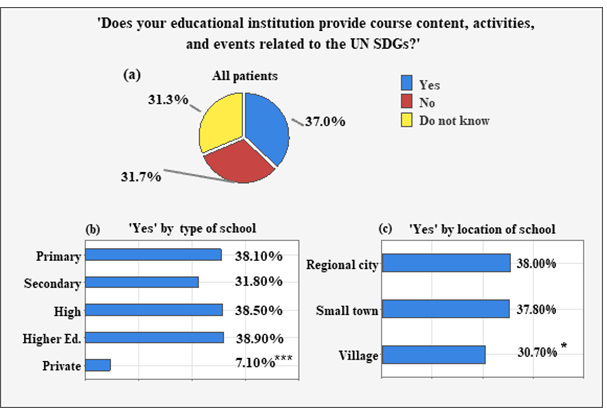
* Significant difference at p < 0.05; *** Significant difference at p < 0.001
Figure 1. Participants’ responses regarding their institution’s implementation of the UN SDGs
Regarding the incorporation of sustainability into their teaching, 26.3% (n = 736) of the educators reported systematic implementation, 41.1% (n = 1,150) reported occasional inclusion, 18.4% (n = 514) reported rare inclusion, and 14.3% (n = 401) reported no inclusion. Multiple linear regression indicated significant associations between classroom implementation and both teaching experience (p = 0.017) and type of school (p = 0.036). As illustrated in Figure 2, mean implementation scores (on a 1 – 4 scale, where 4 indicates systematic implementation and 1 indicates none) were highest among teachers with over 30 years of experience, followed by those with 21 – 30 years. Primary school teachers reported the highest mean implementation, followed by high school and secondary school teachers, while private school teachers reported the lowest inclusion.
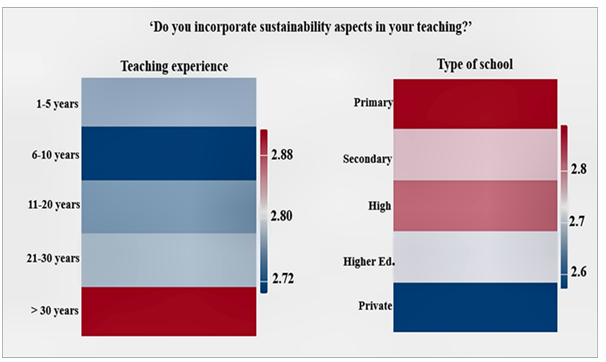
Figure 2. Heat maps illustrating the mean implementation of sustainability into teaching by teaching experience and type of school
Regarding the assessment of student performance on sustainability-related tasks, 17.2% (n = 481) reported having established criteria and instruments that they actively use. An additional 35.8% (n = 1003) reported having criteria and instruments but were uncertain about their validity and reliability. The remaining 47.0% (n = 1317) reported lacking assessment criteria and not considering this issue. There was a strong positive correlation between implementing sustainability in teaching and having assessment criteria (rs = 0.547; 95% CI, 0.519 – 0.575; p < 0.001). Educators who reported systematically integrating sustainability into their teaching also reported having established assessment criteria and instruments for sustainability-related tasks.
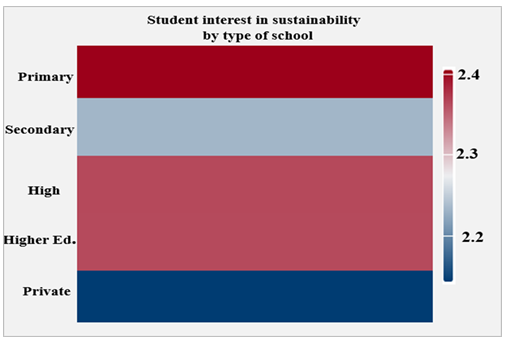
Regarding students’ interest in sustainability issues, 7.2% (n = 202) of educators reported a high level of interest, 42.0% (n = 1,177) indicated students were somewhat interested, 28.7% (n = 805) pointed out that students were interested only when grades were involved, and 22.0% (n = 617) reported a complete lack of interest. The level of student interest was the highest in primary schools, followed by high schools and higher education institutions. The lowest interest was associated with private schools (Figure 3).
Figure 3. Heat map illustrating the mean student interest in sustainability by type of school
- Discussion
Familiarity with and implementation of the UN Sustainable Development Goals (SDGs) in classroom learning are crucial for fostering environmental awareness and civic responsibility across all levels of education (Ref). In a nationwide survey of Bulgarian educators on sustainability-related issues, most of the 2801 participants reported being familiar or somewhat familiar with the UN SDGs (79.6% rate of combined affirmative responses), irrespective of school location. Teachers with longer experience (21 – 30 years and >30 years) and those employed in higher education reported the highest levels of familiarity. An even larger share of educators believed the UN SDGs should be introduced as part of the academic curriculum (95.2% rate of combined affirmative responses), a view consistent across teaching experience, school type, and school location. These results are encouraging as they suggest that there is already a foundation for further development and expansion of the national effort for sustainability in education.
The need for institutional engagement and support was evident in the less favorable results regarding the institutional implementation of the UN SDGs. Only 37.0% of the participants reported that their institution offered course content, activities, or events related to sustainability. The percentage was even lower for private schools and schools in villages. However, educators appeared more proactive on an individual level, as 67.4% reported systematically or occasionally incorporating sustainability into their teaching. Teachers with longer experience (21 – 30 years and over 30 years) and those working in primary and high schools were the most proactive in sustainability education.
An important issue for educational institutions and the Bulgarian Ministry of Education is the absence of valid, reliable assessment criteria and instruments for evaluating student performance on sustainability-related tasks. This concern emerged in the data: 82.8% of participants reported either uncertainty about their assessment tools or a complete lack thereof (Ref). Educators who reported systematically integrating sustainability into their teaching were the most likely to have assessment criteria and instruments.
A second challenge is the need to strengthen students’ awareness of – and engagement with – the importance of sustainability. Survey results indicated only moderate interest, and for some students, motivation appeared to be driven primarily by grades. Primary school teachers reported the greatest success in cultivating student interest in sustainability.
4.1. Limitations
Although this study’s findings are based on a fairly large sample of Bulgarian educators from all levels of education and all 28 regions of Bulgaria, they still carry an inherent limitation of survey research, which generally lacks in-depth understanding of the issues that are being investigated. Moreover, certain responses may reflect social desirability bias. Ordinal data analyzed as continuous may reduce sensitivity to group differences.
- Conclusions
The findings of this study establish a benchmark for educational policies and practices aimed at enhancing awareness of the Sustainable Development Goals (SDGs) and supporting effective implementation in Bulgarian classrooms. The results indicate that there is a foundational readiness among Bulgarian educators that allows for further systematic development and expansion of national and institutional efforts. Educational institutions need to put in place specific policies that promote the implementation of SDGs in academic curricula, offer support and assistance to teachers, and promote institution-wide events and activities designed to increase student interest and motivation. Additionally, it is essential to establish valid and reliable assessment criteria across educational levels and subject areas to ensure confidence in the objective grading and evaluation of student performance on sustainability-related tasks.
REFERENCES
Anđić, D. (2020). Continuing professional development of teachers in education for sustainable development: A case study of the Republic of Croatia. Teacher Development, 24(2), 248 – 263. https://doi.org/10.1080/13664530.2020.1719877.
Baroudi, S., & Abi Haidar, H. (2025). Sustainability in the United Arab Emirates secondary schools: A policy practice analysis. Sustainability, 17(7), 3129.
Bremner, P. A. M., & Steed, J. (2025). Embedding sustainable development goals (SDGs) into the curricula using an interdisciplinary design thinking approach. Journal of Perspectives in Applied Academic Practice, 13(1), 171 – 177. https://doi.org/10.56433/t0vhf816.
Dittrich, A.-K., et al. (2024). An international reconstruction of teachers’ and teacher educators’ perspectives on the challenges of education for sustainable development in teacher education. Journal of Education for Sustainable Development. https://doi.org/10.1177/09734082241309704.
Duda, E. (2022). Building the learning environment for sustainable development: A co-creation approach. arXiv. https://arxiv.org/abs/2208.14151.
Ferguson, T., Roofe, C., & Cook, L. D. (2021). Teachers’ perspectives on sustainable development: The implications for education for sustainable development. Environmental Education Research, 27(10), 1490 – 1510. https://doi.org/10.1080/13504622.2021.1921113.
Mendoza Carretero, M. D. R., Benítez Sastre, L., Gonzalo Muñoz, V., Sáenz-Rico de Santiago, M. B., Anta Martínez, J., Martín Gámez, L., et al. (2025). Sostenibilidad curricular en la formación inicial de los Grados de Maestro en Educación Infantil y Educación Primaria en el marco de la Agenda 2030.
Monzó-Martínez, A., Ortiz-Cermeño, E., & Martínez-Agut, M. P. (2024). Global citizenship education and its role in sustainability at the university level. Education Sciences, 14(8), 847. https://doi.org/10.3390/educsci14080847.
Rushton, C. (2025). Teachers’ curriculum-making and the alignment of the national curriculum with sustainability education in England. Educational Policy Review, 42(5), 601 – 620.
Saruchera, F. (2025). RETRACTED: Sustainability: A concept in flux? The role of multidisciplinary insights in shaping sustainable futures. Sustainability, 17(1), 326.
Sastre-Merino, S., Zanarotti-Prestes-Rosa, C., & Izaguirres-Betancourth, M. J. (2025). Analysis of initiatives to promote education for sustainability and climate action in schools in Madrid and proposals for improvement. Revista Española de Pedagogía, 83(290), 18.
Tafese, M. B., & Kopp, E. (2025). Education for sustainable development: Analyzing research trends in higher education for sustainable development goals through bibliometric analysis. Discover Sustainability, 6(1), 51.
UNESCO. (2017). Education for sustainable development goals: Learning objectives. UNESCO. https://unesdoc.unesco.org/ark:/48223/pf0000247444.
Vukelić, N. (2022). Student teachers’ readiness to implement education for sustainable development. Education Sciences, 12(8), 505. https://doi.org/10.3390/educsci12080505.
Žalėnienė, I. (2021). Higher education and sustainability: Challenges and institutional impacts. Journal of Cleaner Education, 14(1), 11 – 25.
Dr. Denitza Kurshumova
ORCID iD: 0000-0003-0873-4415
Prof. Dr. Elena Somova
ORCID iD:0000-0003-3393-1058
Faculty of Mathematics and Informatics
University of Plovdiv “Paisii Hilendarski”
E-mail: dcharkova@gmail.com
E-mail: eledel@uni-plovdiv.bg
>> Изтеглете статията в PDF <<

Свързани статии:
 National Identity – European Identity: Resemblance and Dissonance, Complementarity or Contention?
Международна конференция ,,Българистични езиковедски четения“
Лингвокултурологични аспекти на рекламата – съпоставителен анализ на български и испански примери
Кръгла маса „Българистиката в Унгария днес – между традицията и новата опитност на дигиталната ера“
National Identity – European Identity: Resemblance and Dissonance, Complementarity or Contention?
Международна конференция ,,Българистични езиковедски четения“
Лингвокултурологични аспекти на рекламата – съпоставителен анализ на български и испански примери
Кръгла маса „Българистиката в Унгария днес – между традицията и новата опитност на дигиталната ера“